Showing posts with label Capitalist Crisis. Show all posts

Friday, September 10, 2021

The storm before the storm

https://www.workers.org/2021/09/58808/

~~ posted for collectivist ~~

There is no doubt that the climate catastrophe threatens the future of life on the planet. A massive mobilization of the working class will be needed to combat this threat.

But, as Hurricane Ida and the associated flooding revealed, this is not just a threat to future generations — climate change is already a killer. Not only have dozens of people drowned in the hurricane’s wake, but hundreds are dead from the heat wave in the Northwest. 

Structural failures under capitalism are compounding the climate catastrophe for the working class. As the Sept. 3 New York Times admitted, “Disasters cascading across the country this summer have exposed a harsh reality: The United States is not ready for the extreme weather that is now becoming frequent as a result of a warming planet.”

We see a clear lack of preparedness in the richest country in the world. There is no regard for poor, oppressed and working-class people, who get no evacuation assistance in a life-threatening situation and are basically left to their own devices. 

The trillion-dollar infrastructure bill passed by Congress “includes $150 billion for clean energy and climate change protections. Tens of billions would also be utilized to fight extreme weather like drought, wildfire, flooding and erosion.” (PBS, Aug. 5)

Tens of billions is woefully inadequate. 

Consider, on the 16th anniversary of Hurricane Katrina, how Louisiana and Mississippi were devastated, their governments still not fully prepared for another major weather event. One million people remain without power and with little gas and water during the worst heat of the summer.

Floods devastated New York City. Here, Harlem subway station.

Throughout New York’s five boroughs and parts of New Jersey and Pennsylvania, people were trapped, some dying in flooded basement apartments, others unable to commute to work or do essential tasks due to collapsed roadways and bridges, totaled vehicles and flooded subways and expressways.

Lack of money isn’t the problem. There is incredible wealth concentrated in New York City and the surrounding areas, yet workers who produce that wealth were helpless in the rush of floodwaters. If the financial fortunes in Wall St. alone were taxed at the same rate as an average worker, funds could be used to prevent many of these tragic deaths.

Manhattan is an island of asphalt, with too little exposed soil to absorb floodwaters. The land was stolen from Indigenous people and then built up to serve the interests of finance capital — people and the environment be damned. As with every major urban center, money in the city budget — needed for infrastructure repairs and improvements — instead goes to city bondholders. Big Wall Street banks extort bloated interest payments from New York and other cash-strapped cities.

Time for ‘system change, not climate change’

“The pattern of damage reflects the relationship between climate exposure and racial inequality; impacts were more apparent in low-income communities of color, which, because of historic inequalities, are more prone to flooding, receive less maintenance from city services and frequently experience lax housing code enforcement,” the New York Times acknowledges.

Environmental terrorism and environmental racism in the U.S. are part of the legacy of capitalist development.

And the situation is far worse in the colonized Global South.

But socialist Cuba, with far fewer resources than the U.S., has created a model for hurricane evacuation that looks out for every human being — and even pets and livestock. The whole population is mobilized, and no one is left to fend for themselves.

A program of working-class demands is necessary to meet the twin crises of global warming and faulty or woefully inadequate infrastructure: Money for flood protection and relief, not for war! Money for cooling centers in a heat wave, not for tax breaks to the rich! Money for green jobs, not interest to the banks! People and the planet before profits; make the fossil fuel industry pay to clean up the messes it made! 

This is just a start. It will take a monumental struggle to win climate justice.

But rebellion is inevitable. Ida is the storm of wind and rain before the coming storm of protest. The challenge is to carry future waves of resistance through to their essential conclusion: a workers’ revolution for the abolition of capitalist wage-slavery.

Karl Marx and Friedrich Engels, writing in 1848, said the workers “have a world to win.” 

Saturday, September 4, 2021

The Double Deformation ~~ Michael A. Lebowitz

https://climateandcapitalism.com/2021/06/17/the-double-deformation/

 ~~ posted for collectivist ~~

Economic exploitation is only one aspect of capitalism. The crisis of humanity and the crisis of the earth system are inseparable


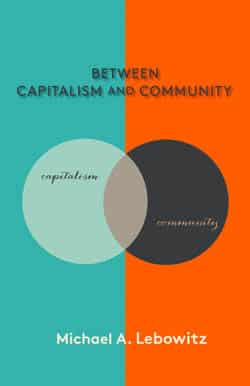
Michael A. Lebowitz is professor emeritus of economics at Simon Fraser University in Vancouver, Canada. His books include The Socialist Imperative, The Contradictions of Real Socialism, and Between Capitalism and Community, all published by Monthly Review Press. This article is excerpted, with permission, from “Know Your Enemy: How to Defeat Capitalism,” published this month in LINKS: International Journal of Socialist Renewal.


Find citations and extended arguments in Between Capitalism and Community (Monthly Review Press, 2020).

by Michael A. Lebowitz

The exploitation of workers is at the core of capitalism. It explains capital’s drive to divide workers in order to grow. Exploitation is the source of the inequality characteristic of capitalism. To fight inequality, we must fight capitalist exploitation. However, inequality is only one aspect of capitalism. In and by itself, exploitation is inadequate to grasp the effects of capital’s drive and thus the products of capitalism. Focus upon exploitation is one-sided because you do not know the enemy unless you understand the double deformation inherent in capitalism.

Recall that human beings and Nature are the ultimate inputs into production. In capitalist production, they serve specifically as means for the purpose of the growth of capital. The result is deformation — capitalistically-transformed Nature and capitalistically-transformed human beings. Capitalist production, Marx stressed, “only develops the technique and the degree of combination of the social process of production by simultaneously undermining the original sources of all wealth — the soil and the worker.”

But why?

The Deformation of Nature

By itself, Nature is characterized by a metabolic process through which it converts various inputs and transforms these into the basis for its reproduction. In his discussion of the production of wheat, for example, Marx identified a “vegetative or physiological process” involving the seeds and “various chemical ingredients supplied by the manure, salts contained in the soil, water, air, light.”

Through this process, inorganic components are “assimilated by the organic components and transformed into organic material.” Their form is changed in this metabolic process, from inorganic to organic through what Marx called “the expenditure of nature.” Also part of the “universal metabolism of nature” is the further transformation of organic components, their deterioration and dying through their “consumption by elemental forces.”

In this way, the conditions for rebirth (for example, the “vitality of the soil”) are themselves products of this metabolic process. “The seed becomes the unfolded plant, the blossom fades, and so forth.” Birth, death, renewal are moments characteristic of the “metabolism prescribed by the natural laws of life itself.”

This universal metabolism of Nature, however, must be distinguished from the relation in which a human being “mediates, regulates and controls the metabolism between himself and nature.” That labor process involves the “appropriation of what exists in nature for the requirements of man. It is the universal condition for the metabolic interaction between man and nature.” This “ever-lasting nature-imposed condition of human existence,” Marx pointed out, is “common to all forms of society in which human beings live.”

As we have indicated, however, under capitalist relations of production, the preconceived goal of production is the growth of capital. The particular metabolic process that occurs in this case is one in which human labor and Nature are converted into surplus value, the basis for that growth.

Accordingly, rather than a process that begins with “man and his labour on one side, nature and its materials on the other,” in capitalist relations the starting point is capital, and “the labour process is a process between things the capitalist has purchased, things which belong to him.” It is “appropriation of what exists in nature for the requirements” not of man but of capital.

There is, as noted, “exploration of the earth in all directions” for a single purpose— to find new sources of raw materials to ensure the generation of profits. Nature, “the universal material for labour,” the “original larder” for human existence, is here a means not for human existence but for capital’s existence.

As we have seen, while capital’s tendency to grow by leaps and bounds comes up against a barrier insofar as plant and animal products are “subject to certain organic laws involving naturally determined periods of time”, capital constantly drives beyond each barrier it faces.

However, there is a barrier it does not escape. Marx noted, for example, that “the entire spirit of capitalist production, which is oriented towards the most immediate monetary profit — stands in contradiction to agriculture, which has to concern itself with the whole gamut of permanent conditions of life required by the chain of human generations.” Indeed, the very nature of production under capitalist relations violates “the metabolic interaction between man and the earth,” it produces “an irreparable rift in the interdependent process of social metabolism, a metabolism prescribed by the natural laws of life itself.”

That “irreparable” metabolic rift that Marx described is neither a short-term disturbance nor unique to agriculture. The “squandering of the vitality of the soil” is a paradigm for the way in which the “metabolism prescribed by the natural laws of life itself” is violated under capitalist relations of production.

In fact, there is nothing inherent in agricultural production that leads to that “squandering of the vitality of the soil.” On the contrary, Marx pointed out that a society can bequeath the earth “in an improved state to succeeding generations.” But this requires an understanding that “agriculture forms a mode of production sui generis, because the organic process is involved, in addition to the mechanical and chemical process, and the natural reproduction process is merely controlled and guided.” The same is true, too, in the case of fishing, hunting, and forestry. Maintenance and improvement of the vitality of the soil and of other sectors dependent upon organic conditions requires the recognition of the necessity for “systematic restoration as a regulative law of social production.”

With every increase in capitalist production, there are growing demands upon the natural environment, and the tendency to exhaust Nature’s larder and to generate unabsorbed and unutilizable waste is not at all limited to the metabolic rift that Marx described with respect to capitalist agriculture.

Thus, Marx indicated that “extractive industry (mining is the most important) is likewise an industry sui generis, because no reproduction process whatever takes place in it, at least not one under our control or known to us,” and, he noted as well “the exhaustion of forests, coal and iron mines, and so on.” Given its preoccupation with its need to grow, capital has no interest in the contradiction between its logic and the “natural laws of life itself.” The contradiction between its drive for infinite growth and a finite, limited earth is not a concern because for capital there is always another source of growth to be found.

Like a vampire, it seeks the last possible drop of blood and does not worry about keeping its host alive.

Accordingly, since capital does not worry about “simultaneously undermining the original sources of all wealth — the soil and the worker,” sooner or later it destroys both. Marx’s comment with respect to capital’s drive to drain every ounce of energy from the worker describes capital’s relation to the natural world precisely:

“Après moi le deluge! is the watchword of every capitalist and every capitalist nation. Capital therefore takes no account of the health and the length of life of the worker, unless society forces it to do so.”

We are seeing the signs of that approaching deluge. Devastating wildfires, droughts, powerful hurricanes, warming oceans, floods, rising sea levels, pollution, pandemics, disappearing species, etc., are becoming commonplace — but there is nothing in capital’s metabolic process that would check that. If, for example, certain materials become scarce and costly, capital will not scale back and accept less or no growth; rather, it will scour the earth to search for new sources and substitutes.

Can society prevent the crisis of the earth system, the deluge? Not currently. The ultimate deformation of Nature is the prospect because the second deformation makes it easier to envision the end of the world than the end of capitalism.

The Deformation of Human Beings

Human beings are not static and fixed. Rather, they are a work in process because they develop as the result of their activity. They change themselves as they act in and upon the world. In this respect there are always two products of human activity — the change in circumstances and the change in the human being. In the very act of producing, Marx commented, “the producers change, too, in that they bring out new qualities in themselves, develop themselves in production, transform themselves, develop new powers and new ideas, new modes of intercourse, new needs and new language.”

In the process of producing, the worker “acts upon external nature and changes it, and in this way he simultaneously changes his own nature.”

In this “self-creation of man as a process,” the character of that human product flows from the nature of that productive activity. Under particular circumstances, that process can be one in which people are able to develop their capacities in an all-rounded way.

As Marx put it, “when the worker co-operates in a planned way with others, he strips off the fetters of his individuality, and develops the capabilities of his species”. In such a situation, associated producers may expend “their many different forms of labour-power in full self-awareness as one single social labour force”, and the means of production are “there to satisfy the worker’s own need for development.”

For example, if workers democratically decide upon a plan, work together to achieve its realization, solve problems which emerge and shift in this process from activity to activity, they engage in a constant succession of acts which expand their capacities. For workers in this situation, there is the “absolute working-out of his creative potentialities,” the “complete working out of the human content,” the “development of all human powers as such the end in itself.”

Collective activity under these relations produces “free individuality, based on the universal development of individuals and on their subordination of their communal, social productivity as their social wealth.” In the society of the future, Marx concluded, the productive forces of people will have “increased with the all-round development of the individual, and all the springs of co-operative wealth flow more abundantly”.

But that’s not the character of activity under capitalist relations of production, where “it is not the worker who employs the conditions of his work, but rather the reverse, the conditions of work employ the worker.” While we know how central exploitation is from the perspective of capital, consider the effects upon workers of what capital does to ensure that exploitation. We’ve seen how capital constantly attempts to separate workers and, indeed, fosters antagonism among them (the “secret” of its success); how capital introduces changes in production that divides them further, intensifies the production process and expands the reserve army that fosters competition.

What’s the effect? Marx pointed out that “all means for the development of production” under capitalism “distort the worker into ah fragment of a man,” degrade him and “alienate him from the intellectual potentialities of the labour process”. In Capital, he described the mutilation, the impoverishment, the “crippling of body and mind” of the worker “bound hand and foot for life to a single specialized operation” that occurs in the division of labor characteristic of the capitalist process of manufacturing.

But did the subsequent development of machinery end that crippling of workers? Marx’s response was that under capitalist relations such developments complete the “separation of the intellectual faculties of the production process from manual labour.” Thinking and doing become separate and hostile, and “every atom of freedom, both in bodily and in intellectual activity” is lost.

In short, a particular type of person is produced in capitalism. Producing within capitalist relations is what Marx called a process of a “complete emptying-out,” “total alienation,” the “sacrifice of the human end-in-itself to an entirely external end”. Indeed, the worker is so alienated that, though working with others, he “actually treats the social character of his work, its combination with the work of others for a common goal, as a power that is alien to him.”

In this situation, in order to fill the vacuum of our lives, we need things — we are driven to consume. In addition to producing commodities and capital itself, thus, capitalism produces a fragmented, crippled human being, whose enjoyment consists in possessing and consuming things. More and more things. Capital constantly generates new needs for workers, and it is upon this, Marx noted, that “the contemporary power of capital rests.”

In short, every new need for capitalist commodities is a new link in the golden chain that links workers to capital.

Accordingly, rather than producing a working class that wants to put an end to capitalism, capital tends to produce the working class it needs, workers who treat capitalism as common sense. As Marx concluded:

“The advance of capitalist production develops a working class which by education, tradition and habit looks upon the requirements of that mode of production as self-evident natural laws. The organization of the capitalist process of production, once it is fully developed, breaks down all resistance.”

To this, he added that capital’s generation of a reserve army of the unemployed “sets the seal on the domination of the capitalist over the worker.” That constant generation of a relative surplus population of workers means, Marx argued, that wages are “confined within limits satisfactory to capitalist exploitation, and lastly, the social dependence of the worker on the capitalist, which is indispensable, is secured.”

Accordingly, Marx concluded that the capitalist can rely upon the worker’s “dependence on capital, which springs from the conditions of production themselves, and is guaranteed in perpetuity by them.”

However, while it is possible that workers may remain socially dependent upon capital in perpetuity, that doesn’t mean that capital’s incessant growth can continue in perpetuity. In fact, given that workers deformed by capital accept capital’s requirement to grow “as self-evident natural laws,” their deformation supports the deformation of Nature.

In turn, the increase in flooding, drought and other extreme climate changes and resulting mass migrations which are the product of the deformation of Nature intensify divisions and antagonism among workers. The crisis of the earth system and the crisis of humanity are one.

Saturday, August 21, 2021

Operation Tradewinds: Collective Militarized White Supremacy and Black Neocolonialism in the Caribbean ~~ Gerald A. Perreira

https://blackagendareport.com/operation-tradewinds-collective-militarized-white-supremacy-and-black-neocolonialism-caribbean

~~ posted for dmorista ~~

Operation Tradewinds:  Collective Militarized White Supremacy and Black Neocolonialism in the Caribbean
Operation Tradewinds: Collective Militarized White Supremacy and Black Neocolonialism in the Caribbean

The People of the Caribbean and Latin America Must Say No to U.S. militarism and Subversion.

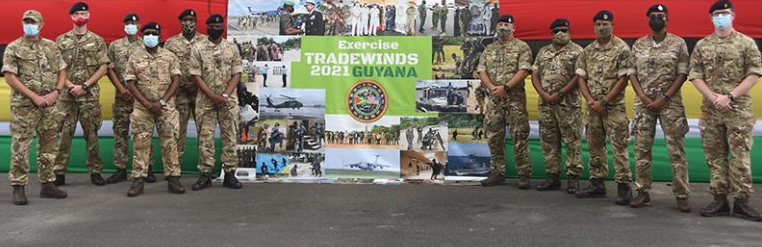
Except for the hum of US helicopters flying overhead, there was a deafening silence throughout the Caribbean region, during the recent Operation Tradewinds, Progressive and Pan-African forces did not utter a word, as soldiers from Guyana, Brazil, Bahamas, Barbados, Belize, Bermuda, Dominican Republic, Jamaica, and Trinidad and Tobago participated in this region-wide military exercise with army personnel from the United States of America, the United Kingdom, Canada, France and the Netherlands.

We were told that Operation Tradewinds was “a US Southern Command sponsored combined joint exercise conducted with partner nations to enhance the collective ability of defense forces and constabularies to counter transnational criminal organizations, conduct humanitarian assistance, and disaster relief operations.”

The catch-phrases “transnational criminal organizations,” “humanitarian assistance” and even “disaster relief operations” are worn-out euphemisms for the neo-colonial presence of the US Empire and its European allies in Guyana and throughout the region. Military exercises and CIA manuals are a vital part of the game plan to ensure the continued strength and influence of the hegemon.

Their lackeys in the region follow suit, utilizing tactics of disinformation. Often, when people from poor and marginalized communities in the Caribbean and the Americas resist neo-colonialism and its persistent, debilitating poverty and oppression, they are labelled “criminals,” and legitimate grassroots movements are described as “criminal gangs.” This then acts as an excuse for State repression, extra-judicial killings, imprisonments and political assassination. In Colombia and Brazil, activists, and in particular, African and Indigenous activists, are targeted for elimination. According to Africa Globe, an African-Brazilian is killed by the police every 23 minutes. Operation Tradewinds was a tacit reminder that if things get out of hand in the “colonies,” the Empire is there to back up their local “governors,” who pose as presidents and prime ministers.

The poverty and suffering throughout the region is largely due to the persistent imperialist plunder and exploitation of our abundant natural and human resources, as well as the imposition of political and economic systems that maintain dependency and dysfunction, while widening the gap between rich and poor. Countries in the region that have dared to break these chains, such as Cuba, Nicaragua, Venezuela and Bolivia, suffer the Empire’s full wrath. Speaking for Guyana in 2021, the most apt description would be a neo-plantation, where the colonial structures, institutions and systems remain firmly in place, and where the president, prime minister and other government officials are no more than governors, viceroys and overseers for the Empire, as in colonial times. That is why Caribbean liberation theologian, Kortright Davis, could have proclaimed, “emancipation still coming.”

Geopolitical and historical fatalism
It’s hard to fathom the seeming acceptance, across the political spectrum, of this provocative military exercise, coordinated by the world’s major imperialist powers. The very same powers that worked together as a well-oiled machine in the destruction of the Libyan Revolution. Provocative, because the exercise was so obviously staged in an attempt to intimidate Venezuela, Cuba, Nicaragua and any other nation in the Caribbean or the Americas that dares to dream of sovereignty and the right to self-determination.

To remain silent, is to acquiesce. A dangerous acceptance of the absurd notion of historical and geo-political fatalism is in the air. The acronym TINA (There Is No Alternative) was concocted so it could be transplanted into our thinking and sure enough it is manifesting itself. Even amongst Pan-Africanists across the region I am sensing a kind of “this is the reality we have to deal with.” Really? With this self- defeating approach, they are actually legitimizing and “Pan-Africanizing” neo-colonialism and in so doing, forfeiting our inalienable right to authentic independence and self-determination.

Joe Biden has now tightened the noose around Cuba’s neck. It’s no surprise that the planned distribution of Cuba’s vaccines, Soberana, Abdala and Mambisa, to the Caribbean, Central and South America and Africa, sent the Empire’s machinery into overdrive, accelerating its attempts to create chaos in Cuba. As far as the imperialists were concerned, this phenomenal achievement by a small, truly sovereign and socialist nation had to be disrupted and discredited.

US imperialists, be they Democrats or Republicans, displaying the fact that their wickedness knows no bounds, have actually hindered Cuba’s access to syringes and other supplies to assist in the manufacture and distribution of life-saving vaccines in the middle of a global pandemic. Cuba’s Foreign Affairs Minister, Bruno Rodriguez Parrilla, rightfully described this as an “act of genocide” and said that “like the virus, the blockade asphyxiates and kills.”

Worldwide, youth are rejecting capitalism
If anything has laid bare capitalism’s contradictions, it is COVID-19. Capitalism’s failure is on show as never before. Youth around the world are rising up in large numbers with the word “socialism” on their lips. And most worrying to the ruling classes and the imperialists, is that the youth movements in their own countries are among the largest. According to recent polls, a majority of youth in the US are rejecting capitalism. More than half of those polled view socialism positively. These young people in advanced capitalist countries such as the US, the UK and France are struggling to make ends meet. Unemployment figures are soaring, social and economic inequality is growing at an unprecedented rate, and even those who have employment are forced to have a side hustle or two. The inarguable connection between racism and capitalism is highlighted everywhere they turn. In the early 60s, when Malcolm X said, “you can’t have capitalism without racism” he had to argue that point in order illustrate it, in 2021, the nexus between capitalism and racism has surely become self-evident.

Increasingly, youth in the West are no longer blaming themselves for their situation, as neo-liberals and conservatives have encouraged them to do, but are instead turning their disdain towards the economic and political system which they see as being rigged against them. They are laying bare the injustice perpetrated by the ideology of White supremacy, which allows Africans in the US to be shot in their homes, neighbourhoods, malls, playgrounds and streets by agencies of the State. Chanting “Black Lives Matter” and “No pride in genocide”, Black and White youth in the citadels of capitalism are tearing down, burning and smashing symbols, icons and images of this system.

The blatant way in which Bernie Sanders was sidelined and rigged out of the US presidential race, despite overwhelming support, contributed to the huge wave of disillusionment. It was a bitter pill for the thousands of young people who were actively involved in his campaign. After witnessing this electoral charade, the numbers of disenchanted youth soared, causing many to turn their back on any remnant of belief they still had in the US political system and bogus liberal democracy. In increasing numbers, US citizens are simply no longer able to close their eyes to the fact that the US is a plutocracy, not a democracy.

When detractors claim that socialism does not work, I ask them for just one example of a place anywhere on earth where neo-liberal capitalism is working. I’m still waiting for a case in point! In fact, if socialism is such a failure, why do the imperial powers spend millions trying to derail it – surely it should fail of its own accord?

Truth be told, it is White supremacy that came into the world as capitalism that is failing, and it is the US Empire and its European allies that are in crisis—directionless and floundering. Despite their bravado and victorious rhetoric, the question is not if this Empire will fall, but rather when? Forced to withdraw their troops from both Afghanistan and Iraq, having failed to achieve their objectives, they are mired in humiliation and defeat. Old Joe is a fool, as are Boris and Macron. Of course, no Empire goes down without a fight. As the Empire falls into the hell of its own making, for the vast majority, life on this earth will get even harsher than it already is. In its dying throes, we can expect the Empire to become even more vicious. All progressive and revolutionary oriented governments and movements understand that the Empire’s fight back will intensify in this historical period.

The Empire fights back to no avail
It is in this context that the Empire’s most recent assault on Cuba took place. As the crisis of capitalism intensifies, the imperial powers are more determined than ever that no alternatives to neo-liberal capitalism can be left standing.

Imperialism’s policy has always been to nip socialist and revolutionary oriented governments in the bud, by ensuring that they are never given a breathing space.  However, despite economic sanctions, covert and overt acts of sabotage, campaigns of disinformation, funding and support of insignificant counter-revolutionary entities and fake NGOs to the tune of millions of US dollars, CIA orchestrated coups, political assassinations and contra-wars, it has not been easy, to say the least, to nip the revolutions of the Caribbean and the Americas in the bud.

Although concerted efforts have been made and millions of US dollars spent, Biden will be the 12th US president who has tried to bring Cuba to its knees. After the waging of a brutal and unrelenting CIA sponsored contra-war against the Sandinista government for more than a decade, today support for President Daniel Ortega and the Sandinistas in Nicaragua is stronger than ever. In Venezuela, under enormous pressure, as the Empire continues to unleash the full extent of its destabilization arsenal on this nation-state, the Bolivarian revolution has survived, In Bolivia, following the US-backed electoral/constitutional coup that forced President Evo Morales from office, the Movement Towards Socialism party that he led, is back in power. In Haiti, Colombia, Brazil, Peru and across the region, the resistance continues.

‘Look for me in the whirlwind…’
What the imperialists fail to understand is that the Caribbean and the Americas have an extraordinary legacy of resistance that has unleashed an historical revolutionary continuum that they can never defeat. Revolutionary leader, Maurice Bishop asked, “When will imperialism learn?” He went on to explain that, “they can kill our bodies but they can never kill the spirit of a people fighting for their liberation…”

In 1987, addressing revolutionaries from the Caribbean and the Americas gathered at the World Mathaba in Libya, Muammar Qaddafi alluded to this impressive and defiant legacy, stating, “I have the feeling that the new world will begin in your region. It is there that the new outlines that will shape the world – outlines that correspond to our aspirations – shall be etched out.”

There can be no doubt that the spirit of Tupac Amaru, Agüeybaná II, Hatuey, Cuauhtémoc, Cahuide, Guaicaipuro, Lautaro, Dessalines, L’Ouverture, Boukman, Bolivar, Marti, Sandino, Bussa, Kofi, Atta, Bogle, Nanny, Makandal, Garvey, Guevara, Castro, Allende, Bishop and so many others rage on. Marcus Garvey told us to look for him “in the whirlwind or the storm, look for me all around you, for, with God’s grace, I shall come and bring with me countless millions of Black slaves who have died in America and the West Indies and the millions in Africa to aid you in the fight for Liberty, Freedom and Life.” It brings to mind the ancient phrase: “They tried to bury us, but they didn’t know we were seeds.”

Exhausted playbook
The most recent attempt to destabilize Cuba simply illustrates just how exhausted the imperialist playbook is—floods of hashtags, bots, automated trolls, doctored photographs and videos, large cash payments to insignificant counter-revolutionary groups etc. The oppressed masses throughout the Caribbean and the Americas know exactly what is going on. In 2021, there is no nation on earth not facing huge challenges, let alone a nation that has withstood more than 60 years of harsh and comprehensive economic sanctions. Cuba’s survival under such harsh and intolerable conditions, is proof of the resolve and resilience of the Cuban people and the revolution they gave birth to. No matter how high the price they are forced to pay, they refuse to surrender their God-given right to true independence, dignity and self-determination. There can be no doubt that the Cubans have come too far to turn back, and will resolve their own issues and challenges on their own terms.

Declaration of war
On July 22nd, when Biden intensified the embargo by introducing new sanctions targeting individual Cuban officials and entities, he declared war. Sasha Tirador, a well-known Miami based counter-revolutionary, exclaimed, “This is huge!”

Another high profile and outspoken Miami based counter-revolutionary, Orlando Gutíerrez-Boronat and Miami mayor, Francis Suarez, called for US airstrikes on the island-nation.

Contributing to the war-room like discourse, in an interview with MSNBC, Marco Rubio commented that “at the end of the day, the key…is to go after the loyalty and the confidence of those in the security apparatus in Cuba.”

The Biden administration is doing everything it can to provide internet access to the Cuban people to “circumvents the regime’s censorship efforts.” This is rich, coming from a US administration that is tagging what it considers to be “inappropriate messages” on Facebook for referral to Facebook management. The US State has, in effect, become an extension of Facebook in its attempts to censor.

In a clear directive to US partners in the region, Biden, referring to Cuba, Venezuela and others, said that “advancing human dignity and freedom is a top priority” for his administration, and the US would work closely with its “partners throughout the region” to achieve these goals. And there they were, US military helicopters flying overhead in in Guyana, not far from the Venezuelan border, as part of Operation Tradewinds.

Never tiring of hypocrisy, Biden of course is speaking as president of a country with the largest incarcerated prison population on earth, including many political prisoners, where censorship and State-sponsored disinformation has become the order of the day, where the entire population, and in particular dissidents, are targeted for Orwellian type surveillance, and where demonstrations are put down with brutal militaristic force. Nowhere on earth is the “fascistization” of the State more evident than in the US of A.

#UnBlockCuba
We must intensify our fight back. Words, resolutions and statements of solidarity are important but not enough. Revolutionary and progressive forces across the Caribbean and the Americas must mobilize and organize a mass movement around just one single demand that we can all agree on: An immediate end to the United States illegal embargo on Cuba.

We must call on our progressive and revolutionary brothers and sisters worldwide to take up this campaign with such thunder that the Empire comes under pressure to relent. Only then can we demonstrate that there is indeed an alternative, and that we are determined to defend that alternative.

Revolutionary Pan-Africanist and socialist, Kwame Ture said, “When Africa called, Cuba answered.” He was of course not only referring to the medical brigades and other humanitarian assistance, but also to Cuba’s unprecedented military assistance in the fight against the South African Apartheid regime, and the decisive battle at Cuito Cuanavale. Now, when after six decades of illegal sanctions that have crippled Cuba economically, and are fomenting unrest among Cuba’s youth, as they were designed to do, Cuba is calling. Let us answer with a resounding and sustained campaign of resistance until the illegal embargo is lifted. In doing so, we will send a definitive message to the US rogue regime, that in the words of Grenadian freedom fighter, Maurice Bishop, “we are in nobody’s backyard.”

Wednesday, July 28, 2021

Global Capitalism: Biden’s Economic Plans and Likely Results ~~ Richard Wolff with introduction by dmorista

https://www.youtube.com/watch?v=Y9lWJB1jPVQ

~~ posted for dmorista with introduction by dmorista ~~

Introduction by dmorista

In this talk, from May of 2021, Richard Wolff discusses some of the socioeconomic policies that President Joe Biden has already implemented or is/was trying to implement. Wolff notes that both political parties loyally serve the interests of capital, but that they view how to do that somewhat differently. The Republicans tend to pursue policies that reduce the share of the economic output that working people get through wages and benefits, while the Democrats think it is better to provide a somewhat greater share of national wealth and income to working people through mild reformist policies.


He compares Biden's policy goals to: 1). the social policies of Donald Trump; and 2). the social policies of Franklin D. Roosevelt. As Wolff noted Trump represents the most extreme right-wing of the Republican Party and wanted to eliminate all public spending on the social welfare of the bottom half of the country's socioeconomic hierarchy. Trump wanted to eliminate Social Security, Medicare, Medicaid, Foodstamps, rental assisstance and so on. Structural impediments stopped him from achieving his larger goals, though he did manage to push through yet another massive tax cut for the rich, rivaling those passed during the Bush the Younger and Obama administrations. And this particular tax cut was given to the well-off at a time when they had benefitted from 20 years a transfer of wealth; moving up from the majority of the population into the hands of the rich. Biden's policies are certainly more humane, but the bar set by Trump was extremely low. Biden proposed to change the tax cut for corporate profits, that the Trump regime cut from 35% to 21%, back to 28% but he immediately cut that to 25% in the face of stiff Republican resistance.


Comparing Biden's proposals to the policies of Franklin Roosevelt shows just how weak and meager they really are. Wolff notes that both Biden and Roosevelt were elected as Centrists, Roosevelt actually ran on a platform of “balancing the Federal Budget” in his 1932 campaign. Only after entering office did Roosevelt realize just how serious the socioeconomic situation was. In addition, Roosevelt worked under sisnificant political pressure from the U.S. working class, as channeled through the major working class organizations of the day; the 2 Socialist Parties, the Communist Party, the unions such as the Congress of Industrial Organizatins (CIO), the United Mine Workers (UMW) and the still forming United Auto Workers (UAW). Any impulses Biden might have to try to push though and reforms on the scale of the New Deal, or even The Great Society, are limited by the much lower degree of organization and mobilization of the Left in current day American Society.


Later in the talk Wolff discusses the economic decline of U.S. Capitalism and how that has been manifested. The U.S. remains a major power, but its position of near supremacy that it occupied in the decades after WW 2 has come to an end. The U.S. ruling class has found that their influence in the world has become seriously diminished. They have not yet come to grips with all the ramifications of this and how it constrains their scope of action, both domestically and in world affairs.

Monday, July 26, 2021

“Global Capitalism: The Challenge of China”. ~~ Richard Wolff and Introduction by dmorista

 https://www.youtube.com/watch?v=XpD0Im5d9-c

~~ posted for dmorista with introduction by dmorista ~~

Introduction by dmorista

Richard Wolff gives a talk, generally about 1 hour long, every other month. He used to give the talks live at the Judson Church in Manhattan, but now he is doing it online, and his organization then posts you tubes of the talks at their website Democracy at Work. This is the most recent of his bimonthly talks.

This particular lecture “Global Capitalism: The Challenge of China” recorded on July 14, 2021 opens with about 3 minutes of a typical pitch for either financial support or help with work on various aspects of the website and its various youtubes and podcasts. Then for 7 or 8 minutes Wolff discusses the differences between the situation faced by Joe Biden and Franklin Roosevelt, and their respective responses to the two crises.

He emphasizes the difference in the level of organization of the working class in the U.S. now, as compared to that in the 1930s. He ascribes much of the weakness of Biden's response to the lack of organizational power and mobilization of working people in the U.S. now; as compared to that 80 years ago. He sees Biden's plan as falling far short of what Roosevelt, who had to contend with a strong, organized, and highly mobilized working class on his left. A class that had several active and growing unions, and that had 1 Communist Party and 2 Socialist Parties. All three of those leftwing political parties also played a major role in shaping the policies of the New Deal era.

In the main text of the talk Wolff succinctly analyzes the business deals made between the rulers of the U.S. and China. U.S. capital was in a serious crisis of low profitability, for most of its basic industries, in the early to late 1970s when the first opening to China took place. The capitalists in the U.S. thought they had found a solution to the problem of high wages, that American workers had fought for during the 1930s and 1940s. That solution was to move a significant portion of U.S. industrial production out of the country to low-wage low-regulation places.

American capitalists essentially went on an “investment strike” for the domestic U.S. economy. They moved their industrial investment to a variety of places including Mexico, Central America, S. Korea, and Taiwan. By the 1990s China became the main destination for U.S. and other Western and Japanese capital investment. The Chinese Communist Party guaranteed a low-wage, well educated, healthy, and docile workforce. In return they demanded some level of technology transfer as part of the investment process. Wolff does not try to paint China as a paradise, but he points out that the Chinese kept their end of the bargain. They were just smart enough to invest much of the profit into advancing Chinese social and technological and industrial development. The rulers in the West meanwhile, were disinvesting in their domestic societies.

Saturday, June 26, 2021

Jerry Mander - Overthrowing Capitalism

https://www.youtube.com/watch?v=CyS7VsQ5jYQ

~~ posted for collectivist ~~


Jerry Mander is the founder, former director, and presently distinguished fellow of the International Forum on Globalization (IFG), a San Francisco “think tank” focused since 1994 on exposing the negative impacts of economic globalization, and the need for economic transitions toward sustainable local economies. He was also, until recently, program director of the Foundation for Deep Ecology.  IFG has been widely credited as the principal organizer of the immense protests against the World Trade Organization (WTO) in Seattle, 1999, closing down the Doha round.

Mander was trained as an economist in the 1950s (Columbia University), but his early career was as president of a major commercial ad agency, Freeman, Mander & Gossage, and then as founder of the country’s first nonprofit ad agency in 1971, Public Media Center, which ran advertising and publicity campaigns for Sierra Club, Greenpeace, Friends of the Earth, and various indigenous and antiwar groups. These campaigns included the celebrated Sierra Club campaigns (with David Brower) that kept dams out of the Grand Canyon, established a Redwood National Park, and stopped production of the Supersonic Transport (SST).

Mander’s most recent book (2012) is The Capitalism Papers; Fatal Flaws of an Obsolete System. Prior books include international best-sellers Four Arguments for the Elimination of Television, and In the Absence of the Sacred, both critiques of the growing negative power of technological systems.  Other books include The Case Against the Global Economy (with Edward Goldsmith), Alternatives to Economic Globalization (with John Cavanagh), Paradigm Wars: Indigenous Peoples’ Resistance to Globalization(with Victoria Tauli-Corpuz) and The Superferry Chronicles (with Koohan Paik.)


The video starts with these gems:  

Capitalism is built on endless growth

If you have wealth, your job is to have more wealth and to use that wealth to have more wealth

Capitalism is amoral

It is inherently hierarchical - all the benefits flow up.  When employees get a raise, those up the top get less.  The system is designed to prevent this.

7 corporations control 70% of global media - resulting in a massive takeover of consciousness

Inherent propensity to war - war is good business - it employs people at low wages.

Does capitalism bring happiness to society?  "no"

America is first in divorce, first in obesity, first in prison populations, second in the world in murder rate, wealth inequality, pay differential, etc

and goes on from there...


...  watch the video..., NB. 💗


Monday, May 31, 2021

Dynamite in the foundations: Alan Woods on the crisis of world capitalism

https://www.marxist.com/dynamite-in-foundations-alan-woods-video.htm

~~ posted for dmorista ~~

At a meeting of leading members of the International Marxist Tendency at the end of January, Alan Woods (editor of marxist.com) provided an overview of the dramatic events unfolding at the start of 2021. The crisis of world capitalism is causing ruptions, dislocation and class polarisation in one country after another. We have also included below an audio recording with the Spanish translation removed. 

The COVID-19 pandemic continues to inflict misery and hardship on ordinary people, while the wealthy enrich themselves even further. The ruling class is pumping trillions into the system to keep it afloat, but even if there are short-term recoveries, this will ensure an even-deeper collapse down the line.

The new year barely began before a far-right mob stormed the US Capitol Building in Washington at the urging of former US president, Donald Trump – turning the centre of Western imperialism into the image of a failed state. These events, coupled with the vastly larger BLM protests last summer, show how deep the polarisation of US society has become.

Elsewhere, big protests in India and Russia demonstrate the same process: the masses' resentment is growing, and the ruling class is failing to govern in the old ways. As Alan explains, every road leads to an unprecedented explosion of class struggle on the world stage.

In this context, the task of Marxists is to present a revolutionary socialist alternative to the millions of radicalising workers and youth who are witnessing with their own eyes the total failure of capitalism to provide them with a decent existence.

(Please go to the link at the top for links to the video and podcast - for some reason they would not "take" on Blogger, NB)

Transcript

These world perspectives are unlike any other I’ve spoken on, like a black cloud hanging over the situation is this unparalleled pandemic, subjecting millions to misery and death. There are almost 100m cases worldwide, and over 2m deaths.

These figures are unprecedented outside a terrible world war. 

The situation is especially bad in poor countries, in Africa, Asia, Latin America. But it also affects some of the richest. In the USA there are over 25m cases, and the number of deaths is creeping inexorably towards half a million. I’m sitting in London, where Britain has the worst number of deaths per head. 3.5m cases, and they’ve just officially admitted to over 100,000 deaths.

In other words, the present crisis is not like an ordinary economic crisis. This is a literal life-and-death situation for millions of people. The starting point of our analysis is capitalism cannot solve the problem: it is itself the problem.

This terrible scourge serves to expose the deep divisions between rich and poor. It’s exposed the deep fault lines that divide society. Between those who are condemned to get sick and die, and those who are not.

It has exposed the wastefulness of capitalism, its chaos and inefficiency, and is preparing class struggle in every country in the world. Governments are fond of military analogies in describing the current situation. They say we are at war with an invisible enemy, this terrible virus. Their solution is all classes and parties must unite – behind the existing government. 

Yes, but a tremendous gulf separates words from deeds. This gulf is between the urgent needs of society, and the mechanisms of the market economy. If we were really at war with the virus, then all governments should mobilise all their resources towards one single task: to mobilise for a global plan of action.

The case for a planned economy, internationalism and international planning is unanswerable. Despite the ideas of Mr Trump, the virus doesn't respect frontiers or border controls. 

From a purely rational point of view, the response would be to ramp up vaccine production, one would have thought. Instead, we have the disgusting spectacle of the row between Britain and the EU over scarce vaccines, while the poorest countries are virtually denied access to any vaccines at all.

The question arises: why is there a scarcity of vaccines at all? Capacity for production needs to be expanded by setting up new factories. Why is this not done? For the simple reason that the big pharmaceutical companies have no interest in massively expanding production, because they’d be worse off. If they ramped up production capacity, so that the whole world was supplied within six months, which is entirely possible, the newly built factories would stand empty immediately after – think about it!

Profits would therefore be much lower than the current situation, where existing plants can produce at-capacity for years to come. Which means the pharmaceutical companies earn big profits, and of course there are constant problems with production and supply. This means shortages everywhere, with millions of doses being unused, and millions dying as a result.

On the other hand, the capitalist class of all countries are pressing for people to get back to work, for production to be restarted. 

Workers are forced back into crowded workplaces, without adequate means of protection, and this is equivalent to passing a death sentence on many workers and their families. 

On the other hand, the economic crisis is the most severe in 300 years, they say. Just between April and June of last year, 400m jobs were lost worldwide. If you take tourism alone, which is important for many poor countries, 120m jobs will be wiped out, they think. The so-called emerging economies are being dragged down with the rest. India, Brazil, Russia, Turkey are all in crisis. South Korea’s economy sank last year for the first time in 22 years. Despite state subsidies worth about $283bn.

I won’t spend much time on economics, though I will later if I have time. From a Marxist point of view, the study of economics is not an abstract question, not an academic question. But it [the economy] has a profound effect on the development of consciousness of all classes, that’s the point. The main thing that we note everywhere now is a crisis, not just of governments, a political crisis, but a crisis of the regime. Particularly in Europe and the USA, I would say.

There are clear indications that the crisis is so severe, so deep, that the ruling class is losing control of the traditional instruments they used in the past for running society. And bourgeois politicians have totally lost control. 

Beginning with the USA, the wealthiest and most powerful country. The world economic crisis has hit the USA very hard. 40m Americans filed for unemployment during the pandemic, as always it’s the poorest who suffer most, and the youth. A quarter of under-25s have lost work. This undoubtedly caused serious alarm in ruling class circles in the USA. 

The state was not supposed to play any part in economic life, perhaps you remember that theory? But, alarmed by the danger imposed by the situation, the ruling class was forced to take emergency measures. They ditched all the old theories that the state must not interfere in the economy, and now in all countries, starting with the USA, the so-called free market economy, capitalism, is really on a life support system, like a coronavirus patient. It only exists because of the crutches of the state. 

Most of this money went straight into the pockets of the rich. But initially it did have the effect of cushioning the effects of the crisis on the poorest layers. But now these supports are being withdrawn. And we have, as a result, the most terrible poverty in the richest country in the world. 

I gave the figures in a recent article that I wrote, horrifying statistics. US families now, many of them, lack enough money to put food on the table. Food banks are proliferating, and millions are sinking into the direst poverty. Many are threatened with losing their homes, because they can’t pay the rent. 

In other words, the gulf between rich and poor has been transformed into an unbridgeable abyss. 

And this has an effect. All this demagogy about the national interest, we must fight together, all in the same boat, etc. Well, let’s spell it out. The masses are prepared to make sacrifices under certain circumstances. In time of war, people are prepared to unite to fight a common enemy, that is true. They are prepared for a period at least, to accept lower living standards. And also restrictions on democratic rights, to some extent, for a period. 

But the existence of unprecedented inequality, the scandalous riches accumulated by the rich… while for example, the IMF estimates that close to 90m people are due to fall below the level of $1.90 a day: the threshold of extreme deprivation. 

Yet, in 2020, the total wealth of the billionaires grew by $1.9tn. That is during the pandemic, during the crisis. The example of Jeff Bezos stands out. He now makes more per second than the typical US worker makes in a week. 

The gulf separating the haves, and have-nots, has stretched into an unbridgeable abyss, as I said. And this is deepening the social and political polarisation, that’s the point. It’s creating an explosive mood of anger in society. Everywhere you look, in all countries, there’s a burning hatred of the rich and powerful: the bankers, Wall Street, and the establishment in general.

This hatred was skillfully channelled by the right wing demagogue Donald Trump. And this has appalled the serious representatives of capital. They rightly saw Donald Trump as a threat because he was deliberately dynamiting the basis of consensus, of all the centre politics they’d been painstakingly building up for decades.

The ruling class is desperate to prevent this polarisation, and put the centre together again. But all of the objective conditions militate against their success. And the events of 6 Jan are a striking demonstration of this. Now they’re saying it was an insurrection, they’re trying to impeach Trump who is accused of organising an insurrection. If it was an attempted insurrection it was a very poor one! More than that, it was a big riot. But nevertheless, it was dangerous for the ruling class, and glaringly exposed deep rifts in the state itself.

The events of 6 Jan in Washington indicate the polarisation of society have reached an unbearable point, a breaking point. The institutions of bourgeois democracy are being tested to the point of destruction. It’s a crisis of the regime, not a normal political crisis. Despite a barrage of media hostility afterwards, 45 percent of registered Republicans though the storming of Capitol Hill was justified. You’re talking about millions! That’s quite significant, but more significant is the fact that 54 percent of all Americans thought the burning down of the Minneapolis police precinct was justified. And let’s not forget that 10 percent of the US population took part in the BLM protests, which is many times more than those who stormed the Capitol.

The spontaneous movement that swept the country after the murder of George Floyd and the unprecendented (sic) events that followed the US elections, if taken together, represent a turning point in the entire situation. Of course, the movement is confused, to put it mildly. It has some reactionary elements, but it isn’t just a black tide of reaction. That’s the nonsense of liberal observers who understand nothing.

Marxists must be capable of determining what is progressive from what is reactionary. We must understand that here, in embryo, we have revolutionary developments in the future. The stupid liberals understand nothig  (sic), they shout about fascism, about which they know nothing. I will quote later from a very perceptive article which shows the far-sighted bourgeois understand what we understand: everywhere, in every country, beneath the surface, there is a mood of anger and resentment against the established order. This mood expresses itself in the collapse of confidence in the official institutions, the parties, the governments, the political leaders, bankers, rich people, the police, the judiciary, existing laws, tradition, religion, morality of the existing system. 

People no longer believe what they’re told by the newspapers and the TV, they compare the huge difference between what is said and what happens, and they realise we’re being sold a pack of lies. This wasn’t always the case. In the past, most people didn’t pay much attention to politics, which goes for workers also. Conversations in the workplaces were usually about football, movies, television programmes. Politics were rarely mentioned, except maybe at election time.

Now, all that’s changed. The masses are beginning to take an interest in politics, because they’re beginning to realise this directly affects their lives, and the lives of their families. This in and of itself is a reflection of a mood of revolution. The institutions of bourgeois democracy were based on the assumption that the gulf between rich and poor could be disguised and contained within manageable limits. But that’s no longer the case. That is precisely the reason for the collapse of the political centre. 

It’s true that because of the complete bankruptcy of the reformists, including the left reformists, this mood has been capitalised upon by right-wing demagogues, so-called populists. Of course, nature abhors a vacuum. This is being interpreted by the stupid liberals and reformists as fascism. But the strategists of capital do understand, very clearly. 

At Christmas time, the FT published an article signed by the editorial board, which showed a very different assessment of the process, and where it would go. With your permission, I’ll quote a few lines:

“Groups left behind by economic change are increasingly concluding that those in charge do not care about their predicament.” 

It’s true, these people – Trump supporters – when they’re interviewed say “Washington doesn’t care about us! We’re the forgotten people!” 

The article continues… 

“[O]r worse, have rigged the economy for their own benefit against those on the margins. Slowly but surely, that is putting capitalism and democracy in tension with one another. Since the global financial crisis, this sense of betrayal has fuelled a political backlash against globalisation and the institutions of liberal democracy...” (this is the fascinating bit!) “Rightwing populism may thrive on this backlash while leaving capitalist markets in place.” And this is the point… “But as it cannot deliver on its promises to the economically frustrated, it is just a matter of time before the pitchforks come out for capitalism itself...” “and for the wealth of those who benefit from it.” 

Now, that’s serious talk, isn’t it? It shows a perfect understanding of the dynamics of the class struggle. How so-called right-wing populism can just be the first stage before a revolutionary explosion. They understand that perfectly well. Even the language is significant. Armed with pitchforks suggests an analogy with the French Revolution, or the Peasants’ Revolt of 1381, where the peasants seized London. This tremendous volatility can be observed in many countries, if not in every country.

We saw it just recently in Russia, where the return of Navalny was the signal for an explosion of protests in Moscow and 110 other cities. Places like Vladivostokin the provinces. What does this represent? It’s not yet the Russian Revolution, it’s true. They’re also very heterogeneous demonstrations, lots of middle-class people, intellectuals, liberals – but also a growing number of workers. But these were big demonstrations in a Russian context. It needs to be seen in the context of falling living standards. Between 2013 and 2018, before the pandemic, the annual economic growth was 0.7 percent, basically stagnant. At the end of last year, you saw negative growth of about 5 percent.

Putin the past could boast of some success in the economic field, but not anymore. Unemployment is growing fast and many families are losing their homes. So the question of Navalny is only one element in this situation. Everything indicates as well that Putin’s support is collapsing. Two days after his arrest, Navalny put out a very interesting video, seen by millions, exposing the personal corruption of Putin, showing he’s built a large palace on the Black Sea, and all this is building up an explosive mood. As I say, Russia is not in a pre-revolutionary situation yet, but events are moving very fast now. 

Now at the other end of the world, in India, as I speak we see events that amount to an insurrectionary movement: of the farmers, who staged a tractor march to Delhi on 26 January, a couple of days ago, on Republic Day, where Modi was celebrating with a big military parade. It was impressive to see this on TV, astonishing, to see thousands of farmers fighting with the police to get to the red fort, fighting with heavily armed police, attacked and beaten. Modi has been clearly shaken by that uprising, which gave some idea of the pent-up fury of the masses.

But the weakness of the movement in India is the absence of a serious response from the powerful Indian working class. 

The farmers’ struggle did have a powerful impact in the factories, but the powerful Stalinist trade union leaders are trying to put the breaks on. Now the fire is under their backsides, Now they’re talking about a four-day general strike, which is significant. In the past they tried to exhaust the workers, as they did in Greece, calling a series of one-day general strikes. This is a trick to blow off steam, and prevent a generalised movement.

Earlier we were discussing the IS of the slogans proposed by comrades in Pakistan and India of a general strike: I hope I will have time to deal with that later on. 

I won’t spend long on the perspectives for the Biden administration, but clearly Wall Street is pinning all its hopes on administration and its vaccination efforts, but Biden will preside over a divided and declining nation. His attempts to buy his way out will only build up the debt in the system, which will prepare a bigger crisis down the line.

I don’t have time to deal much with China, but China is the only major economic power to have had some kind of positive growth. That’s because the Chinese state intervened decisely to counteract both the pandemic and the economic crisis. A kind of state capitalism, if you want to use that expression. And to be fair it’s got results up to now. 

It’s true that China’s growth is at about 2 percent, which is very poor from a Chinese perspective, but they’re now forecasting growth of 8 percent this year. If that is true, then China will outperform the rest of the world. But this very success will be its undoing. This economic growth is based excessively on exports. China is intervening aggressively on the world market and will have to intervene even more aggressively. This will inevitably mean tension between China and the US, which sees China as the main danger – not just Trump, but Biden as well, the Democrats agree. 

Previously, China was a big part of the solution for world capitalism, now it’s a big part of the problem. And the conflict particularly between the USA and China threatens to bring about an even-more-serious trade war, which is the greatest possible threat to world capitalism that exists, because it was the growth of world trade that explains the development of capitalism in the last period. So-called globalisation. Now of course this will turn into its opposite with very negative results for capitalism. 

This in turn will have an effect inside China. There have already been factory closures and unemployment, which have been concealed, but they exist. That explains the reason for Xi Jinping clamping down on Hong Kong. This wasn’t an expression of strength, but of fear and weakness. The Chinese ruling class were concerned this kind of movement would spread to the mainland, and it will, as night follows day. As an international we must be prepared for big events in China, which will happen when nobody expects it, because it is a totalitarian regime, we don’t know what’s happening there. While Chinese state could suppress a small state like Hong Kong, it will not be so easy to control 100 Hong Kongs in mainland China. So we must follow China carefully.

I don’t have time to discuss the economy for long. But it’s important to underline what I said earlier: when the bourgeoisie is faced with losing everything, they will resort to the most extreme methods to defend their system. Everywhere now, they’ve ditched their old arguments about the market, and opted instead for Keynesianism. They’ve lurched like a drunken man from one lamppost to another.

Now they depend, almost exclusively, on the handouts of the state. Ted Grant used to describe Keynesianism as voodoo economics, I think that’s a fair description. The idea that the state has unlimited funds is nonsense. That’s really a desperate policy they’ve adopted everywhere, and it’s led to astronomical, unthinkable debts. This is the greatest danger facing the capitalist system at this time. 

I have the figures here, we will produce this in a document later. But sooner or later, these debts will catch up with them. There’s a ticking time bomb of debt, which is built into the foundations of the economy now. In the long term, the effects will be more devastating than any terrorist bomb. But in the short term, they’re quite happy to continue this. And they even publish articles confidently predicting a rebound. 

Now, as serious people, we must consider these arguments seriously. Is a recovery of some sort possible? Well, first of all, we must understand that the economic predictions of the IMF and World Bank should be taken with a large pinch of salt. In the first place, the present crisis is different from crises of the past because it’s entangled inseparably with the coronavirus pandemic, and nobody can predict with any degree of certainty how long that will last. For this reason, the predictions of the economists cannot be considered more than mere guesswork. The only certainty is all the main indicators are pointing downwards, that much is clear. 

But does that mean a recovery of some sort is completely ruled out? No, you can’t draw that conclusion. In fact at a certain point, some sort of recovery is inevitable. The capitalist system has always moved in booms and slumps. Sooner or later, they’ll find a way out of this also. But we have to look at what kind of recovery we’re talking about. Are we talking about the beginning of a long period of growth and prosperity, or merely a temporary interlude between one crisis and another? 

The most optimistic prognosis is based on the existence, at least in the advanced capitalist countries, of what they call ‘pent-up demand.’ There are plenty who are facing genuine impoverishment, but there are also millions of better off families who now have money to spend – that’s a fact. At the end of the pandemic, they’ll be eager to spend in restaurants, bars, foreign holidays etc. This could mean an immediate sharp uptick in the economy after the pandemic, that’s not ruled out, together with further, huge injections of money from the state.

Now let’s be clear: sometimes comrades have a too black-and-white idea on this question. From our point of view, a temporary recovery would not be a bad thing. The pandemic and the consequent rise of unemployment, shocked the working class and led to a certain amount of paralysis, that’s a fact. But even a modest, small recovery of the economic activity, a slight fall in unemployment would have the immediate effect of reactivating the economic struggle, as workers strive to win back everything they’ve lost in the previous period.

And let’s be absolutely clear about it. Such a recovery would be temporary, and extremely unstable, because it’s on an artificial and unsound basis. It would contain within itself the seeds of its own destruction. And the higher it climbs, the more severe the fall will be.

But as I said earlier, the question of economics is only of interest from our point of view insofar as it impacts the consciousness of the masses. And here I must confess I feel a little bit uneasy about the way some comrades pose the question of perspectives. It strikes me as a bit mechanical. A comrade writes an article, makes a list of very interesting statistics on hunger, misery, unemployment etc., and then immediately concludes: capitalism is finished, long live the socialist revolution!

Comrades, things are not quite as simple as that, I’m afraid to say, and from a dialectical perspective that method is quite objectionable. You do not inject conclusions into a situation, you cannot assume what is not proven. Don’t assume that people who read these articles agree with what we stay. The conclusions must flow from the analysis, and it must be a serious analysis.

It’s not hard to describe the crisis of capitalism. What is not so easy, and what we have to establish, is to explain how you get from A to B. And this needs to be explained. The main problem is the absence of the subjective factor. The crisis is a fact, and the fact is the workers are learning, but it takes time – it’s a learning process. And the masses will not merely draw the same conclusions that we drew, for theoretical reasons, years ago. The masses can only learn from one thing, that’s experience. As Lenin used to say: “Life teaches.”

But learning from the great book of experience is a slow and painful process. It would be greatly expedited if there existed a mass revolutionary party like the Bolsheviks. An organisation with sufficient numbers to be present and with sufficient authority to be listened to by the workers.

Lenin quoted Hegel, he said the truth is always concrete. Sometimes, the most erudite Marxists have forgotten. Comrades, we must show concretely how to pass from A to B, and B to C and D and E. For this purpose, we must create an appropriate series of transitional demands that protect the health and livelihoods of workers, and place the burden of the crisis on the shoulders of the bosses. We must make appropriate demands, not just for workers in healthcare and frontline services, but for all workers, paid for by the employers. If the bosses say we can’t afford these things, let them open the books and expose the huge amounts of money they’ve got hidden, and the huge injections of money they’ve been given by the state!

It is only by the bosses’ failure to grant these demands that the workers will see the necessity of a transformation of society.

The main problem is one of leadership. The angry mood of the masses cannot find an expression from the leading layers of the class. The trade union leaders are holding the movement back. But with or without them the workers will find a way of expressing themselves. In Italy there is no mass workers’ party, but the mood of the workers grows angrier and more impatient every day. The repeated failures of government are inevitably leading to an explosion of the class struggle. 

This mood is expressing itself not in parliament but on the streets. New layers are being drawn into the struggle. We saw it in France with the gilets jaunes, we saw it in India with the farmers, in a peculiar way we see it in the storming of the Capitol. 

What would the appropriate slogans now be in India? Objectively speaking, all the conditions exist for an all-out general strike. The problem is the Stalinist leaders, as usual, have been dragging their feet. They’re hopelessly corrupt, counterrevolutionary, but you must understand that even the most corrupt and counterrevolutionary leaders can come under the pressure of the working class when it begins to move.

Now the trade union leaders in India are discussing the idea of the four-day general strike. Our position is for an all-out general strike. So what do we do? We’re not the leadership of the movement, but these guys are. We should say to them: ‘very well, let’s have a four-day strike – but less talk, and more action! First: name the day! Start a campaign in the factories, call mass protest meetings, set up strike committees, and draw in the farmers, women, youth and unemployed – and all oppressed sections of society. And link up these organs of struggle at a local and national level. In other words, soviets! If that were done – I don’t say it will be – but if it were, a four-day strike would be transformed into a four-day general strike, which poses the question of power. Once the masses in India are organised for that, no force on earth will stop them.

I must sum up my remarks. But there is one point we must understand: this will be a long, drawn-out crisis. It will last years, or even decades, with ups and downs. It will be longer due to the absence of the subjective factor.

However, this is only one side of the coin. The fact that it will be long and drawn out doesn’t mean it will be any less turbulent, quite the opposite. The current perspective is for sharp and sudden changes. Processes that took many years to develop in the past can now occur overnight, posing very serious questions before us. And we must be prepared, comrades! The year 2021 will be like no other, the working class has entered a very harsh school, there will be many defeats and setbacks, but from that school the workers will draw the necessary lessons.

The TU leaders are completely out of their depth – they reflect the past, the days when they had an easy life with the bosses, could easily get small concessions for the workers. Now things are very different. They will have to fight for every demand. And the workers find themselves in intolerable conditions, where their lives and those of their families are in danger. 

The unions will be transformed in the course of struggle. One by one, the old right-wing leaders are dying or retiring, or being replaced. A new generation of younger class fighters is beginning to challenge the leadership. The stage is set for the transformation of the unions into organisations of struggle. 

And even the most reactionary and apparently inert TUs will be drawn into this struggle. And we Marxists must be at the front ranks of this struggle, upon which ultimately the success of the socialist revolution depends. Dialectics tells us things can change into their opposites, and we must be prepared for this.

We have the correct ideas, methods and perspectives. Our task is now to turn this into growth, to create a powerful revolutionary army of cadres, that is capable of leading a revolutionary army, capable of leading workers in the struggle for power. 

There is nothing more important in our lives. And together, we can definitely achieve it.