Showing posts with label Republicans. Show all posts

Monday, March 22, 2021

An Honest History of Texas Begins and Ends With White Supremacy ~~ Casey Michel

https://newrepublic.com/article/161685/texas-1836-project-white-supremacy?utm_source=social&utm_medium=facebook&utm_campa

~~ posted for collectivist ~~

One Texas Republican state House member wants to create a “patriotic” education project to celebrate the Lone Star State—and whitewash its ugly past.
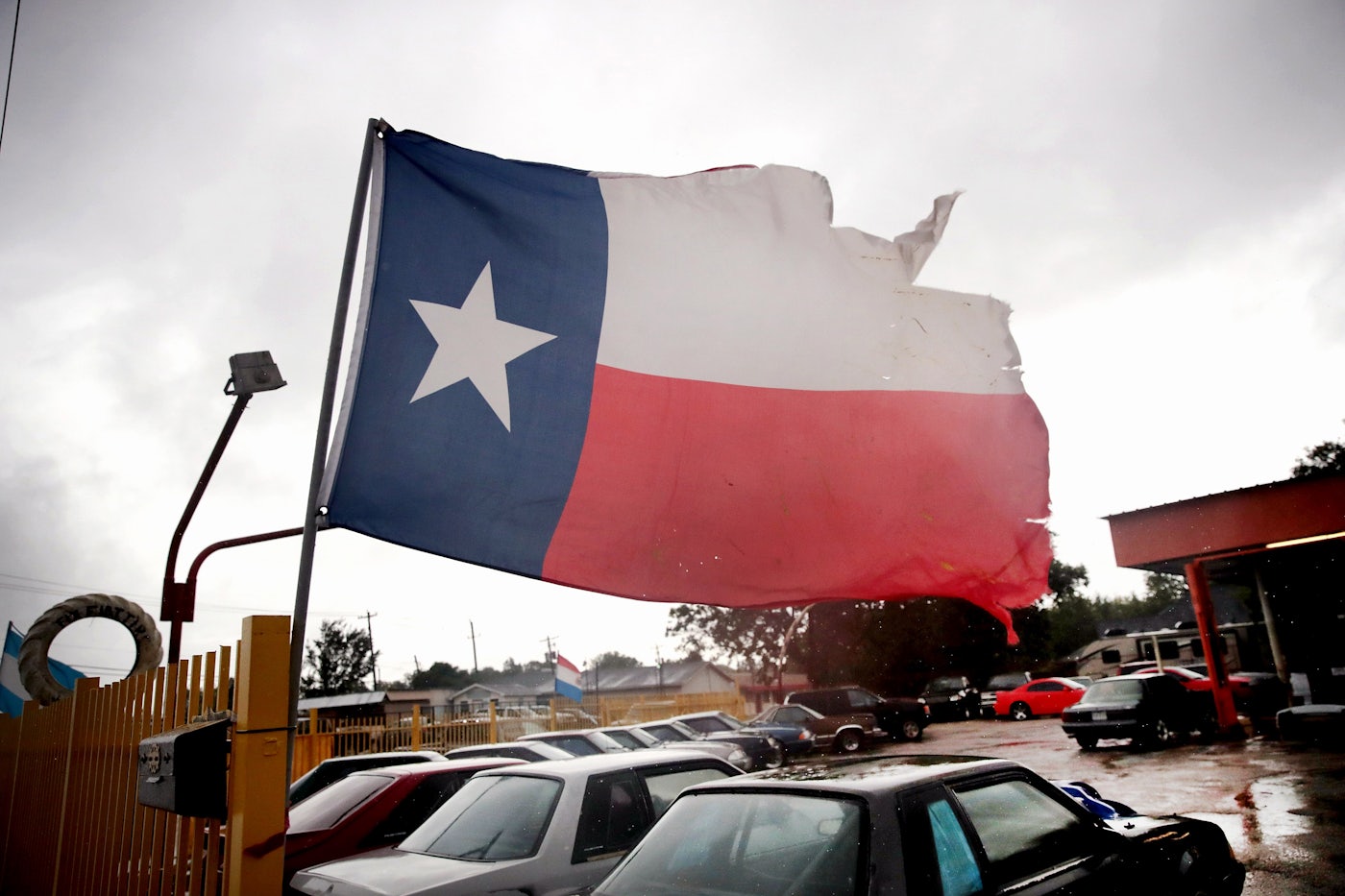
A torn state flag of Texas hangs on a staff in Houston.

SCOTT OLSON/GETTY IMAGES

The past few months have been rough for Texasand for the Texas Republican Party in particular. Republicans in the state led the charge to overturn the 2020 election results, centering their anti-democratic arguments on fantasies of stolen ballots and smothered voices. Then a once-in-a-generation winter storm revealed the extent to which years-long GOP control had rotted the state’s infrastructure, providing a searing illustration of collapse that gripped the news cycle and the nation. (And leading to Senator Ted Cruz tucking tail for Cancun.) Just last week, Governor Greg Abbottin a fit of “neanderthal thinking,” as President Joe Biden saidlaunched a premature lifting of the state’s mask mandate, setting the stage for new Covid-19 variants to wash across the population, the potential for new casualties in a pandemic the rest of the country is finally obtaining the upper hand over, and new reasons for voters who may be tilting in their partisan preferences to consider ousting the governor when he’s up for reelection in two years.

Perhaps unsurprisingly, the state’s GOPmimicking its national counterparthas responded to these cascading failures not with sound policy proposals but with a bushel of distractions related to America’s never-ending culture wars. The state’s oleaginous lieutenant governor has led the way, proposing legislation that would force publicly funded entities and events to perform the national anthem. The Texas Republican Party’s official headquarters, hurtling headlong into cognitive dissonance, endorsed the first serious secession bill the country has seen since the Civil War. That measure has since picked up multiple Republican sponsors in the House.

All of which brings us to the latest front that Texas Republicans have launched in their war on reality. This month, one Texas Republican House member filed legislation to force the creation of a new project for supposedly “patriotic education.” Calling for the formation of an “1836 Project,” named after the year Texas declared independence from Mexico, the bill models itself after former President Donald Trump’s ill-starred “1776 Project.” Trump’s effort—which barely lasted a week before the new administration obliterated it wholesale—was itself a response to The New York Times’ “1619 Project,” which recentered slavery and human bondage in the story of colonial America.

According to Representative Tan Parker, the legislator who filed the bill, the proposal is “exclusively about celebrating Texas.” As Parker contended, “Many of our children are taught to denounce Texas history and do not understand what it means to be a virtuous citizen.” It’s unclear what Parker has in mind when he describes “virtuous” citizens, but it’s clear that the ultimate aim of the project is simply to whitewash Texas’s past of any critiques about the central role human enslavement played in the Texas Revolution. “It’s about reasserting whiteness and focusing on when white people ‘founded’ this state,” University of North Texas professor Amanda Vickery told The Dallas Morning News.

Vickery has this correct. Parker’s paeans to “patriotic education” are little more than a smokescreen for reinforcing the kinds of myths and legends about the Texas Revolution that have played down slavery’s central, essential role in breaking the state off from Mexico. But if Parker wants to paper over the role of race and revolution in Texasand to try to parley these myths to a new generation of Texas studentsthe least we can do is highlight just how the Republic of Texas became arguably the most anti-Black, and most avowedly white supremacist, country to have ever existed.

A few years before Texians, the term given to those who resided in the state at the time, launched their independence movement against the Mexican government in 1836, officials in Mexico City launched a historic salvo of their own. Decades before his counterparts in Washington, Mexican President Vicente Guerrero issued a proclamation: Mexico, Guerrero announced in 1829, would abolish slavery.

While abolitionists celebrated the decree (and rightly perceived it as a precedent that would eventually sweep through the rest of North America), the Anglos flooding into northeast Mexico stood shocked. Enticed by the region’s fertile cotton lands, white settlers from the U.S. had blanketed the region, looking to replicate the slave-centered economic boom in other parts of the American South. Led by those like the Austin family, Anglos pegged economic success in the Mexican region of Texas to a single commodity: enslaved humans. “Keeping slavery legal was a key component of the success of Moses Austin’s settlement; Anglo settlement of Mexican Texas would not have happened without it,” Emily McCullar wrote for The Texas Monthly. Following Guerrero’s decree, Anglos were “aghast.” As The Houston Chronicle summed it up, Stephen F. Austin, Moses’s son, was clear: “Texas could not survive without slavery.”

A few years later, the piling tinder gave way to revolution. While there was plenty of room for complaint about Mexican leader Santa Annathe self-styled “Napoleon of the West” was hardly a democratdemands for revolution caught fire among those with the most to lose: slaveholders. “The fact that calls for revolt bubbled up among Texans in the primary slave-holding region is no coincidence,” the Chronicle wrote. Thanks in no small part to Santa Anna’s incompetence, the Texians and Tejanos linking arms managed, over the course of a few short months, to steal independence from an anti-slavery republic.Around the same time, legislators in Texas began hammering out a new constitution for the breakaway regiona constitution that, in language clear as any, illustrates how the Republic of Texas became the first true slave empire in the Americas, surpassing even the U.S. Indeed, while modern Texas Republicans like to view the Texas Revolution as a spiritual successor to the American Revolution, it’s far more accurate to describe it as a precursor to the Confederacy. To wit, the Texas Constitution explicitly prohibited its new government from ever emancipating slaves. Moreover, the constitution expressly barred any Texan from freeing other humans they enslaved, unless they pledged to evict them from the new nation entirely. “No free person of African descent, either in whole or in part, shall be permitted to reside permanently in the Republic, without the consent of Congress,” the constitution read, effectively ensuring that Texian slaveholders would never have to worry about free Black residents.  Led by the younger Austin, Anglos managed to lobby Mexican officials for a carve-out to allow them to continue enslaving thousands of Black residents, forcing them to work the cotton fields against their will. (“The scheme simply redefined slavery as debt peonage,” the Chronicle continued.) But a seed had been planted, and Anglo slavers began worrying about their ability to extract wealth from those they enslaved. Those like Austin were clear; as the Texan founding father stated in 1833, “Texas must be a slave country.

This language had an immediate impact on both the state’s economy and on the swelling ranks of those enslaved on these shores. In less than a decade of independence, the numbers of Black residents enslaved exploded, growing some 500 percent. And the driving force for the race into American embrace—the U.S. annexed Texas in 1845likewise centered on slavery. Texians knew full well that a regrouped Mexico could steamroll the slave republic and enforce its abolitionist writ on the region once more. The only thing saving Texians’ ability to enslave other humans was joining the U.S. But even that effort eventually faltered. Just 15 years after annexation, Texas once more declared its intent to secede—this time, as part of yet another would-be slave empire. As Texas’s 1861 declaration of secession made clear, the state existed as “a commonwealth holding, maintaining and protecting the institution known as negro slavery—the servitude of the African to the white race.”

To be fair to Texas Republicans, it’s not yet clear how much the central role of human bondage will play in any “patriotic education” they have in mind. But the reactionary impulses that the “1619 Project” have broadly engendered among conservatives provide a window into why something like this proposed “1836 Project” would suddenly become a cause célèbre among the Lone Star State’s GOPand who would find it so appealing. For instance, some of the state’s frothing, far-right militias (including those present at the January 6 insurrection) have made similar rhetoric a staple of their fascistic behavior. One in particularthe unfortunately named “This Is Texas Freedom Force,” or TITFFhas not only cozied up to Texas Republicans but has made shoring up whitewashed myths about the Texas Revolution central to its efforts.

But it’s also not surprising that this effort to spin a revisionist version of the Texas Revolution for another generation comes amid titanic shifts in the state’s political realities. Texas appears to be, at some point in the not-so-distant future, a good candidate to be the next state to tilt Democratic, following in the wake of states like Georgia and Arizona. In 2020 alone, Texas boasted the third-highest number of Biden voters, following only California and Florida. And with that looming shift comes a looming reckoning with the state’s sanitized historyand with the key role the perpetuation of slavery played in Texas’s birth.

The contours of this shift are already in motion, and what the reclamation of slavery’s central role in propelling Texas’s 1836 revolution will look like is slowly coming into view. While not everyone is comfortable yet placing slavery as the main cause of the Texas Revolution, voices like the flagship magazine Texas Monthly have dropped any qualms they may have had in portraying it as such. As the magazine tweeted last year, “Slavery was the driving force in Texas’s decision to break free of Mexican control.”

Current and future voices that might attest to the role chattel slavery played in the establishment of Texas will find themselves substantially buoyed by the voices of the past and their own recollections. Former President Ulysses S. Grantthe man who strangled one insurrection as a general and many more as presidentwas, in many ways, perhaps the most astute observer of the geopolitical tides of the era. To Grant, the iniquitous Mexican-American War was “one of the most unjust [wars] ever waged by a stronger against a weaker nation” (it was), while the Confederacy’s attempted secession was “plainly suicidal for the South” (also true). Grant, as a recent annotated version of his memoirs makes clear, was likewise “never confused about the fact that … ‘slavery’ was the ‘cause’ of the Civil War.”

Grant, of course, was a Republican president unafraid of looking at developments—and insurrectionists, for that matteras they truly were, rather than as he wished them to be. It’s a lesson that the current crop of Texas Republicans would do well to heed. If not, they may face the same fate as the white supremacist seditionists who once dominated the state before themand their version of Texas history might, like the Republic of Texas itself, soon be relegated to the dustbin of history.Neither was he confused about the role Texas played in the lead-up to the Civil War. The Civil War, Grant wrote in his memoirs, became “inevitable” not due to Abraham Lincoln’s election but directly due to the American annexation of Texas. And the “occupation, separation and annexation” of Texas were not due to concerns about dictatorship in Mexico City, or arid concerns about things like “liberty.” Instead, as Grant wrote, it was “from the inception of the movement to its final consummation, a conspiracy to acquire territory out of which slave states might be formed for the American Union.” The revolution, in other words, lay at the feet of one thing alone: a would-be permanent dominion of slavers and their enslaved.


Saturday, January 16, 2021

Classic Case of Crisis Opportunism': Republicans in Three States Introduce Bills Criminalizing Protest in Wake of Capitol Attack ~~Kenny Stancil,

https://www.commondreams.org/news/2021/01/13/classic-case-crisis-opportunism-republicans-three-states-introduce-bills

These proposed laws are "aimed at police brutality protests, not right-wing insurrection."

Police advance on demonstrators who are protesting the killing of George Floyd on May 30, 2020 in Minneapolis, Minnesota (Photo: Scott Olson/Getty Images)

Police advance on demonstrators who are protesting the killing of George Floyd on May 30, 2020 in Minneapolis, Minnesota (Photo: Scott Olson/Getty Images)

Progressives are sounding the alarm that a handful of Republican lawmakers are exploiting the deadly attack on the U.S. Capitol on January 6 by an insurrectionist pro-Trump mob to push for anti-protest bills that critics say do not aim to stem the tide of right-wing extremism but instead criminalize dissent by those seeking social change and justice.

In the immediate aftermath of last week's invasion of the halls of Congress, GOP lawmakers in Florida, Mississippi, and Indiana introduced bills that "do not represent new strategies designed specifically to prevent future right-wing insurrections... [but] draw from a set of policies that numerous state legislators introduced [last] summer in order to appear tough on protests against police brutality," The Intercept reported Tuesday.

According to the news outlet:

Florida's and Mississippi's bills in particular represent a new brand of anti-protest laws on steroids, creating penalties for a wide array of activities, from damaging monuments to obstructing traffic. The bills include measures that could encourage harsh law enforcement responses to protests as well as provisions meant to prevent local governments from reducing police funding.

The narrower Indiana bill would broaden the definition of rioting—which the Florida bill did as well—and would criminalize camping at the Indiana state Capitol. The Mississippi bill would also allow the state to strip unemployment benefits from anyone who pleads guilty to participating in disruptive protests.

The Intercept noted that lawmakers are using last week's events as an excuse to build on earlier efforts to penalize left-wing civil disobedience. This is "a renewed push to criminalize certain kinds of dissent," including protests against police violence as well as the fossil fuel industry.

"Civil liberties advocates warn that the three bills are only the tip of the iceberg," The Intercept reported, stressing that the new bills should not be interpreted as straightforward responses to the assault on the Capitol. Instead, the news outlet said, this legislative push is an attempt to "rebrand" previous anti-democratic attempts to crack down on protests, taking advantage of outrage over the right-wing attack on the Capitol to inhibit demonstrations for progressive causes.

"Look closely" at the proposed laws, said Alleen Brown, who co-authored the article with Akela Lacy. "They're aimed at police brutality protests, not right-wing insurrection."

In a critique of what he called the "righteous bipartisan weaponizing of this crisis," journalist Christopher Cook argued on Tuesday in The Progressive that the tools we create in response to the January 6 insurrection "will certainly be used to tamp down mass protest from the left."

"It's easy to see the Trump-incited insurrection as sheer madness fueled by utter falsehoods, not genuine dissent or 'protest,' but that won't keep it from being weaponized to expand the policing of protest throughout the United States," he warned.

In fact, Cook pointed out, Florida's Republican Gov. Ron DeSantis "promoted a new bill 'cracking down on Black Lives Matter protests... [on] the same day insurrectionists were storming the Capitol." DeSantis used the riots in Washington, D.C., attended by several neo-Confederates, as a pretext to "make taking down Confederate statues a felony."

"When the acts of sedition spew from toy-soldier white supremacists and venomous self-proclaimed 'patriots' motivated by outright lies," it is easy to call for more surveillance, but "do we wish to... suppress every type of uprising, every act of sedition, no matter the cause or agenda?" Cook asked.

"We must remain vigilantly clear-eyed about protecting the right to nonviolent protest and dissent."
—Christopher Cook, journalist

"As the planet burns, our healthcare system crumbles, and our economy grows more vastly unequal and untenable, there may well be a need for some nonviolent rebellion from the left," Cook concluded. "We must remain vigilantly clear-eyed about protecting the right to nonviolent protest and dissent."

There is considerable overlap between critiques of crisis-driven attempts to criminalize dissent and warnings of the repressive implications of passing new laws targeting "domestic terrorism."

As Common Dreams reported on Monday, progressives say the federal government's failure to crack down on far-right extremists is a matter of insufficient will, not a lack of power. If law enforcement agencies are given an enlarged toolbox, critics say, those weapons will be used to stifle constitutional protections of free speech and the right to air grievances before the state.

Alluding to the significance and fragility of ongoing fights against Enbridge Energy's Line 3 project and against police violence, The Intercept's Ryan Grim noted that enacting "new laws criminalizing protest [and] expanding the definition of what counts as terrorism... [will] make pipeline companies" and Rep. Tom Cotton (R-Ark.)—who last summer advocated for invoking the Insurrection Act and deploying the military to quash racial justice demonstrations—"very very happy."

Spencer Ackerman, a reporter at The Daily Beast, on Wednesday spoke with Rep. Ilhan Omar (D-Minn.) about the danger of allowing January 6 to be turned into a "new September 11" that is followed by a punitive curtailment of civil liberties. While the progressive lawmaker has demanded accountability and supports Rep. Jamaal Bowman's (D-N.Y.) efforts to launch an investigation into the right-wing insurrection, she warned against greenlighting an expansion of the national security state.

As "the first woman in Congress to wear a hijab, someone who came to Minnesota as a refugee from Somalia, Omar... embodies everything that people who wear Camp Auschwitz sweatshirts consider the imminent end of America: political power in the hands of a left-wing Black Muslim woman," Ackerman wrote

He continued:

Trump, who is not incompetent when it comes to demagoguery, fed on a generation of security politics, regnant in both parties, that expressly demonized people like who look and worship like Omar. A rhetorical fixture at his rallies, his supporters would chant send her back. Omar's career shows the promise of American democracy despite such entrenched forces. But it also shows how a War on Terror is reactionary wildfire. Imagine for a moment what the mob would have done if the men who entered the Capitol brandishing zipties had gotten ahold of her...

[And yet,] Rep. Omar, with the weight of all of that on her shoulders, is warning against a domestic War on Terror.

Omar told The Daily Beast that notwithstanding the "traumatizing" nature of last week's events, "we must not give into fear or allow ourselves to be terrorized by those who seek to harm us. The answer is not a broader security structure, or a deeper police state."

"We should not lose sight of our disgust at the double standards employed against white protesters and black ones, or against Muslims and non-Muslims," Omar added. "But at the same time we must resist the very human desire for revenge—to simply see the tools that have oppressed black and brown people expanded."

Thursday, November 12, 2020

Don’t Let Up: Fascism isn’t Dead Yet ~~ PETE DOLACK

https://www.counterpunch.org/2020/11/08/dont-let-up-fascism-isnt-dead-yet/

~~ posted for Collectivist ~~

Even if Joe Biden had won the U.S. presidency by the expected landslide, the threat of fascism would remain. And not simply because Trumpites are not going away anytime soon.

Donald Trump doesn’t have the intelligence, competence or sufficient ruling-class backing to actually become a fascist dictator. His desire to be one, however, has been more than sufficient to necessitate the widest possible movement against him and the social forces he will continue to represent, and there is no doubt his authoritarian impulses would have become still worse had he won a second term. What little democracy is left in the United States’ capitalist formal democracy would have been further reduced.

It might be better to understand Trump as the Republican Party’s frankenstein — the culmination of the Republican “Southern Strategy.” Richard Nixon was an open racist who developed the strategy of sending dog whistles to White racists; Ronald Reagan promoted “states’ rights,” well understood code words for supporting racially biased policies; George H.W. Bush exploited racial stereotypes with his Willie Horton campaign ads; George W. Bush’s presidency will be remembered for his callous ignoring of New Orleans and its African-American population in the aftermath of Hurricane Katrina; and the roster of Republicans hostile to civil rights is too long to list. Moreover, the Republican Party, with very few exceptions, has been an eager promoter and enabler of Trump’s virulent pro-big business policies with most not even bothering to pretend to challenge Trump’s racism and misogyny.

It was no surprise that a billionaire con man whose business plan has long been to screw his real estate empire’s working-class contractors and use every trick imaginable to not pay taxes or his creditors was going to stick it to working people.

The Trump administration has been the worst U.S. presidency in history with an extraordinarily fierce approach to class warfare. But let us consider what fascism is: At its most basic level, fascism is a dictatorship established through and maintained with terror on behalf of big business. It has a social base, which provides the support and the terror squads, but which is badly misled since the fascist dictatorship operates decisively against the interest of its social base. Militarism, extreme nationalism, the creation of enemies and scapegoats, and, perhaps the most critical component, a rabid propaganda that intentionally raises panic and hate while disguising its true nature and intentions under the cover of a phony populism, are among the necessary elements.

Despite varying national characteristics that result in major differences in the appearances of fascism, the class nature is consistent. Big business is invariably the supporter of fascism, no matter what a fascist movement’s rhetoric contains, and is invariably the beneficiary. We often think of fascism in the classical 1930s form, of Nazis goose-stepping or the street violence of Benito Mussolini’s followers. But it took somewhat different forms later in the 20th century, being instituted through military dictatorships in Chile and Argentina. Any fascism that might arise in the U.S. would be wrapped in right-wing populism and, given the particular social constructs there, that populism would include demands to “return to the Constitution” and “secure the borders.”

Formal democracy vs. fascism

United Statesians have indeed suffered through four years of militarism, extreme nationalism, the creation of enemies and scapegoats, the imposition of “constitutionalist” judges and demands to “secure” borders, complete with open racism and misogyny. But the Trump administration and its followers constitute a movement with the potential to bring about a fascist dictatorship, not actual fascism. Should the U.S. ruling class — industrialists and financiers — decide they would no longer tolerate the country’s limited, corporate-constrained variety of “democracy,” the militias and assorted far right street gangs that “stand by” on Trump’s command would be unleashed without constraint. And they would be openly joined by police and security agencies in fomenting violence rather than being tacitly supported as they are at present.

Nonetheless, fascism is the last resort of any capitalist ruling class. Instituting a fascist dictatorship is no easy decision even for the biggest industrialists, bankers and landowners who might salivate over the potential profits. For even if it is intended to benefit them, these business elites are giving up some of their own freedom since they will not directly control the dictatorship; it is a dictatorship for them, not by them. It is only under certain conditions that business elites resort to fascism — some form of formal democratic government, under which citizens “consent” to the ruling structure, is the preferred form and much easier to maintain. Working people beginning to withdraw their consent — beginning to seriously challenge the economic status quo — is one “crisis” that can bring on fascism. An inability to maintain or expand profits, as can occur during a steep decline in the “business cycle,” or a structural crisis, is another such “crisis.”

A summary of what happened under the fascist regimes of the 20th century shows the class nature of fascism clearly.

*In Germany, corporate profits more than doubled in five years, while from Hitler’s ascension to power on January 30, 1933, to the summer of 1935, wages dropped 25 to 40 percent. In 1935, a “labor passport” was instituted in which the employer wrote reports on the holder. The employer could confiscate the passport at will, without which employment could not be taken, effectively making it impossible to change jobs. In 1938, it was formally made illegal for a worker to change jobs.

*In Italy, from 1926 to 1934, industrial wages were reduced at least 40 to 50 percent, while agricultural wages were reduced 50 to 70 percent. Unemployment meant the specter of starvation, and as a further whip to keep wages down, children were regularly used in agricultural and factory work as substitutes for fired adults. From 1935, many factory employees were placed under direct military discipline; missing more than five days of work was a penalty subject to nine years’ imprisonment. All workers had to carry a “labor passport.”

*In Francisco Franco’s Spain, real wages in 1949 were 50 percent of those in 1936. Rationing lasted until 1952; the rations alone were insufficient to maintain human existence. The historian Paul Preston, author of two books that closely examine Franco and his regime, quoted Hitler aide Heinrich Himmler as calling the Franco regime “more brutal in its treatment of the Spanish working class than was the Third Reich in its dealings with German workers.”

*In Augusto Pinochet’s Chile, the majority of workers earned less in 1989 than in 1973 (after adjusting for inflation). Labor’s share of the national income declined from 52 percent in 1970 to 31 percent in 1989. The minimum wage dropped almost by half during the 1980s, and by the end of that decade, Chile’s poverty rate reached 41 percent and the percentage of Chileans without adequate housing was 40 percent, up from 27 percent in 1972. One-third of the country’s workforce was unemployed by 1983.

*In Argentina, the main union federation was abolished, strikes outlawed, prices raised, wages tightly controlled and social programs cut. As a result, real wages fell by 50 percent within a year. Tariffs were reduced deeply, leaving the country wide open to imports and foreign speculation, causing considerable local industry to shut. For the period 1978 to 1983, Argentina’s foreign debt increased to $43 billion from $8 billion, while the share of wages in national income fell to 22 percent from 43 percent.

Capitalists remain firmly in control

Even with the dramatic rise in unemployment and the trillions of dollars handed out to large corporations since the start of the pandemic, the above disasters for working people, imposed through unrestrained violence, is far beyond what working people experienced under Trump.

Industrialists and financiers have an iron grip on U.S. politics (witness the dreadful choice the two corporate parties have just offered), and the overdue economic downturn triggered by the pandemic has not hurt profits for most big corporations, with bailouts provided for those who have taken a hit to their bottom lines. Financiers and speculators are doing quite well, and because Wall Street values stability, financiers likely were more behind Joe Biden than Trump. As the Democratic Party favors financiers (while the Republicans favor industrialists), Wall Street will have no problem at all with the incoming Biden administration. Some industrialists likely have tired of Trump’s antics, or calculate that they have gotten all the services they can reasonably expect from him; some among this grouping probably don’t mind a change. And given Biden’s decades of loyal service to corporate interests, in particular the banking industry, little gnashing of teeth is likely to be found in corporate boardrooms.

There was no need for U.S. capitalists to institute a fascist dictatorship during the Trump administration and there won’t be any need in the near future. So, to circle back to the opening of this article, why should it be said that the threat of fascism is undiminished with the ouster of Trump? That is because as long as capitalism exists, the threat of fascism exists.

The system is called capitalism for a reason — it is the rule of capital. The owners of capital. Those who have capital generally divide into two camps, industrialists and financiers, as alluded to above. Industrialists own or are the top managers of enterprises that produce tangible goods and services, while financiers trade, buy and sell stocks, bonds and other securities, continually inventing new instruments to profit off virtually every aspect of commercial activity. The two compete fiercely for the bigger half of the profits and thus have sometimes conflicting interests, but there is considerable overlap between the two sectors of capitalists. Crucially, their class interests are completely aligned.

Employees are paid far less than the value of what they produce; this is the source of corporate profit. The bloated salaries and profits generated by exploitation of employees is far greater than can be thrown into spending on luxuries or used for business investment, so these massive piles of money are diverted into financial speculation, swelling an already bloated financial sector, which grabs large amounts of this speculative money for itself. Top managers of industrial firms in turn are paid largely in stock so that their interests are “aligned” with that of finance capital, to use Wall Street lingo.

Elections dont decide who gets to rule

This is the ordinary and routine working of capitalism. As long as people consent to this arrangement — and thus consent to their ongoing exploitation — all is well for industrialists and financiers. But what if consent begins to be withdrawn? What if an economic downturn is so severe and sustained that it becomes difficult to extract profits? This is when capitalists begin to think about putting an end to formal democracy and instituting authoritarian rule. At the most extreme, this authoritarian rule can slide into fascism. Such a scenario is always a possibility because capitalism is inherently unstable. Twenty years into the 21st century, we’re already living through a third economic downturn, each worse than the previous one.

United Statesians, for now, have pushed back against a potential slide toward fascism by ousting Trump, albeit only by a narrow margin. But the recent global trend is unmistakable: Far right authoritarian ideologues remain in office in countries around the world, among them Brazil, Turkey, Hungary, Poland and the Philippines, and the U.S. has a history stretching back to the 19th century of installing right-wing dictators and overthrowing democratically elected governments. Capitalists have a variety of economic tools at their disposal to maintain their rule, the armed force of governments to enforce their rule, and a variety of institutions and control of the mass media to reinforce ideologies upholding their rule. Elections in capitalist countries decide who gets to govern, not who gets to rule.

Formal democracy is the preferred method of ruling, but if violence, ranging all the way to fascism, is the only way to maintain their power, that is what industrialists and financiers will insist their governments impose. Fascism can’t arise or be raised to power without a social base, a badly confused bloc that supplies support and the shock troops. This social base has to be maleducated enough to believe the obvious lies spewed by the leader and be enthused by the permission granted to openly display their hatreds, be those racism, misogyny, nativism, homophobia or anti-Semitism, permission wrapped in virulent nationalism. The millions of fanatical Trump followers are a monument to the lack of education in the U.S., a pervasive propaganda system and the product of decades of relentless Republican Party ideology. There can be no potential fascist movement without such a social base.

Given this fanatical support of Trump despite the massive failures and undisguised class warfare of his administration, both the followers and the shock troops will remain when Trump soon leaves the White House. Will they be called on in the future? If you don’t want the threat of fascism to hover in the background, you’ll have to get rid of capitalism.