Showing posts with label Wolff Richard. Show all posts

Wednesday, July 28, 2021

Global Capitalism: Biden’s Economic Plans and Likely Results ~~ Richard Wolff with introduction by dmorista

https://www.youtube.com/watch?v=Y9lWJB1jPVQ

~~ posted for dmorista with introduction by dmorista ~~

Introduction by dmorista

In this talk, from May of 2021, Richard Wolff discusses some of the socioeconomic policies that President Joe Biden has already implemented or is/was trying to implement. Wolff notes that both political parties loyally serve the interests of capital, but that they view how to do that somewhat differently. The Republicans tend to pursue policies that reduce the share of the economic output that working people get through wages and benefits, while the Democrats think it is better to provide a somewhat greater share of national wealth and income to working people through mild reformist policies.


He compares Biden's policy goals to: 1). the social policies of Donald Trump; and 2). the social policies of Franklin D. Roosevelt. As Wolff noted Trump represents the most extreme right-wing of the Republican Party and wanted to eliminate all public spending on the social welfare of the bottom half of the country's socioeconomic hierarchy. Trump wanted to eliminate Social Security, Medicare, Medicaid, Foodstamps, rental assisstance and so on. Structural impediments stopped him from achieving his larger goals, though he did manage to push through yet another massive tax cut for the rich, rivaling those passed during the Bush the Younger and Obama administrations. And this particular tax cut was given to the well-off at a time when they had benefitted from 20 years a transfer of wealth; moving up from the majority of the population into the hands of the rich. Biden's policies are certainly more humane, but the bar set by Trump was extremely low. Biden proposed to change the tax cut for corporate profits, that the Trump regime cut from 35% to 21%, back to 28% but he immediately cut that to 25% in the face of stiff Republican resistance.


Comparing Biden's proposals to the policies of Franklin Roosevelt shows just how weak and meager they really are. Wolff notes that both Biden and Roosevelt were elected as Centrists, Roosevelt actually ran on a platform of “balancing the Federal Budget” in his 1932 campaign. Only after entering office did Roosevelt realize just how serious the socioeconomic situation was. In addition, Roosevelt worked under sisnificant political pressure from the U.S. working class, as channeled through the major working class organizations of the day; the 2 Socialist Parties, the Communist Party, the unions such as the Congress of Industrial Organizatins (CIO), the United Mine Workers (UMW) and the still forming United Auto Workers (UAW). Any impulses Biden might have to try to push though and reforms on the scale of the New Deal, or even The Great Society, are limited by the much lower degree of organization and mobilization of the Left in current day American Society.


Later in the talk Wolff discusses the economic decline of U.S. Capitalism and how that has been manifested. The U.S. remains a major power, but its position of near supremacy that it occupied in the decades after WW 2 has come to an end. The U.S. ruling class has found that their influence in the world has become seriously diminished. They have not yet come to grips with all the ramifications of this and how it constrains their scope of action, both domestically and in world affairs.

Monday, July 26, 2021

“Global Capitalism: The Challenge of China”. ~~ Richard Wolff and Introduction by dmorista

 https://www.youtube.com/watch?v=XpD0Im5d9-c

~~ posted for dmorista with introduction by dmorista ~~

Introduction by dmorista

Richard Wolff gives a talk, generally about 1 hour long, every other month. He used to give the talks live at the Judson Church in Manhattan, but now he is doing it online, and his organization then posts you tubes of the talks at their website Democracy at Work. This is the most recent of his bimonthly talks.

This particular lecture “Global Capitalism: The Challenge of China” recorded on July 14, 2021 opens with about 3 minutes of a typical pitch for either financial support or help with work on various aspects of the website and its various youtubes and podcasts. Then for 7 or 8 minutes Wolff discusses the differences between the situation faced by Joe Biden and Franklin Roosevelt, and their respective responses to the two crises.

He emphasizes the difference in the level of organization of the working class in the U.S. now, as compared to that in the 1930s. He ascribes much of the weakness of Biden's response to the lack of organizational power and mobilization of working people in the U.S. now; as compared to that 80 years ago. He sees Biden's plan as falling far short of what Roosevelt, who had to contend with a strong, organized, and highly mobilized working class on his left. A class that had several active and growing unions, and that had 1 Communist Party and 2 Socialist Parties. All three of those leftwing political parties also played a major role in shaping the policies of the New Deal era.

In the main text of the talk Wolff succinctly analyzes the business deals made between the rulers of the U.S. and China. U.S. capital was in a serious crisis of low profitability, for most of its basic industries, in the early to late 1970s when the first opening to China took place. The capitalists in the U.S. thought they had found a solution to the problem of high wages, that American workers had fought for during the 1930s and 1940s. That solution was to move a significant portion of U.S. industrial production out of the country to low-wage low-regulation places.

American capitalists essentially went on an “investment strike” for the domestic U.S. economy. They moved their industrial investment to a variety of places including Mexico, Central America, S. Korea, and Taiwan. By the 1990s China became the main destination for U.S. and other Western and Japanese capital investment. The Chinese Communist Party guaranteed a low-wage, well educated, healthy, and docile workforce. In return they demanded some level of technology transfer as part of the investment process. Wolff does not try to paint China as a paradise, but he points out that the Chinese kept their end of the bargain. They were just smart enough to invest much of the profit into advancing Chinese social and technological and industrial development. The rulers in the West meanwhile, were disinvesting in their domestic societies.

Monday, June 14, 2021

Massive Inequality Is a Feature of Capitalism, Not a Bug ~~ Richard Wolff

https://inthesetimes.com/article/inequality-capitalism-biden-administration-economy

The Biden administration may usher in a new period of reform, but history shows that it’s unlikely to last if our economic system remains intact.

RICHARD D. WOLFF 

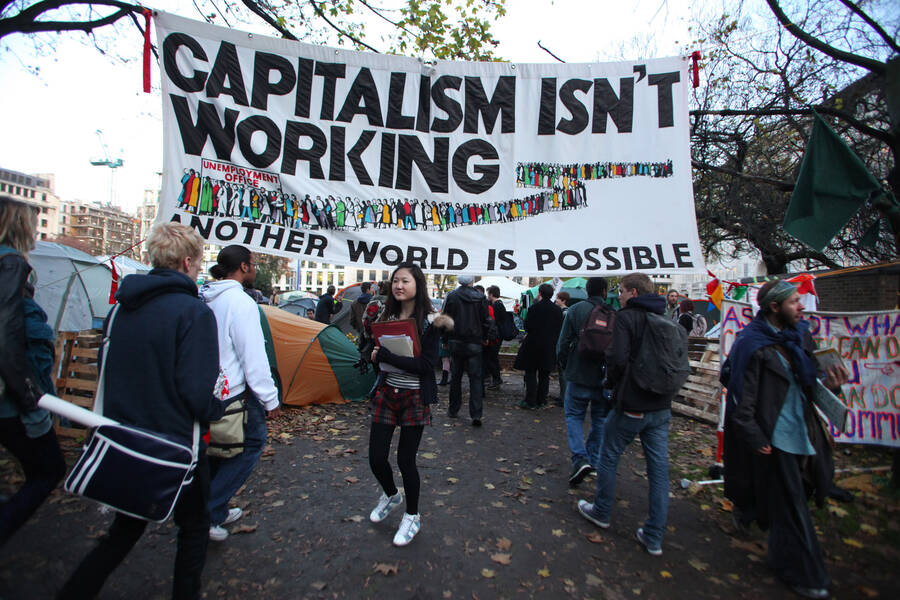
Students arrive at Finsbury Square in London on November 9, 2011 under a banner reading "Capitalism isn't working" for a demonstration against cuts in education funding.GEOFF CADDICK/AFP VIA GETTY IMAGES


This article was produced by Economy for All, a project of the Independent Media Institute.

To grasp the sheer magnitude of U.S. economic inequality in recent years, consider its two major stock market indices: the Standard and Poor (S&P) 500 and Nasdaq. Over the last 10 years, the values of shares listed on them grew spectacularly. The S&500 went from roughly 1,300 points to over 3,800 points, almost tripling. The Nasdaq index over the same period went from 2,800 points to 13,000 points, more than quadrupling. Times were good for the 10 percent of Americans who own 80 percent of stocks and bonds. In contrast, the real median weekly wage rose barely over 10 percent across the same 10-year period. The real federal minimum wage fell as inflation diminished its nominal $7.25 per hour, officially fixed and kept at that rate since 2009.

All the other relevant metrics likewise show that economic inequality in the United States kept worsening across the last half-century. This happened despite concerns” about inequality expressed publicly across the years by many establishment politicians (including some in the new Biden administration), journalists, and academics. Inequality worsened through the capitalist downturns after 1970 and likewise through the three capitalist crashes of this century (20002008, and 2020). Nor did the deadly pandemic provoke soul-searching or policies adequate to stop, let alone reverse, the ongoing redistribution of income and wealth upward.

No advanced economics is required to grasp that divisions, bitterness, resentment, and anger flow from such a persistently widening gap between haves and have-nots. Among millions who search for explanations, many become prey for those mobilizing against scapegoats. White supremacists blame Black and Brown people. Nativists (calling themselves patriots” or nationalists”) point to immigrants and foreign trade partners. Fundamentalists blame those less zealous and especially the non-religious. Fascists try to combine those movements with economically threatened small-business owners, jobless workers, and alienated social outcasts to form a powerful political coalition. The fascists made good use of Trump to assist their efforts.

U.S. history adds a special sharpness to the search for explanations. The dominant argument for capitalism in the 20th century after the 1930s Great Depression was that it produced a great middle class.” Real U.S. wages had risen even during the Depression. They were generally higher than elsewhere across the globe, and especially in comparison with those in the USSR. High wages showed the superiority of U.S. capitalism according to the system’s apologists in politics, journalism, and academia. Demolition of that middle class at the end of the 20th and into the new century pained especially those who had bought the apologies.

And indeed, the Great Depression and its aftermath had lessened inequality significantly, enabling such a defense of capitalism to have some semblance of validity. However, for that defense to be persuasive required two key facts to be forgotten or hidden. The first is that the U.S. working class fought harder for major economic gains in the 1930s than at any other time in U.S. history. The Congress of Industrial Organizations (CIO) then organized millions into labor unions utilizing militants from two socialist parties and a communist party. Those parties were then achieving their largest-ever numerical strengths and social influences. That is how and why together the unions and the parties won the establishment of Social Security, federal unemployment compensation, a minimum wage, and a huge federal jobs program: all firsts in U.S. history. The second fact is that capitalists in the 1930s and afterward fought harder than ever against each and every working-class advance. The middle-class” status achieved by a large portion of the working class (by no means all and especially not minorities) happened despite not because of capitalism and capitalists. But it was certainly clever propaganda for capitalism to claim credit for working-class gains that capitalists tried but failed to block.

The reduction of U.S. economic inequality accomplished then proved temporary. It was undone after 1945. Particularly after 1970, capitalism’s normal trajectory of deepening economic inequality resumed through to the present moment. Simply put, capitalism’s basic structure of production — how it organizes its enterprises — positioned capitalists to reverse the New Deal’s reduction of economic inequality. Much of the temporary U.S. middle class is now gone; the rest is fading fast. Over the last half-century, U.S. capitalism brought inequality to the extremes surrounding us now. No wonder a population once persuaded to support capitalism because it fostered a middle class now finds reasons to question it.

In capitalist enterprises, tiny minorities of the persons involved occupy positions of leadership, command, and control. The owner, the owner’s family, the board of directors, or the major shareholders comprise such minorities: the class of employers. Opposite them are the vast majorities: the class of employees. The employer class determines, exclusively, what the enterprise produces, what technology it uses, where production occurs, and what is done with its net revenue. The employee class must live with the consequences of employers’ decisions from which it is excluded. The employer class uses its position atop the enterprise to distribute its profits partly to enrich itself (via dividends and top executive pay packages). It uses some of its profits to buy and control politics. The goal there is to prevent universal suffrage from moving the economic system beyond capitalism and the economic inequality it reproduces.

Deepening U.S. inequality flows directly from this capitalist organization of production — its class system. Occasionally, under exceptional circumstances, rebellious social movements win reversals of that inequality. However, if such movements do not change the capitalist organization of production, capitalists will render such reversals temporary. To solve the extreme inequality of U.S. capitalism requires systemic change, an end to capitalism’s specific class structure pitting employers against employees. If production were organized instead in enterprises (factories, offices, stores) that were democratized — one worker, one vote — as worker cooperatives, economic inequality could and would be drastically reduced. Democratic decisions over the distribution of individual incomes across all the participants in an enterprise would far less likely give a small minority vast wealth at the expense of the vast majority. The same logic that dispensed with kings in politics applies to employers in capitalism’s enterprises.

Wednesday, March 17, 2021

Rising Food Prices and War ~~ Thom Hartmann and Richard Wolff

https://www.rdwolff.com/thom_hartmann_rising_food_prices_could_bring_world_war


Food lines, growing prices, and widening inequality are all leading to global unrest. Economist Richard Wolff warns that it will only get worse. 

What is the relationship between rising food prices and social unrest? Prices have increased by 2.4% in just February. What does this mean for the economy? What does that mean for the world's hungry? Professor Richard Wolff joined The Thom Hartmann Program to discuss how healthy the economy is for food and whether there is trouble on the way.


Monday, February 15, 2021

The Centers of Global Capitalism Are Migrating Away From the U.S., Europe and Japan ~~ RICHARD D. WOLFF

 https://www.counterpunch.org/2021/02/15/the-centers-of-global-capitalism-are-migrating-away-from-the-u-s-europe-and-japan/

Image by Etienne Girardet.

Modern capitalism began in England in the 17th century and spread eventually throughout the world. Its particular evolution produced a global economy organized around centers and a periphery (colonized economically and often politically as well). In those centers—chiefly Western Europe, North America, and Japan—capitalism concentrated its accumulating assets. Factories, offices, stores, distribution centers, and transport networks built fast-growing cities. Supporting institutions of government, schools and universities, and hospitals likewise grew into the centers of urban capitalism especially in the 19th and most of the 20th century.

However, new centers of capitalism have emerged and grown especially quickly over the last half-century. China, India, and Brazil are leading examples where jobs, real wages, consumption, profits, and investments are growing. Their size and global impact not only make them the new centers of capitalism but also require attaching the adjective “old” to capitalism’s earlier set of centers.

The blunt truth of modern economic development is this: capitalism is leaving its old centers and relocating to its new centers. About this leaving we can and should borrow the phrase: this changes everything.

U.S. capitalism achieved global dominance during the 20th century after two world wars plus anti-colonial movements destroyed the European empires that might have contested for such dominance. Impressive as it was, U.S. capitalism’s dominance did not last long. With no little irony, it was the big capitalists of the old centers whose profit motives led them to leave and help create new centers. The latter’s much lower wages and fast-growing mass consumer markets drew them. Many of the biggest capitalist corporations relocated (or expanded) from the old to the new centers. As those corporations that moved early profited mightily, competitive pressures accelerated other corporations’ decisions to follow their example. Capitalism’s relocation of its centers continues.

The U.S.’s economic footprint in world trade and capital flows has been giving way steadily to other countries’ rising footprints. The global dominance of the U.S. dollar confronts increasing transactions using other currencies. Trump’s wholesale attacks on China via trade wars, tariff impositions, and persecutions of individual Chinese corporations and executives did not stop or change China’s economic development. Neither did the hostile denunciations of China’s policies on Hong Kong, its Uighur minority, intellectual property, and so on. Across 2020, China’s economy grew 2.3 percent while that of the United States fell by 3.5 percent. China’s record on containing COVID-19 proved far superior to that of the United States. In short, no end, let alone reversal, of the relative decline of the United States vis-à-vis China occurred.

The aspects and implications of such relocating capitalist centers touch almost every aspect of our lives. The costs and debts plaguing U.S. higher education contrast sharply with the huge expansion of Chinese higher education. Even starker has been the contrast between China’s preparedness and containment of COVID-19 and that of, say, the U.S. and the UK. Of course, in terms of public health, India and Brazil show that even new centers of capitalism can experience severe difficulties when their governments fail to mobilize both private and public resources to achieve prioritized social goals (like defeating a virus or maximizing sustained economic growth).

Old and new centers of capitalism deserve the same key noun—capitalism—because both organize their enterprises/workplaces in the same dichotomous way. A minority are employers while a majority are employees. The minority decide exclusively what the product will be, what technology will be used, where production will occur, and how net revenues will be distributed (to whom and for what). While old and new centers of capitalism usually display different mixtures of private and state enterprises, it is noteworthy that both types of enterprises in both centers are organized in the same employer/employee dichotomy that defines capitalism.

Declining capitalisms’ problems differ from those of rising capitalisms. In the United States, Western Europe, and even Japan, many capitalist corporations pursue defensive strategies (relocating elsewhere, merging, or shrinking). Cost-saving automation is often the more attractive profit-raising strategy than output expansion. Thus, communities agonize over “runaway shops” and joblessness cutting tax revenue: must they reduce public services or impose rising government debt burdens? Real wages stagnate. The jobless move or emigrate looking for work and disrupting their and their families’ lives. Inequality soars as the top 5 percent (major shareholders, top executives) get most of the profits from relocating capitalism to low-wage countries and from automation. The other 95 percent struggle to minimize the costs and burdens on them from capitalism’s relocating centers and other profit-driven strategies.

In contrast, China, India, and Brazil have the problems of fast-growing capitalism, rather like the problems that beset 19th and early 20th-century capitalism in its old centers. Resistance, unions, and socialist movements arise from workers streaming into cities and industrial jobs and adopting correspondingly new ways of thinking and being. Crowding, environmental pollution, and inadequate housing and sanitation trouble the new centers more or less. Ruthless competition produces horrific working conditions as does internationally mobile capital seeking quick profits. Business cycle instability and deeply embedded tendencies to ever-greater income and wealth inequality provoke social criticisms. The latter are often borrowed and adapted from the labor, socialist, and communist movements that grew in capitalism’s old centers.

On the one hand, the movement of capitalism from old to new centers plunges the old into a long-term decline evident in decaying industries and cities. Politics shifts away from prioritizing growth, adjudicating internal conflicts in ways that reproduce growing capitalism, and shaping the world into a distinctive center-periphery pattern. Instead, policies shift toward maintaining the global status quo against the many forces eroding it. For many politicians that shift of focus degenerates into scapegoating amid cascading social divisions and decay.

On the other hand, capitalism finds profitable new territory in its new centers. Growth there offsets a decline in the old centers. The global 1 percent get richer because they draw increased wealth from both the old and new centers. What happened inside capitalist countries—movements, say, from old Rust Belt centers to new high-tech centers—has been transposed onto the world as a whole.

The great social question is whether the different problems of capitalism in both its old and new centers will cumulatively undermine the system or provide it with a further lease on life. Perhaps growing conflict between old and new centers—expressed, for example, in the struggle between the United States and China—will follow the ancient path from economic to military conflict. Then the great social question will go unanswered and global capitalism would have fulfilled one prophecy of its critics: that its internal contradictions will prove self-destructive.

This article was produced by Economy for All, a project of the Independent Media Institute.

Richard Wolff is the author of Capitalism Hits the Fan and Capitalism’s Crisis Deepens. He is founder of Democracy at Work.

Thursday, February 4, 2021

How Capitalism and Racism Support Each Other ~~ Richard Wolff

https://www.democracyatwork.info/how_capitalism_and_racism_support_each_other

dollar_thumb.jpg

By Richard D. Wolff
This article originally appeared at Truthout.org

Capitalism's supporters use and benefit from a racism whose practice and consequences should be blamed on capitalism itself.

"Racism" is so often applied to US prison statistics and policing; to data on differences in employment, housing, wealth and income distributions, college enrollments, film awards, and so much more; and to hardening hostilities toward immigration. At the same time, racism is so often condemned -- at least in mainstream media, dominant political circles and most intellectual and academic institutions. Racism's persistence where the capitalist economic system prevails raises the question of the connection between capitalism and racism.        

Many societies are structured and operate to subordinate one or more portions of their population -- politically, culturally, economically or in combinations of these ways -- while privileging others. Among the successive generations born into societies with such subordinations, some will challenge and seek to change their condition. Force can try to maintain subordination, but it is costly, dangerous and often unsuccessful. The preferred method has rather been (a) to develop an idea that justifies the subordination and (b) to install that idea as deeply as possible into the thinking of both the subordinated and the privileged.

One such idea is "race," the notion that sets of inherent (often deemed "natural") qualities differentiate groups of people from one another in fundamental ways. This idea of race can then be used to explain the subordination of some and the privileges of others as effects of their racial differences. The concept of race thus accomplishes a reversal: Instead of being a produced idea, an ex-post justification of structures of social subordination, race morphs instead into some pre-existing "reality" thatcaused or enabled the subordination.

We know how and why racism worked often to support slavery around the world and especially in the early United States. Masters endorsed and promoted ideas that justified slaves as subordinated because they were an inferior race. Racist ideology also sometimes supported feudalism by dividing lords and serfs into different races. Indeed, some early capitalist systems likewise racially distinguished employers from employees.

Racism persists in no small part because its benefits to capitalism outweigh its costs.

However, capitalism presents a more complex case, because it often made "individual freedom" central to its supportive ideologies. Opponents of slavery could use that ideology to fight for slavery's abolition. Yet capitalism's history nonetheless keeps exhibiting both the idea of race and racism. And the evidence marshaled by, among others, Manning Marable in How Capitalism Underdeveloped Black America (1983) certainly documents capitalism's subordination of many African Americans. Do racism and capitalism then support one another as per Malcolm X's famous statement, "You can't have capitalism without racism"? Should we follow Adolph Reed Jr.'s perspective (in his 2013 New Labor Forum article "Marx, Race and Neoliberalism") that sees racism as a "historically specific ideology that emerged, took shape, and has evolved as a constituent element within" capitalism?

Answers to these questions emerge from patterns exhibited by capitalism's inequality and instability. Capitalists never could end their system's tendency to generate gross inequality (in wealth and income distributions) nor its instability (in cycles of depression and recession). Both those features of capitalism have contributed to ongoing social injustice and oppositional social movements. Had the heavy burdens of recurring business cycles (periodic unemployment and its multiple consequences) been distributed roughly equally or randomly across societies where capitalism prevailed -- threatening and frightening everyone -- those oppositional movements might well have gathered the broad support needed to consign capitalism to an early demise.

However, those burdens were never distributed equally or randomly. Some suffered them disproportionally and repeatedly, resulting in social subordination. Others were relatively privileged, exempted from those burdens partially or totally. Yet, in their struggles to displace slavery and feudalism as societies' prevalent pre-capitalist economic systems, supporters of capitalism had often promised that it would differ from those systems by guaranteeing everyone liberty, equality and brotherhood or solidarity. What capitalism achieved contradicted that promise.

The burdens of capitalism's instability fell much harder on employees than employers, and much harder upon some employees than others. Capitalism thus always faced a basic legitimation problem. How could it justify its unequal distributions of income, wealth and the burdens of its systemic instability among the people whose condition of being "free and equal" capitalism was supposed to guarantee?

One of the major means of managing this legitimation problem has been an ideology of race (alongside other ideologies centered around concepts such as "productivity" and "meritocracy"). Capitalism repurposed race and racism. By dividing human beings, conceptually and practically, into intrinsically different subgroups, capitalism's defenders could explain and justify why its economic benefits (e.g. the status of employer rather than employee) and burdens (unemployment, poverty etc.) were so unequally distributed (both within countries and globally). Employers, politicians, academics and journalists reinforced the notion that the cause, fault or blame for that unequal distribution lay with racially differentiated characteristics, not with the capitalist system.

Certain population groups -- conceived as races -- were deemed underdeveloped, incapable, irrational and/or psychologically disqualified in relation to capitalism's productive rigors. Such presumed inferiority was then offered as an explanation for why people of some races were rarely employers and, among employees, were those last hired and first fired, poorly paid, ghettoized etc.

Such races -- often non-whites -- were, in effect, assigned to play the role of shock absorbers in and for capitalist business cycles. They still are: A 2016 report from the University of Illinois, using the racialized differentiations, documents how young people of color in the United States continue to face significantly higher rates of unemployment and lower employment per population ratios than young white people do.

In the United States, most white employees have been spared constantly fearing and periodically suffering unemployment and its consequences. A minority of white employees shares the fate of a huge portion of the "shock absorber" races. That fate comprises job insecurity, recurring unemployment and its consequences: loss of skills, job connections and promotions; descent into hopelessness and desperation; turning toward illegal revenue-generating activities; policed into disproportionate incarceration; etc. By concentrating both poverty and the business cycle shock absorber role in certain subgroups of their populations and by using racism to explain that concentration, capitalist societies "manage" the risks attending their tendencies to gross inequality and instability.

Some conservatives and right-wingers further legitimate capitalism by reframing their racism. For them "the problem" is that capitalism has not been allowed to work its healing magic -- market discipline -- upon those inferior groups. Misguided social protections, minimum wages, safety nets, welfare etc. have kept them inside a "culture of poverty" defined as recurring unemployment, poverty, social isolation, family instability, incarceration etc. By correcting (i.e. removing) those misguided and counterproductive social protections, capitalism's disciplines would integrate them into prosperity and growth. That this has not happened for most subordinate groups is blamed on the depth of their racialized inferiority and/or the legacy of liberals' imposition of a culture of poverty.

In contrast, liberals and social democrats who accept the concept of race have mostly sought to ameliorate the sufferings of the unemployed and poor by policies such as education, welfare and training. Such policies likewise rarely succeeded either generally or enduringly. They could not overcome the system's reproduction of poverty and unemployment and the imposition of them disproportionally on the shock absorber "races." Both conservatives and liberals have enforced a shared denial of the mechanisms of mutual support between capitalism and racism.

Of course, capitalism is not the only cause or source of racism, but ignoring or minimizing its role only perpetuates racism. By designating some members of society to be shock absorbers of recurring business cycles, the capitalist system creates legacies of trauma and inequality that can accumulate into dysfunctional qualities for its victims. There is neither need nor warrant to take those qualities as givens, nor to transform them into racialized attributes. The solution is rather to treat those legacies as among the profoundly unacceptable consequences and costs of capitalism's profoundly divisive inequality and instability.

A capitalism that perpetuates itself via racism incurs huge self-protection costs: to police and imprison or to provide some safety nets for its shock absorber "races" or varying combinations of both. When capitalists shift some or all of those costs onto the tax obligations of workers, more social tensions emerge. Workers are then told their tax payments must compensate for the "deficiencies" attributed to the shock absorber "races" rather than to the structural irrationalities of capitalism. Racial conflicts then preclude or tear apart working-class political unity. Racism persists in no small part because its benefits to capitalism outweigh its costs, or at least those costs capitalists have to bear.

When capitalists and their ideological supporters disavow racism, they carefully ignore capitalism as a key part of the problem. They point instead to the intolerance of "some people who lack compassion for the less fortunate." Thereby they further divide the working class, in effect, into one race that cannot or will not work hard (and is therefore unemployed and poor) and another race that lacks compassion. In comparison, capitalists and their supporters congratulate themselves for their superior morality.

Capitalism thus comes full circle. Its supporters use and benefit from a racism whose practice and consequences they blame exclusively on others but never on capitalism itself.

Sunday, January 31, 2021

The U.S. Economy Excels at One Thing: Producing Massive Inequality ~~ RICHARD D. WOLFF

https://www.counterpunch.org/2021/01/29/the-u-s-economy-excels-at-one-thing-producing-massive-inequality/


Photograph by Nathaniel St. Clair

To grasp the sheer magnitude of U.S. economic inequality in recent years, consider its two major stock market indices: the Standard and Poor (S&P) 500 and Nasdaq. Over the last 10 years, the values of shares listed on them grew spectacularly. The S&P 500 went from roughly 1,300 points to over 3,800 points, almost tripling. The Nasdaq index over the same period went from 2,800 points to 13,000 points, more than quadrupling. Times were good for the 10 percent of Americans who own 80 percent of stocks and bonds. In contrast, the real median weekly wage rose barely over 10 percent across the same 10-year period. The real federal minimum wage fell as inflation diminished its nominal $7.25 per hour, officially fixed and kept at that rate since 2009.

All the other relevant metrics likewise show that economic inequality in the United States kept worsening across the last half-century. This happened despite “concerns” about inequality expressed publicly across the years by many establishment politicians (including some in the new Biden administration), journalists, and academics. Inequality worsened through the capitalist downturns after 1970 and likewise through the three capitalist crashes of this century (2000, 2008, and 2020). Nor did the deadly pandemic provoke soul-searching or policies adequate to stop, let alone reverse, the ongoing redistribution of income and wealth upward.

No advanced economics is required to grasp that divisions, bitterness, resentment, and anger flow from such a persistently widening gap between haves and have-nots. Among millions who search for explanations, many become prey for those mobilizing against scapegoats. White supremacists blame Black and Brown people. Nativists (calling themselves “patriots” or “nationalists”) point to immigrants and foreign trade partners. Fundamentalists blame those less zealous and especially the non-religious. Fascists try to combine those movements with economically threatened small-business owners, jobless workers, and alienated social outcasts to form a powerful political coalition. The fascists made good use of Trump to assist their efforts.

U.S. history adds a special sharpness to the search for explanations. The dominant argument for capitalism in the 20th century after the 1930s Great Depression was that it “produced a great middle class.” Real U.S. wages had risen even during the Depression. They were generally higher than elsewhere across the globe, and especially in comparison with those in the USSR. High wages showed the superiority of U.S. capitalism according to the system’s apologists in politics, journalism, and academia. Demolition of that middle class at the end of the 20th and into the new century pained especially those who had bought the apologies.

And indeed, the Great Depression and its aftermath had lessened inequality significantly, enabling such a defense of capitalism to have some semblance of validity. However, for that defense to be persuasive required two key facts to be forgotten or hidden. The first is that the U.S. working class fought harder for major economic gains in the 1930s than at any other time in U.S. history. The Congress of Industrial Organizations (CIO) then organized millions into labor unions utilizing militants from two socialist parties and a communist party. Those parties were then achieving their largest-ever numerical strengths and social influences. That is how and why together the unions and the parties won the establishment of Social Security, federal unemployment compensation, a minimum wage, and a huge federal jobs program: all firsts in U.S. history. The second fact is that capitalists in the 1930s and afterward fought harder than ever against each and every working-class advance. The “middle-class” status achieved by a large portion of the working class (by no means all and especially not minorities) happened despite not because of capitalism and capitalists. But it was certainly clever propaganda for capitalism to claim credit for working-class gains that capitalists tried but failed to block.

The reduction of U.S. economic inequality accomplished then proved temporary. It was undone after 1945. Particularly after 1970, capitalism’s normal trajectory of deepening economic inequality resumed through to the present moment. Simply put, capitalism’s basic structure of production—how it organizes its enterprises—positioned capitalists to reverse the New Deal’s reduction of economic inequality. Much of the temporary U.S. middle class is now gone; the rest is fading fast. Over the last half-century, U.S. capitalism brought inequality to the extremes surrounding us now. No wonder a population once persuaded to support capitalism because it fostered a middle class now finds reasons to question it.

In capitalist enterprises, tiny minorities of the persons involved occupy positions of leadership, command, and control. The owner, the owner’s family, the board of directors, or the major shareholders comprise such minorities: the class of employers. Opposite them are the vast majorities: the class of employees. The employer class determines, exclusively, what the enterprise produces, what technology it uses, where production occurs, and what is done with its net revenue. The employee class must live with the consequences of employers’ decisions from which it is excluded. The employer class uses its position atop the enterprise to distribute its profits partly to enrich itself (via dividends and top executive pay packages). It uses some of its profits to buy and control politics. The goal there is to prevent universal suffrage from moving the economic system beyond capitalism and the economic inequality it reproduces.

Deepening U.S. inequality flows directly from this capitalist organization of production—its class system. Occasionally, under exceptional circumstances, rebellious social movements win reversals of that inequality. However, if such movements do not change the capitalist organization of production, capitalists will render such reversals temporary. To solve the extreme inequality of U.S. capitalism requires systemic change, an end to capitalism’s specific class structure pitting employers against employees. If production were organized instead in enterprises (factories, offices, stores) that were democratized—one worker, one vote—as worker cooperatives, economic inequality could and would be drastically reduced. Democratic decisions over the distribution of individual incomes across all the participants in an enterprise would far less likely give a small minority vast wealth at the expense of the vast majority. The same logic that dispensed with kings in politics applies to employers in capitalism’s enterprises.

Saturday, January 23, 2021

US Capitalism’s Decline and Desperate Efforts to Save It [January 2021]. ~~ Richard Wolff

 https://www.youtube.com/watch?v=0EC1KMfUECw&authuser=0

Essay to support Richard Wolff monthly talk for January, 2021 ~~ Written by dmorista


This is an hour and twenty minute talk by noted Marxist Scholar Richard Wolff.  He traditionally presented about an hour and a half lecture / discussion, once a month, at Manhattan's Judson Memorial Church.  The Covid-19 situation changed that and now the monthly lecture is presented on-line.


In this discussion Dr. Wolff spends the first 10 minutes or so talking about Advertising and how it affects the price of many items that the Capitalists sell.  Then he spends another 15 minutes talking about how the military is deeply embedded in the U.S. political system, despite the various protestations by military leaders that they would not intervene in the U.S. Presidential election of 2020.  He also discusses the letter signed by the ten living former Secretaries of Defense (they really should be called the Secretaries of Attack) that extolled the “tradition of civilian control of the military”, and proclaimed that the military would make a grave mistake if it actually intervened in the election.


Wolff spends nearly an hour discussing the socioeconomic background for the “election” of Donald Trump in 2016.  This included Trump's usefulness to the Capitalist elites and how that usefulness declined precipitously after the second or third year.  He also talked about the “American Drean”, and how that came to an end for most working Americans after about 1970; when the terms of global trade, and the temporary advantages that the U.S. held for 25 years changed dramatically.  He addresses the questions of falling  or stagnant U.S. real incomes, particularly for American working class men.  He takes up the issues of women entering the workforce in large numbers, automation and the elimination of many “good” jobs, and the deindustrialization of the U.S. with large numbers of factories, and entire industries moving to other places.  That was most notably to China, but to many other places as well.  He chickens out this time and does not discuss the massive immigration into the U.S. since the 1965 Immigration Law changes, the numerous failed colonial wars, coups, death squad campaigns etc.  However he has included that issue in previous talks and written articles.  It is one of four changes that Wolff pointed out had undermined the American Working Class: 1). Women enter workforce in huge numbers; 2). Many blue-collar jobs and lower level white-collar jobs lost to automation and computerization; 3). Many jobs lost to “runaway plants” that moved to low-wage low-regulation places in the “developing world”; and 4). nearly 60 million legal immigrants and something on the order of 20 million undocumented immigrants make the economic position, particularly of less-well educated Americans increasingly difficult.  


He discussed the fact that many White Working Class Americans feel robbed and cheated by these developments (that have been going on for 50 years now, he uses the figure of 40 years but states that the process began in 1970).  He mentioned that unless basic structural changes are made in the U.S. socioeconomic system that the far-right will be back with a new Fascist / Authoritarian leader.  This is in contrast to what happened during the last crisis of this gravity in the 1930s led to the New Deal in the U.S. and the Nazi takeover in Germany.  The U.S. has no organized left to present a coherent analysis and to organize left-led resistance and demands.  He states that he thinks the solution is to “democratize the workplace” and end the rule of Private Capitalists.  He admits that this is a very dangerous time for American society.  He does not look at the events at the Capitol in any great detail, but puts them in the larger context noted above