Showing posts with label Work. Show all posts

Saturday, August 28, 2021

Can ordinary people run society? ~~ Paul D'Amato

https://socialistworker.org/2007-1/620/620_11_RunSociety.php

A COMMON argument against socialism is that the majority is incapable of ruling collectively. We need educated, intelligent experts to run such a complex system.

The legendary stupidity of George W. Bush, whose rich parents and crony friends bought him passing grades and much more, or the incompetence of Federal Emergency Management Agency bureaucrats during Hurricane Katrina in 2005 are both strong arguments against this view.

"I think we are welcomed," said Bush when asked about Vice President Dick Cheney's predictions that U.S. troops would be greeted with thanks by Iraqis. "But it was not a peaceful welcome." When Brazilian President Luiz Ignácio "Lula" da Silva showed him a map of Brazil, Bush exclaimed, "Wow! Brazil is big."

There are many other examples that could be cited of presidents, industrialists and bureaucrats with limited, if non-existent, abilities.

Most people at the very top of society, the multimillionaires and billionaires, play no direct function in its running--they merely collect the rewards of ownership. The ruling class today has become entirely parasitic, siphoning wealth, but serving no useful social function.

As early as 1881, Frederick Engels wrote that the capitalists do little but cash in dividend checks. "The social function of the capitalist here," he says, "has been transferred to servants paid by wages; but he continues to pocket, in his dividends, the pay for those functions though he has ceased to perform them."

"We [can] manage very well without the interference of the capitalist class in the great industries of the country," Engels concluded. "Stand back! Give the working class the chance of a turn."

Bankers and investors don't make steel. It hardly takes intellectual brilliance for some who inherits a million to double it. Society could do away with the ruling class and suffer no more than when an appendix is removed from a human body.

- - - - - - - - - - - - - - - -

BUT DO workers possess the capacity to rule? Won't they still depend on experts?

Often, it is workers' own hard-won, first-hand knowledge that engineers and managers use to figure out how to improve production--that is, to squeeze as much out of workers as possible.

Not to deny the genius of a Newton or an Einstein, but "if science is understood in the fundamental sense of knowledge of nature," writes Clifford Connor in his People's History of Science, " it should not be surprising to find that it originated with the people closest to nature: hunter-gatherers, peasant farmers, sailors, miners, blacksmiths, folk healers and others forced by the conditions of their lives to wrest the means of their survival from an encounter with nature on a daily basis."

Given the opportunity, everyone is capable of learning the scientific, administrative and mathematical skills necessary to play a direct role in running society, just as in pre-class society, knowledge of terrain, plants and animals or tool-making was shared by the group, and not treated as the monopoly of a minority.

Experts and scientists would still be needed for a time even under socialism, until the education system was improved to the point that the majority received education which today is reserved only for the privileged few. For a time, workers would have to exercise democratic control over the bookkeepers, managers and engineers.

But with society's vast resources diverted toward education, the distinctions between mental and manual work would break down, and the majority would be capable of doing many different kinds of jobs, from manual work to scientific work to administrative work.

If workers, through their own directly elected representatives, were to seize control of production, mistakes would no doubt be made. But they would be the mistakes of the collective rather than the blind workings of the market--and could quickly be remedied by experience.

For example, if the workers of Chicago ran the city instead of corporate bigwigs and their corrupt political hirelings, they would immediately begin solving the city's most pressing problems.

The homeless would be quickly housed in unused homes, excess hotel space, and the requisitioned second and third homes of the rich. Meanwhile, unemployed construction workers would be organized to begin building more houses.

The ill-gotten gains of the city's patricians and their hangers-on would be seized and used to provide jobs, feed the hungry, improve dilapidated schools and provide better park services, improved transportation and real after-school programs for all.

In our society nothing is done if it isn't profitable. In a society run by the collective producers, these problems could be solved because social need, rather than the market, would determine how decisions are made.

Thursday, June 17, 2021

The WPA’s Federal Theatre: Creating Jobs and Creative Achievement ~~ TRUDY GOLDBERG and SHEILA COLLINS

https://njfac.org/index.php/2021/06/10/the-wpas-federal-theatre-creating-jobs-and-creative-achievement/

~~ posted for collectivist ~~

Hallie Flanagan

Hallie Flanagan, Director of the FTP
Flanagan on CBS Radio for the Federal Theatre of the Air, 1936. Courtesy, Wikipedia Commons.


By TRUDY GOLDBERG and SHEILA COLLINS

A brief but spectacular achievement, the New Deal’s Federal Theatre Project (FTP) (1936-1939) provided jobs for some 13,000 destitute people at its height and created and produced 63,600 performances of 1,200 major theatrical works. It reached audiences of more than 30 million people in cities, towns, and rural areas nationwide, the vast majority of whom had never experienced live theater. With unemployment in the arts cutting deeper than in other hard-hit industries, the New Deal approach to unemployment among theatre people takes on new relevance.

The U.S. Congress funded the Federal Theatre Project primarily to provide jobs for unemployed theatre people during the Great Depression. But WPA administrator Harry Hopkins and the FTP’s dynamic director Hallie Flanagan had a much broader mission: to create a publicly funded national theater, accessible to all, that would both entertain and strengthen public dialogue and democracy.

Flanagan had achieved noteworthy results as director of Vassar College’s Experimental Theater, largely with amateurs and low cost. Along with her wide knowledge of the theatre, including European dramatic experiments, she was well prepared for the challenges of founding a national theater.

Harry Hopkins and Hallie Flanagan

Harry Hopkins and Hallie Flanagan
In the lobby of the Experimental Theater, New York City, 1936. Courtesy, NARA.

But the task was daunting—meeting the primary goal of employing jobless theatre people and at the same time achieving quality productions, surmounting funding and bureaucratic hurdles, and responding to union demands while striving for her own broader artistic vision and social goals that evoked criticism and even charges of subversion.

Ninety percent of those employed by the FTP came from the relief rolls. Though several future stars got their start with the FTP, it was not easy to hire top talent. It could be more time-consuming to determine eligibility for an FT hire than a construction worker. Plus, there was the need to hold auditions.

The FTP still stands out for an enlightened racial policy that differed significantly from other New Deal programs. African Americans received equal pay for equal work in every aspect of theatrical production. Audiences were integrated. If a theatre refused to seat Blacks and whites together, the Federal Theatre canceled the performance. Moreover, some of the plays dramatized African Americans’ resistance to white oppression, previously unheard of in American theater.

Federal Theatre Circus 
New York City, probably 1936. Courtesy, Coast to Coast: The Federal Theatre Project, 1935-1939, Library of Congress.

According to Rosetta LeNoire, who acted in one of the Negro Units, “It was the Federal Theatre that gave us so many of our great actors because they were permitted to play roles that they would never have been offered on Broadway.”

Witches’ scene from Voodoo Macbeth
Adapted by Orson Welles, New York City, 1936. Courtesy, Library of Congress.

The repertoire of the Federal Theatre and its national scope are astounding. Productions ranged from circuses, puppet shows, children’s plays and vaudeville to classic works—both traditional and reinterpreted, such as “Voodoo Macbeth,” set in Haiti with the witches invoking voodoo to conjure up their “toil and trouble,” and “Swing Mikado,” set on a Pacific South Sea island, instead of Japan.

There were also modern dramas unlikely to play commercially, such as T.S Eliot’s “Murder in the Cathedral” and the staging of Sinclair Lewis’s anti-fascist novel, “It Can’t Happen Here.”

It Can't Happen Here

It Can’t Happen Here.
By Sinclair Lewis, Jewish Theatre Unit production, 1935. Courtesy, Federal Theatre Project, FDR Library.

The Lewis play opened in 21 theatres in 17 states and was performed in English, Spanish and Yiddish—a significant step toward Flanagan’s goal of a national theatre reflecting the ethnic diversity of the country.

The FTP also found creative ways to take theatre to new audiences. New York City’s Caravan Theatre used tractors to tow collapsible trailers storing costumes, props, and stages for outdoor performances at parks, baseball fields, and blocked-off streets.

The FTP’s accomplishments extended to experimental theater. “The Living Newspaper” dramatized current events using newsreels, still photographs, live actors, music, and song. Playwright Arthur Miller, who joined the Federal Theatre as a jobless college graduate, considered “The Living Newspaper” “the one big invention of the theatre in our time.”

Living Newspaper

Living Newspaper, One-Third of a Nation
Depicting a tenement fire, New York City, 1938. Directed by Arthur Arent, setting by Howard Bay, costumes by Rhoda Rammelkamp. Courtesy, Coast to Coast: The Federal Theatre Project, 1935-1939, Library of Congress.

Despite scrupulous adherence to the facts and even canceling some of the more “hysterical” productions, the FTP came under investigation by the House Un-American Activities Committee (HUAC).  HUAC charged that the plays were “propaganda for Communism.” Flanagan countered that they were “propaganda for Democracy.”

As HUAC’s attack on the FTP and the consequent defunding of the theater show, government support for a national theater likely would be as problematic today as it was then. Some large, public-spirited foundations would need to sponsor such a revival. Surely, factual and dramatic presentations of current events—like the Living Newspaper– could counter the ubiquitous sensational lies to which the American public is routinely subjected. As recent tragic events demonstrate, Americans are no less in need of “propaganda for Democracy” than during the Great Depression.

Swing Mikado

Swing Mikado
Directed by Harry Minturn. Courtesy, Coast to Coast: The Federal Theatre Project 1935-1939, Library of Congress.

Federal Theatre Director Flanagan stars–not only as a revolutionary force in the American theatre–but as one who recognized the role of art and culture in strengthening democracy and the national character.  Under Flanagan’s leadership, the Federal Theatre was such a force—albeit for too short a time.

New Deal government job creation is the model for achieving a current federal Job Guarantee or useful, living-wage employment for all. It is a model for employing jobless people and at the same time building the nation’s physical, environmental, social, and cultural resources. The Federal Theatre is proof that both goals can be successfully achieved. How about a New Deal model to revive the post-pandemic American theatre.

This article is condensed from an essay by Collins and Goldberg to be published in an e-book series, E-Theatrum Mundi, ed. by Emeline Jouve and Géraldine Prévot, Sorbonne University Press, 2022. An earlier version of this article appeared as “The Federal Theatre: Where Art Went Live, in The Fireside, May 1, 2021, a monthly newsletter of the nonprofit Living New Deal, livingnewdeal.org.


Monday, June 7, 2021

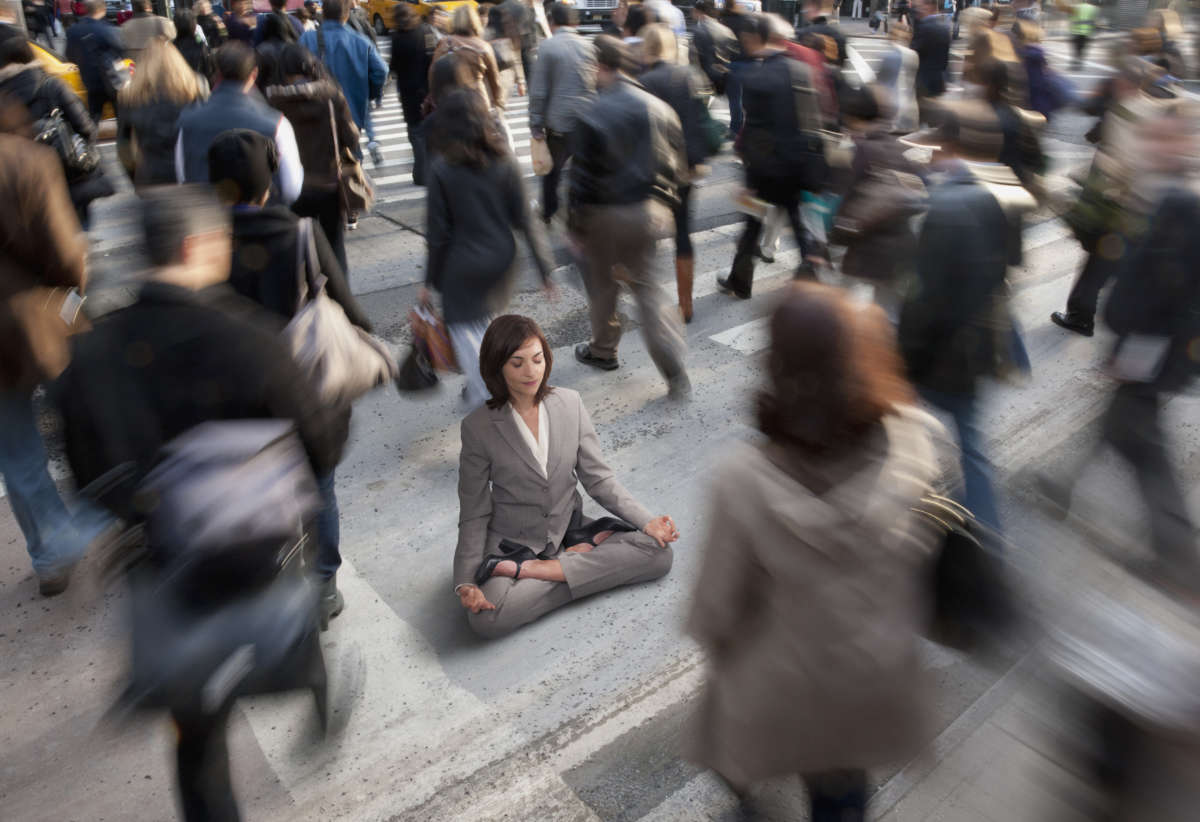
Corporations Are Trying to Co-opt Mindfulness to Avoid Meeting Workers’ Needs ~~ Robert R. Raymond

https://truthout.org/articles/corporations-are-trying-to-co-opt-mindfulness-to-avoid-meeting-workers-needs/

~~ posted for collectivist ~~

Toiling under surveillance, Amazon workers watch company videos about mindfulness in “ZenBooths” in the warehouses.


It’s 6 a.m. You’re just arriving to your workplace, a 1 million-square-foot warehouse known as an Amazon fulfillment center. As a stower for Amazon, your job is to take the hundreds of items per hour that arrive at your roughly 10-foot-sized station and sort them onto shelves. As you start your shift, the loud sounds of Amazon’s mobile fulfillment robots, which deliver the items to you, reverberate throughout the warehouse. Above, a surveillance camera monitors your activity. You can feel its presence as you try to hit your production quotas for the day, knowing that if you don’t you could be fired automatically.

You do this for 12 hours with just a few breaks. When your shift is over, you drive home, exhausted and sore from the monotony and repetitive physical motions. The tendons in your wrists are aching, you feel anxious and stressed. “They should be paying me more for this,” you’re just about to sigh, when you get a notification from your phone. It’s a reminder to begin your nightly meditation, coming not from a Headspace app, but from an app named “AmaZen,” part of Amazon’s new WorkingWell program designed to address worker’s health issues.

Amazon’s WorkingWell program is just part of a much broader trend taking place throughout the corporate landscape encouraging workers to utilize activities such as yoga, meditation and mindfulness to reduce work-related stress and improve performance. Author and professor of management Ron Purser refers to this phenomenon as “McMindfulness,” a co-opting of Buddhist spiritual traditions by corporations, schools, and even the military and police departments, in order to persuade and manipulate workers into conformity. This a stark departure from meditation as part of a spiritual practice which aims at knowledge of the mind and reality as an end in itself.

“The WorkingWell program at Amazon is a glaring example of the hidden ideology behind these mindfulness programs — that it’s the individual who needs to adapt to toxic, unfair and dangerous working conditions,” Ron Purser told Truthout. “These programs treat stress as a maladaptation of the individual, not as a symptom of structural and systemic issues, whether it’s gross inequities or whether it’s workplace stressors. It’s a neoliberal, privatized view of stress. And that’s why we see corporate mindfulness programs being so lucrative and so market friendly — because basically they take what is a structural problem and reframe it as an individual problem.”

Amazon has stated that the WorkingWell program was initiated to address the soaring rates of workplace injuries that occur inside of the company’s fulfilment centers — particularly musculoskeletal injuries such as carpal tunnel syndrome and back pain. The program includes meetings covering health and safety topics, spaces for stretching or meditating, and a meditation app called “AmaZen,” all of which are promoted as producing better health outcomes.

The WorkingWell program features “ZenBooths” located in warehouses, where workers can watch company videos about mindfulness while a fan whirrs overhead. These coffin-size booths — which skeptics refer to as crying rooms, screaming chambers, Porta-panic rooms, or even just plain old Porta Potties where employees can urinate into bags — are portrayed as ephemeral escapes from otherwise woeful working conditions.

It’s not so much that any of these tools are bad in and of themselves — meditation and mindfulness have been shown to reduce stress in other contexts. The problem is that nothing in the WorkingWell program actually addresses the root causes driving the 14,000 serious workplace injuries that took place at Amazon facilities in 2019 or the high levels of stress that come with long shifts, demanding work conditions and intensive surveillance.

“It’s sort of like lipstick on a pig, or a Band-Aid over a gaping wound,” Beth Gutelius, research director at the Center for Urban Economic Development at the University of Illinois at Chicago, told Truthout. “If you listen to workers, the root cause of their psychological stress is the pace of work, it’s the feeling of an algorithm sitting on your shoulder constantly and surveilling your every movement.”

The extensive monitoring that takes place in Amazon’s warehouses compels workers to keep up with their robot co-workers — machines that are not impeded by actual human constraints such as, say, having to use the bathroom. They even utilize complex surveillance systems to track warehouse workers’ “time off task” — the amount of time they are not directly working, which is sometimes calculated down to the seconds.


“The pace of work in these warehouses is relentless,” Gutelius said. “They push workers to such an extent that they end up having to risk their bodies and all these health and safety hazards in order to keep up with the pace of work that’s been set by the software, by the algorithms.”

Of course, these kinds of inhumane workplace conditions are nothing new — workers both here in the U.S. and also globally have been subjected to dangerous and soul-sucking work conditions, stretching back through history. What is new, however, are the particular tactics deployed by employers and managers to keep these workforces in line — in effect using a distorted version of “mindfulness” as a way to launder Gilded Age-era dystopian working conditions.

“Throughout the 20th and 21st centuries we’ve seen management consultants and trainers — the handmaidens of corporations — try to find ways to persuade and manipulate employees, to tap into their inner lives, so that they’re in conformity with corporate directives,” Purser said. “McMindfulness is just the latest version of this. It’s a highly instrumentalized technique that can be exploited to serve as a way of suppressing dissent or deflecting it from the organizational stressors — the problems that go beyond the fault of the individual.”

Amazon’s WorkingWell program checks all the boxes when it comes to McMindfulness, but it’s hardly the only program that has co-opted and decontextualized certain elements of Buddhist practice to benefit the owners of capital. Early last year, Starbucks baristas began complaining about how shift cuts and understaffing were leaving them overworked, underpaid and ineligible for health benefits. After the workers created a petition demanding that the coffee giant do something about its “lack of labor” and “sinking morale,” Starbucks finally responded by announcing that the company would provide free access to the meditation app Headspace.

And it’s not just in the corporate sector — police departments have begun utilizing meditation as a tactic to improve “performance” in an inherently violent field. For example, in 2019, the Minneapolis Police Department began requiring police officers to attend mindfulness workshops as part of implicit-bias and de-escalation trainings. Mindfulness is even being used by the U.S. military to help soldiers “gain focus and reduce distraction” as they engage in imperialist state violence.

“Once mindfulness is decontextualized and reduced to an instrumentalized technique, it can then be applied in any context without any critical question for the ends that it serves,” Purser said. “So then you can use mindfulness in the U.S. military, the U.S. Marines can use it to optimize warrior performance, or a hedge fund manager can use it to get a mental edge — whatever it may be.”

This strategic decontextualization and instrumentalization of mindfulness is one of the most nefarious aspects of “McMindfulness,” according to Purser.

“Mindfulness has been turned into an instrumentalized technique that’s completely decontextualized from any sort of social and moral grounding,” Purser said. “By selectively uprooting it from its grounding in ancient religious traditions, the West culturally appropriated mindfulness for clinical applications and for bringing into corporations, public schools, the government.”

Of course, corporate mindfulness programs like WorkingWell are not just co-opting and weaponizing mindfulness as a sort of empty gesture — there’s a profit incentive to these programs as well. In a 2002 report titled “What Your Disaffected Workers Cost,” Gallop estimated that the lower productivity of actively disengaged workers penalizes U.S. economic performance by about $300 billion. Further, The American Psychological Association estimates that more than $500 billion is lost because of workplace stress. With numbers like that, it’s not hard to imagine why companies like Amazon and Starbucks are interested in creating a pacified, docile workforce: It benefits the bottom line.

If companies like Amazon truly cared for their employees’ well-being, there are a number of much more effective solutions they could be exploring. It has been documented through hundreds of studies that the most significant contributions to workplace stress are lack of health insurance, threats of layoffs, job insecurity, a lack of autonomy, long work hours, unrealistic job demands and bad bosses.

“None of those are psychological, individualistic problems — those are problems with corporate culture policy,” Purser said. “Mindfulness programs just cannot address these structural problems — they require more of a systems approach, a holistic approach to diagnosing these stresses and actually doing something about it.”

Of course, mindfulness and meditation are powerful tools linked to positive health outcomes. But like any tools, when uprooted and stripped of any moral or ethical context, they can be used in misguided and dangerous ways. Should Starbucks employees get free access to Headspace? Sure. Will the “AmaZen” app be useful to certain employees? Probably. But neither of these programs will address the root causes of poor mental and physical health outcomes for workers.

Saturday, May 15, 2021

How Corporations Pumped Up CEO Pay While Their Low-Wage Workers Suffered in the Pandemic ~~ SARAH ANDERSON

https://www.counterpunch.org/2021/05/14/how-corporations-pumped-up-ceo-pay-while-their-low-wage-workers-suffered-in-the-pandemic/

~~ posted for collectivist ~~

Sarah Anderson directs the Global Economy Project at the Institute for Policy Studies.

Friday, February 12, 2021

End the Subminimum Tipped Wage ~~ REBEKAH ENTRALGO

 https://www.counterpunch.org/2021/02/12/end-the-subminimum-tipped-wage/

If it’s passed by Congress, President Joe Biden’s COVID-19 relief proposal would do a lot more than fund relief payments and vaccine rollouts. It would also raise the wage floor for all U.S. workers — and give a particularly long overdue raise to restaurant servers, taxi drivers, manicurists, and other tipped workers.

For Tanya Wallace-Gobern, getting rid of the subminimum wage for tipped workers is a matter of racial justice. “Passing a living wage bill for tipped and non-tipped low-wage workers is essential to reducing inequality,” she said in a recent briefing.

As the executive director of the National Black Worker Center Project, Wallace-Gobern oversees a network of eight centers across the country that aim to build power and transform working conditions for Black workers. The subminimum federal wage for tipped workers, which has been stuck at just $2.13 since 1991, is a clear barrier to their goals.

While employers are technically supposed to make up the difference if workers don’t earn enough in tips to reach the current $7.25 federal minimum, this rule is largely unenforced.

Meanwhile, studies have long found a racial bias in tipping. A survey by One Fair Wage found that prior to the pandemic, 60 percent of Black tipped workers earned less than $15 per hour, compared to 43 percent of white tipped workers. And since the pandemic, 88 percent of them have seen their tips plunge by half or more.

The legislative vehicle for the Biden plan, the Raise the Wage Act, would boost the overall federal minimum wage to $15 by 2025. For tipped workers, it would rise to $4.95 this year and then by $2 per year until it matches the overall $15 minimum in 2026.

The subminimum tipped wage is a shameful relic of slavery. Tipping became prevalent in the United States only after the Civil War, when restaurants and railway companies embraced the practice because it meant they didn’t have to pay wages to recently freed slaves.

That past hangs heavily over many Black workers.

“Let’s face it,” Wallace-Gobern told me, “50 years after President Lyndon B. Johnson declared a war on poverty, Black people in the South still contend with economic hardships, persistent poverty, and the enduring legacy of slavery.”

Wallace-Gobern, who is based in Raleigh, North Carolina, argues that policies designed to empower Black workers will help every other worker, too.

“Black workers are the canaries in the economic coalmine of our country,” Wallace-Gobern said. “When the canary died, that was a signal that the conditions were bad for the miners. That’s the role Black workers play. If you improve their working conditions, that will lift all workers.”

New studies agree with her.

The Economic Policy Institute estimates that nearly a third of all Black workers would get a raise under the Raise the Wage Act. The Congressional Budget Office estimates that it could also raise wages for 17 million workers overall. Another 10 million workers earning just above $15 could also see an increase.

With the National Black Worker Center Project, Wallace-Gobern is aiming to strengthen the capacity of Black worker centers to win minimum wage increases, build up a cadre of civil rights organizers, and advance a Southern strategy on racial justice and democratic freedoms.

The challenges are many. Particularly in the South, worker advocates are up against anti-union “right to work” laws and “pre-emption” restrictions that block cities from improving labor protections at the local level. But Wallace-Gobern is optimistic about the future.

Young people “are ready to lead if we step aside and give them space,” she remarked. “I welcome the opportunity for them to stand on our shoulders and take us to heights that I and my grandparents could never imagine.”

Saturday, January 30, 2021

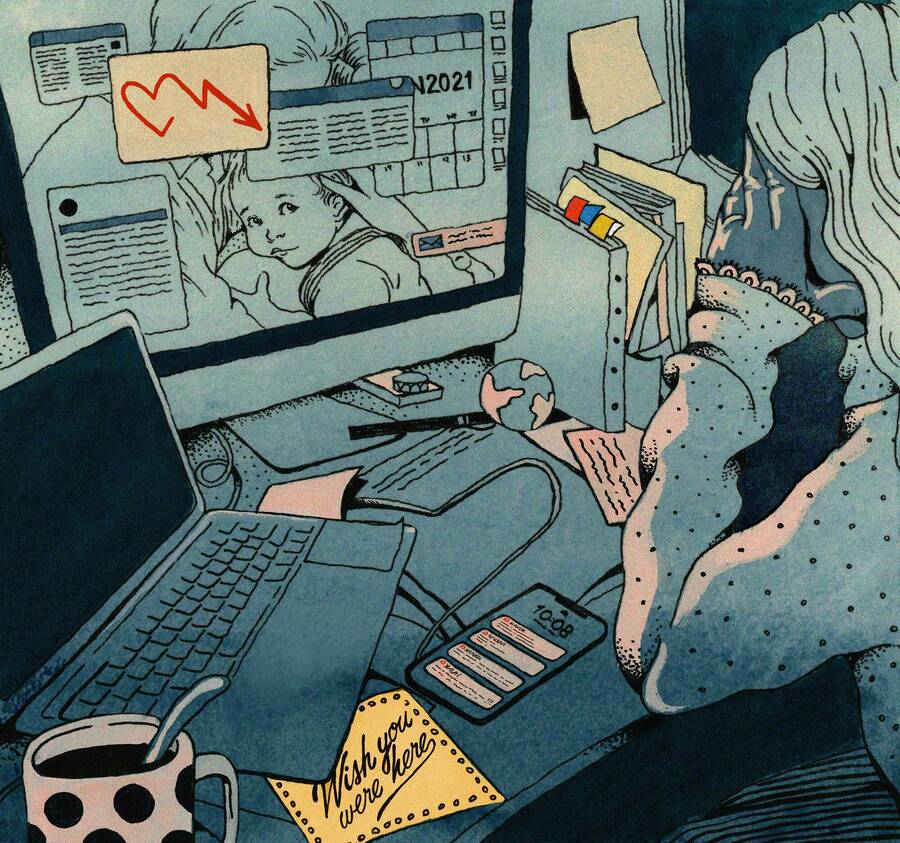
Against Loving Your Job ~~ Sarah Jaffe

 https://inthesetimes.com/article/alienated-labor-capitalism-jobs-work

“We need a politics of time. A political understanding that our lives are ours to do with what we will.”

ILLUSTRATION BY GALINE TUMASYAN\\\

The labor-of-love myth” — the idea that certain work is not really work” and therefore should be done out of passion instead of pay — is cracking.

There are occasional pleasures to be had on the job, certainly; we should take any opportunity for happiness and connection that we get. I do believe, however, that our desire for happiness at work is one that has been constructed for us, and the world that constructed that desire is falling apart around us.

Work itself no longer works. Wages have stagnated for most working people since Reagan and Thatcher’s time. A college degree no longer guarantees a middle-class job. The pandemic exposed the failures of the U.S. healthcare system and the brutality of essential” work for those who had no choice but to keep going to their jobs despite the heightened danger.

A society where we must work the majority of our waking hours will never deliver us happiness, even if we are the lucky few who have jobs in which we do gain some joy. As feminist activist and scholar Silvia Federici wrote, Nothing so effectively stifles our lives as the transformation into work of the activities and relations that satisfy our desires.”

Capitalist society has transformed work into love, and love, conversely, into work. But we are beginning to change our minds about our priorities, whether capital likes it or not. Surveys find more people rating working hours are short, lots of free time” as a characteristic of a desirable job over time, while their desire for important” work went down. This was true among the highly educated as well as the less educated. 

A side effect of all this love for work has been that talking about love between people has lost its importance. Instead, our personal relationships are to be squeezed in around the edges, fitted into busy schedules or sacrificed entirely to the demands of the workplace. Love was understood for a long time to be the opposite of work. Love was for the home, for the family, for the couple; the workplace was where you earned what you needed to sustain that love. Love was also presumed to be more important for women than for men; the home was women’s sphere, the workplace men’s. In reality those lines were always blurred; plenty of women always worked, for one thing, even from the very beginnings of industrial capitalism, and plenty of bosses wanted to extend their control into the home. Henry Ford, for example, famously sent investigators into the homes of his workers to make sure they were upstanding, straight and monogamous, and therefore deserving of higher wages.

As the workplace has changed, our ideas about love have also changed. The feminist revolution known as the second wave” notably demanded access to career-track work for women, seeing it not only as a path to financial independence, but to something more interesting to do with one’s day than clean the house and feed the children. And love, as sociologist Andrew Cherlin has documented, has undergone a transformation from married monogamy to something more open, flexible and often, of course, not heterosexual at all. Yet the way we talk about partnership — even the word partner,” increasingly popular as a gender-neutral term, but also one oddly reminiscent of the workplace, the boardroom, the law firm — still reflects the origins of the family as a complementary institution to the job. When our relationships fall apart, we still blame ourselves rather than looking to all the social, institutional pressures that make it nearly impossible to continue them. Love is still just another form of alienated labor.

It’s not just romantic relationships that have suffered under neoliberalism. Friendship, too, is a casualty of the way our working lives are organized. A 2014 study found that one in 10 people in the United Kingdom did not have a close friend; in a 2019 poll in the United States, one in five of the millennials surveyed reported being friendless. The extended lockdown period of the coronavirus pandemic only exacerbated feelings of isolation that so many already had. People have tried to blame the internet for our collective loneliness, but in fact it comes alongside the change in our working lives and the decline of unions and other institutions that gave people a sense of shared purpose and direction beyond just the job. When I asked the union activists at the Rexnord manufacturing plant in Indianapolis what they’d miss when it closed down in 2017, they all mentioned their friends and the union. Not the work itself.

Work will never love us back. But other people will.

Concurrent political and ecological crises can seem overwhelming, but they have also done something else for us: They have created the possibility of imagining ourselves in a different world. If it was previously easier to imagine the end of the world than the end of capitalism, we have now glimpsed both, and must now begin to think up something new.

As Alyssa Battistoni, a fellow at Harvard’s Center for the Environment, wrote, we cannot move forward without tackling environmentalism’s old stumbling blocks: consumption and jobs”— and our culture of work itself contributes to the problem. Massive reductions in working time are not only desirable (as work is increasingly miserable); they are necessary.

Instead of turning our desires to the objects we can buy with the proceeds from our endless work, what if we turned our desires back onto one another? Spending time with other people has the potential to disrupt the entire economic system. The process of organizing, on the job and off it, is, after all, a process of connection. The first hesitant hello and the chat in the break room are ways of bridging the artificially created gaps between us to gesture toward the power we can have together. A union is only meaningful if the workers in it believe and act like a union, if they are willing to take risks to have one another’s backs. 

To reclaim that space in which to find the connections that matter, we need something more than slight improvements in our individual workplaces or even massive overhauls of labor laws, though we need both of those things desperately. We need a politics of time. A political understanding that our lives are ours to do with what we will. 

Society will always make demands of us, and a world that we built to value the relationships we have with others would perhaps make even more of them. But it would be a world where we shouldered those burdens equitably, distributed the work better, and had much more leisure time to spend as we like. It would be a world where taking care of one another was not a responsibility sloughed off on one part of the population or one gender, and it would be a world where we had plenty of time to take care of ourselves. 

While we have to do our jobs for a living, it makes sense to make demands for better conditions. But alongside those demands, we should always be making demands to reclaim our time.

One of the things that the many social movements of the past decade or so have in common is a reclamation of public space in which to be with other people: the occupied squares of Spain and Greece; Occupy Wall Street; the protests of 2020, exuberantly reclaiming public space after months of lockdown to shout Black lives matter!”

Those spaces were spaces of debate and of action, yes, but they were also spaces of care. The food” and comfort” committees at Occupy made sure not just that people’s basic needs were met but that they felt good in the space. There was singing and dancing, a library for borrowing books. The media often deride the carnival spirit of such protests, as if it were a self-indulgent distraction from the serious political point,” Barbara Ehrenreich wrote in Dancing in the Streets: A History of Collective JoyBut seasoned organizers know that gratification cannot be deferred until after the revolution.’ ”

While we have to do our jobs for a living, we should always be making demands to reclaim our time.

The teachers’ strikes that rippled across the United States after 2012 created anew the spaces of connection. The picket lines in Los Angeles and Chicago featured dance routines and new songs. The strike itself is a means of reclaiming time from work, a way to demonstrate the workers’ importance by halting business as usual, but also a way to stake claim to one’s time and creations. In the midst of the strike, utopia is briefly visible. And the mass strike, as Rosa Luxemburg wrote, has the potential to turn the world upside down. 

These moments and spaces are insufficient, perhaps, to completely overhaul the system.

Imagining love alone as capable of change is idealism, it’s true. Freeing love from work, then, is key to the struggle to remake the world. And people are already reclaiming spaces to experiment with what it means to love one another without the demands of capitalist work patterns. Love, Silvia Federici argued, is a power that takes us beyond ourselves: It’s the great anti-individuality, it’s the great communizer.” 

Capitalism must control our affections, our sexuality, our bodies in order to keep us separated from one another. The greatest trick it has been able to pull is to convince us that work is our greatest love. 

Wednesday, January 27, 2021

The “Essential Worker” Swindle ~~ SARAH LAZARE

https://inthesetimes.com/article/essential-workers-covid-pandemic-labor-exploitation-food-industry-trump-bezos

How this label is used to justify a social order in which workers are abused, discarded and left to die.

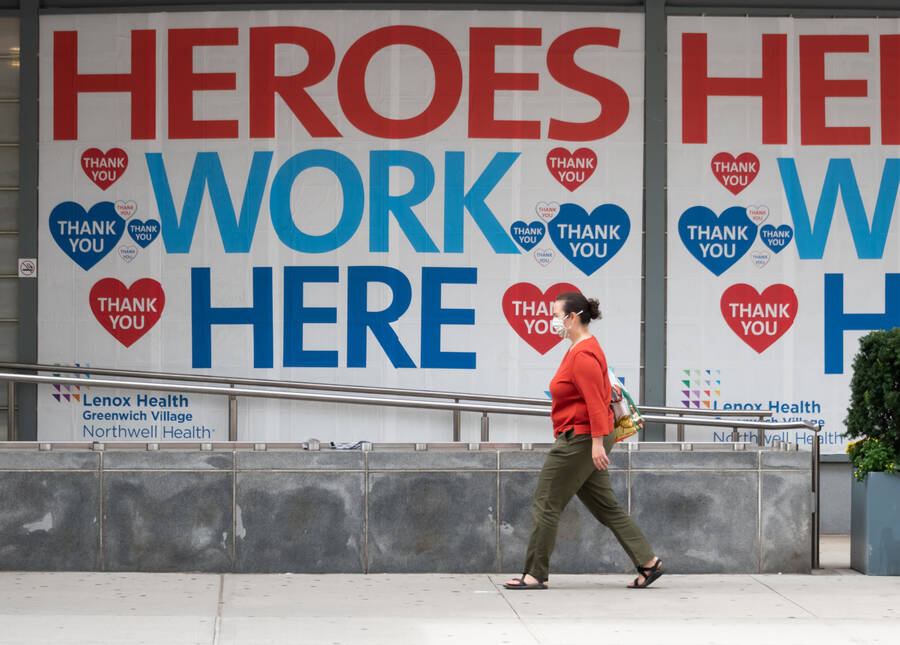
A person wears a face mask outside Lenox Health Greenwich Village hospital on September 27, 2020 in New York City.NOAM GALAI/GETTY IMAGES

Politicians, pundits, CEOs and think tank staffers have spent the past 10 months effusively praising the heroism and sacrifice of essential workers. I’m not alone in being grateful for the work you are doing,” Amazon CEO Jeff Bezos declared in a March 2020 open letter to the company’s workers who have labored throughout the pandemic, risking their lives to deliver hand sanitizer, face masks and baby formula (and increased Bezos’ personal fortune by 65%). Walmart has taken out television ads praising and thanking essential workers (even as it has imperiled and underpaid those under its employ). House Speaker Nancy Pelosi (D‑Calif.) tweeted in July 2020Frontline and essential workers across the country have performed heroically since the start of the COVID-19 pandemic.” Former President Trump, who oversaw 400,000 Covid deaths in the U.S. alone, ran a taped segment during the Republican National Convention in which he said to essential workers, Thank you all very much. Great job.”

But beneath this praise is a troubling truth: Whatever mitigation of suffering and hardship has been achieved during the pandemic, it’s been built on the backs of an essential” workforce that is hyper-exploited, underpaid, placed in extreme danger, and nowhere close to fairly compensated. The endless praise of these essential workers, from the very architects of their exploitation, only serves to justify and normalize a social order in which people who are disproportionately Black, Brown and low-wage are sacrificed. Instead of talking about how workers are being economically coerced into laboring under deadly conditions, we’re talking about heroism. Instead of criticizing policies and political decisions that send workers to their deaths, we are fawning at workers’ voluntary self-sacrifice. The essential worker” discourse has the effect of enforcing discipline on a labor force that CEOs and politicians have decided is dispensable. This is not the language of gratitude — it’s the language of throwing people away.

A recent report on Chicago-area workers in the food industry shines new light on the conditions these essential workers” face. In December, the workers’ rights organizations Warehouse Workers for Justice (WWJ) and Chicago Workers’ Collaborative (CWC) interviewed 90 Chicago-area workers in food production, distribution and logistics (10% of those interviewed are white, 42% are Black and 48% are Latino). Eighty-five percent of the workers interviewed said that when employees raised Covid-19 safety concerns, bosses either failed to respond to complaints, retaliated against people who spoke out, or took actions that were not helpful. Sixty-one percent said they had to go without pay when they were ill or forced to undergo quarantine. Eighty-three percent of the workers who were infected with Covid-19 report that they did not receive paid sick leave from their employer or government assistance.” And a stunning 96% of workers interviewed said they were not receiving hazard pay. 

These workers are being asked to risk their lives every time they clock in to the job, but in return they are receiving no social support or meaningful compensation. One anonymous worker told the researchers, I had the virus in April and had to quarantine for a month. Without insurance or quarantine pay, I had no choice but to stay home and suffer through it.” Another anonymous worker told researchers of a coworker who got sick with Covid and passed away.” The person who died had been working while ill and, according to the interviewee, The company never addressed the death or told us a coworker had died.”

The essential workers” who are dying or going without pay so they can quarantine were already severely underpaid when the pandemic began, particularly those in the food industry. In 2019, the median wage for food and agricultural workers, for example, was just $13.12according to the Economic Policy Institute. Meanwhile, just 8% of workers in this sector were represented by unions. Once the pandemic broke out, the Centers for Disease Control and Prevention put out health and safety guidance” for essential workers. However, according to a research brief from The Shift Project, which collects and analyzes survey data, The Occupational Safety and Health Administration, the federal agency ordinarily tasked with enforcing regulations to protect workers, has largely left safety standards and protocols up to individual employers.” (On Thursday, President Biden instructed OSHA to issue new guidelines to protect workers from Covid-19.)

Essential workers themselves have been some of the loudest critics of the effusive praise with which their exploitation has been met. We are tired of taking the risk,” said San Jose, California McDonald’s worker Maria Ruiz, while on strike in April 2020 for hazard pay of an additional $3 per hour. I’m kind of afraid” to go on strike, she added in an interview with In These Times, ​“but I’m more afraid to lose my life.” A cashier at a New Seasons Market in Portland, Oregon told In These Times in March 2020I don’t really know if any amount of money would make working in this environment and being exposed to this level of risk feel worth it. Personally, I live with my grandmother and mother so it’s just really hard to know if continuing to come to work is the right choice.”

Meanwhile, Koch-funded think tank staffers, Wall Street bankers and even Reagan-era economist Art Laffer have emerged as some of the biggest cheerleaders of sending workers into deadly conditions. We need to get production back — period,” Laffer proclaimed just weeks into the U.S. pandemic (Trump gave Laffer the presidential medal of freedom in 2019).

Of course, there is a conversation to be had about the need to keep people fed and cared for during the pandemic, a feat that almost certainly requires some degree of sacrifice and hard work in the service of the common good. Food must still get to people’s homes, health workers must still care for the sick and dying, farms must keep growing produce so that people can live. And indeed, many workers are acting heroically, as illustrated when they’ve stood up again and again to defend their lives, and the lives of their coworkers, under harrowing conditions.

But 10 months into this crisis, U.S. society has not had a meaningful collective conversation about what a just, shared sacrifice could look like. We have not talked about how to evenly distribute the burden of danger, how to make sure that each human life is valued as we tackle the mammoth challenges before us. With no real public debate, we are operating under the assumption that if sacrifices must be made, it is the most exploited sectors of the working class that should make them — an attitude that prevails during normal” times, but now with brutal efficiency. As Hamilton Nolan pointed out in March, we’re not asking Art Laffer to wait tables. We’re not asking politicians to send their children to work the checkout lines in grocery stores. The idea that those options would even be on the table is laughable. 

If we continue on the current trajectory, when this is all over, the pandemic is going to be the story of how, in the face of social crisis, an entire class of people was abused, discarded and left to die. All the while, we were told that the only way through the crisis was for the workers who have always been sacrificed for the profits of the few to make greater sacrifices than ever before. And as Black, Brown and poor people disproportionately perished from Covid-19, as Chicago-area food workers languished without sick pay, we were reassured not to be outraged. Because this is noble sacrifice, and essential workers are heroes.”