Showing posts with label Labor Unions. Show all posts

Friday, August 20, 2021

Workers organize a historic battle with Amazon in New York City ~~

https://www.workers.org/2021/08/58438/

~~ posted for collectivist ~~

This article is based on a press release issued by Chris Smalls and the Amazon Labor Union.

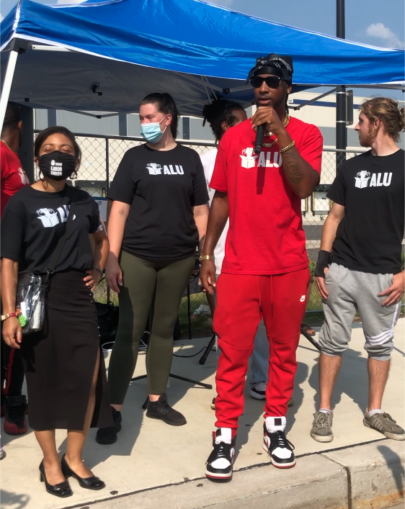
Amazon Labor Union founder Chris Small speaks at the JFK8 warehouse on Staten Island Aug. 11.

Since June, workers at the Amazon warehouse at Staten Island JFK8 and surrounding facilities have been organizing to form the independent worker-led Amazon Labor Union. Other Staten Island facilities currently organizing include Amazon sorting center LDJ5 and delivery stations DYY6 and DYX2. 

The ALU was founded by former Amazon worker Chris Smalls, fired for organizing a March 30, 2020, walkout at the JFK8 facility protesting unsafe working conditions. A leaked memo from Amazon executives revealed the billion-dollar company’s attempt to launch a racist smear campaign against Smalls. (workers.org/2020/04/47554/)

ALU goals are to fight for higher wages, job security and safer working conditions. ALU has successfully built a huge workers’ committee and signed up over 1,000 workers. This puts the campaign on target to file for recognition with the National Labor Relations Board in the coming months.

On Aug 11 at JFK8 Staten Island, ALU held its first press conference to announce the historic campaign. Members of the committee voiced their experiences and told why they decided to join ALU. Workers were joined by U.S. House members Alexandria Ocasio-Cortez and Mondaire Jones, there to support the ALU and demand Amazon to stop its union busting so workers can use their rights to organize towards collective bargaining without interference.

After the launch of the drive, Amazon wasted no time in starting its union busting. Organizers and workers endured the same anti-union tactics used during the unionization campaign at the Bessemer, Ala., warehouse earlier in the year. 

The NLRB ruled in May that Amazon illegally interfered with worker organizing at the Staten Island warehouse. Ploys have ranged from disinformation signs in the bathrooms to the hiring of operatives from The Burke Group to walk through the buildings and spread doubt among the workers. (tinyurl.com/3sc9pesw)

Despite Amazon anti-union attempts, ALU has earned the trust of the workers, hosting a number of barbecues, handing out food and cold water along with masks and T-shirts daily. 

Amazon refuses to acknowledge ALU as a current worker-led entity. Instead, the company sends out false messaging that workers will lose their voices and that ALU will take in millions of dollars in union dues and cause unspecified financial problems. 

To combat these scurrilous charges, ALU members have filed several charges against Amazon with the NLRB. 

This is a remarkable historical moment for Amazon workers all over the U.S. ALU has already broken barriers and will continue to do so. As the workers get closer to filing for their election vote to become an established union, they will need the support of their communities more than ever.


To find out how to support this crucial union drive, follow the Amazon Labor Union at amazonlaborunion.org and @Shut_downAmazon.

Monday, May 10, 2021

Cuban unions build socialism ~~ Stephanie Hedgecoke

https://www.workers.org/2021/04/55957/

~~ posted for collectivist ~~

Member, Communication Workers Local 14156

What are the differences between unions in capitalist countries and socialist countries? What is labor’s role in a socialist country? I first became a supporter of socialist Cuba as a labor activist in the San Francisco Bay Area, and I learned about Cuba’s unions in the course of two trips to Cuba, 27 years apart. 

In 1992, I joined a group of 22 members of over a dozen U.S. unions for the U.S.-Cuba Labor Exchange’s second trip. As guests of the Confederation of Cuban Workers (CTC), we visited all manner of workplaces — factories, ports, agricultural projects, hospitals, clinics and schools. We met with many Cuban union members and leaders. And we had most evenings free to explore Havana!

Our visit was during the Special Period, when Cuba lost 85% of its trade as a consequence of the fall of the Soviet Union and Eastern European socialist countries. Cuba had to make do with less than half its usual oil supply. 

Many shortages resulted as the U.S. intensified its economic war on Cuba’s ability to sell its nickel ore, sugar cane and other agricultural products. Cubans made up shortages of some foodstuffs with what was available, in order to ensure adequate nutrition. In 1992, Cuba was selling its entire lobster catch to buy milk for first-grade children. 

CTC Secretariat member Joaquin Bernal Camero told us: “You will never find a Cuban union leader asking for privatization of enterprise. We’re not going to give back the land to the former landowners or corporations. Our unions are independent, but also independent of the capitalists. We don’t take a coin from the government, and all the dues collected go back into the union work.” 

Membership is voluntary, yet we found out that 97% of Cuban workers belonged to unions, which are entirely self-financed from dues. Cuban unionists enact their own laws and constitutions. The rank and file directly nominate and elect their own leaderships in a regular series of elections far outnumbering those of other countries. 

We learned Cuba had free health care and free or affordable daycare, and rents were limited to 10% of income. Women had three months paid leave before giving birth, six months paid leave afterward and the right to return to their jobs. (Parental leave was later extended to fathers.)

The CTC reviews all new laws before they are enacted, and labor law has workers’ rights at its center. In a joint-venture hotel with Spain, the workers voted out three managers in a row before they got one who complied with Cuban labor law. 

But in 1992 what most impressed me — coming from white-supremacist U.S. during the Rodney King Rebellion — was the deep respect the working people displayed toward each other and the kindnesses we visiting unionists experienced.

Our final workplace visit was to the H. Uppmann tobacco factory. The workers told us they worked six months, then took a month’s vacation. Windows were wide open while they worked with their hands, some singing, others smoking — I could be happy working there!

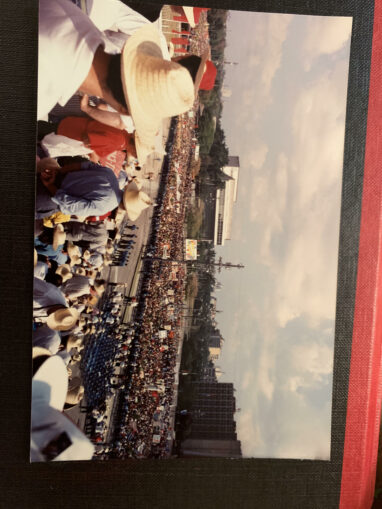
May Day, Havana, 1992
WW Photo: Stephanie Hedgecoke

Going back to Cuba

In the Special Period, Cuba increased resources and built up its biopharmaceutical and tourism industries. But in 2019 former President Donald Trump invoked Title III of the Helms Burton Act, further increasing the illegal blockade’s economic strangulation, threatening the working people. 

I returned in summer 2019 with the 50th Venceremos Brigade, which travels in solidarity with the Revolution to contribute materially to it. The day after we arrived, we toured Las Terrazas in the Sierra del Rosario region, where in 1968 local villagers created a reforestation plan with support from the revolutionary government. 

Within eight years, the rural people in the valley had planted 6 million trees in an area totally denuded during Spanish colonization. Over 80% of the food eaten in the biosphere is locally grown, all organic. Some 7 million indigenous trees have now been planted; biodiversity of flora and fauna has recovered. In 1985, the U.N. Educational, Scientific and Cultural Organization recognized the first Biosphere Reserve in Cuba. 

Our guide Ida explained the impacts of global warming. Some varieties of plants have disappeared from the forest due to the heat; others are in season earlier and longer, like mangoes. The past average year-round temperature in Cuba was 75 to 77°F; in 2019 they had a new high of 103.64°F.

The next day, the Brigade sent me to work in a lime orchard to clear invasive vines choking the trees. Afterward, the local workers regaled us with a fiery recounting of historic Cuban freedom fighters on horseback, machetes in both hands, terrifying the Spanish overlords! 

Later that week, several Brigadistas gathered in the camp library to hear Ismael Drullet Pérez, General Secretary of the National Union of Education, Science and Sports Workers, the largest Cuban union. Pérez said the CTC’s main mission is to represent the needs of the workers and their families before the state and society. 

Ismael Drullet Pérez, General Secretary of the National Union of Education, Science and Sports Workers, Cuba’s largest union

Workers are active in the CTC at municipal, provincial and national levels. In a national survey, Cuban workers wanted the work of the CTC strengthened. 

Although there was no single opinion, it was clear “all workers understood the continued need for their trade unions in the process of construction of our socialism.” Pérez emphasized, “the enemies of the Revolution lie that the CTC is under the government. But we were a union 20 years before the Revolution. The unions were strengthened with the coming of the Revolution.”

Cuban union members meet every two months to ask questions, to get answers — in each of the 19 sectoral unions, at every level. All managers are required to account for the budget, given from the government, to a general assembly of the workers. Union membership remains voluntary, with membership held by 95% of workers in the state sector and 65% of the workers in the private sector. And as we were visiting, the entire state sector had just received significant salary increases after economic studies by the CTC. 

The increased blockade by the U.S. has shut down Cuba’s ability to obtain machinery parts from overseas. Pérez said, “Our factories are old; our machinery needs parts and frequently breaks down. We keep them running through the creativity of the workers solving the problems. But we won’t accept the loss of our independence, our social justice and equity. We are not paradise, and we are not hell.”

Brigadistas asked about the private sector and what role unions have with prisoners. As blockade-imposed hardships resulted in some turning to crime, Pérez said the CTC represents those who were arrested for petty crimes of corruption; “insertados” have representation to help them transition to get work.

The CTC still has final say over new laws; workers in joint ventures can still vote out hostile managers. Pérez noted, “The Labor Code of Cuba regulates all joint ventures and private employers. Problems that come from the past we reshape and eliminate. We accept the workers as they are.” 

The CTC sometimes intervenes with small employers in the private sector; for example, in one case the union had to enforce labor law against gender discrimination in restaurant work. Pérez emphasized: “We are working on this issue on an inherited legacy of slavery and colonialism — hundreds of years of colonialism vs. 60 years of revolution.

During the COVID pandemic, tourism has taken an enormous hit. Yet Cuban science workers created their own vaccines. In 1992 Bernal Camero had said that during the Revolution, “Cuban workers occupied the factories.” Cuba’s unions continue to remain key to building socialism in that Caribbean island nation. 

Wednesday, April 14, 2021

‘Make this a new period of working class challenge’

https://www.workers.org/2021/04/55814/

~~ posted for collectivist ~~

The following edited remarks were made at an April 9 webinar, “The Struggle Continues: Next Steps for BAmazon Union and Beyond — Organizers’ Meeting.” The Support Amazon Workers solidarity campaign (supportamazonworkers.org) organized the session. Saladin Muhammad is a founding member of the Southern Workers Assembly (southernworker.org) and Black Workers For Justice, based in North Carolina.  

Saladin Muhammad

There’s disappointment at the vote against a union at Amazon in Alabama. But recognizing the absence of a real strong labor movement and a strategy for organizing labor in the shop, we go into the campaign for “next steps” with a different kind of view than simply based on winning a particular election. 

For any outcome of the Bessemer Amazon workers campaign, we go on with a view of how a workers’ struggle begins to open up and create a new climate — and possible new alignments and new forms of organization — that could make organizing in the South, and organizing nationally, much more powerful. 

The Amazon corporation, as we know, is one of the biggest corporations in the world, with great amounts of money — a global corporation. And it has new technology that it’s using to organize, monitor and intensify the production levels of the workers. For those of us who consider ourselves on the left, and for trade unionists as well, it’s important to see this battle as an opening battle. 

The battle in the form of solidarity actions has even brought together progressive forces of different political and ideological tendencies that might not ever have come together had there not been this kind of struggle. That’s a positive development. 

The battle created a political climate coming out of the Black Lives Matter period where workers surfaced and probably felt — in spite of the weaknesses from labor’s absence in the South — that this climate was the time to rise up and take the risk of challenging a big corporation. We have to look at some of the positives. 

For those of us who recognize that the struggle against capital is not some instant action, it’s not simply a protest. It’s a strategy that’s deeply rooted in the working class and the oppressed sectors — especially those who have a level of consciousness about exercising power and can identify the weaknesses in our employers and who know them as the backbone of a system that’s reinforced by the state. 

So I raised these things to say: Let’s not be too disappointed! We have an obligation not to let this expression of consciousness and the courage to go up against the big corporation — we must not let it disappear. 

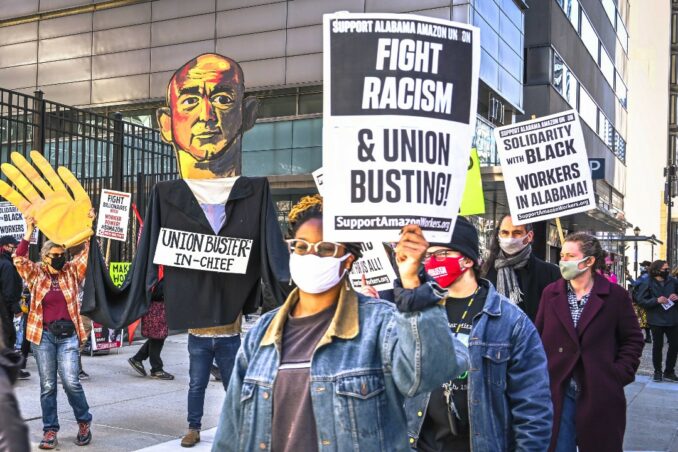
Demonstrators protest outside office of Amazon union busting law firm Morgan Lewis in Philadelphia March 20.

And that’s one of the roles for the left or for progressive forces of the labor left and the trade unions — to make this a new period of working-class challenge, of the working-class movement. That’s a positive. I think it’s important. 

Biden was forced by the climate to make that statement implying support for unions — like Roosevelt was forced by a climate of workers’ struggle. Had the BAmazon Union been a campaign that didn’t have national and international support, Biden wouldn’t have taken that position. So we have to look at some of these elements, these factors in our summations of this campaign.

Strengthen the rank-and-file movement 

Yes, there were weaknesses. And one of the weaknesses is that there is a weak rank-and-file movement in the local trade unions all around the country, in the U.S. unions — there was no pushing the unions, pushing the union leadership to mobilize in support of the Bessemer Amazon workers. Most of the solidarity actions took place outside of the unions. Some local unions mobilized, but there was a lack of a rank-and-file labor left throughout the trade union movement to complement the courage and the initiative taken by the Amazon workers. 

These Amazon workers were majority Black workers — they were Black workers in the South, in a place where labor has been missing as a movement. And a place where the working class was the most divided throughout the history of this country. 

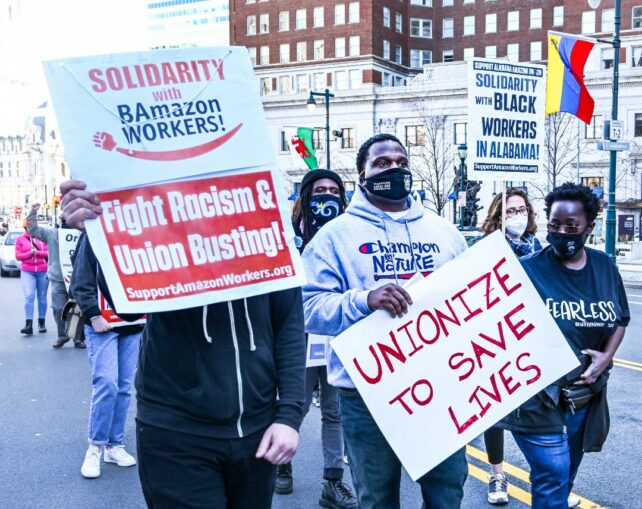
Demonstrators protest outside office of Amazon union busting law firm Morgan Lewis in Philadelphia March 20.

Massive support needed to be built by labor and the trade union movement so that the Black working class can understand that when it steps forward — in its majority, in plants, in communities throughout the country and especially throughout the South — that organizations of the working class, the trade union movements, etc., are there with them side by side by side. 

And if there’s no feeling that that’s the case, then we are in trouble, comrades, in terms of the struggle against systemic racism, or national oppression as I characterize it, or colonialism as others characterize it. If not, we are in real trouble. 

In the Southern Workers Assembly, our perspective has been how to build the rank-and-file infrastructure, rank-and-file anchored infrastructure in the form of workers’ assemblies that have deep roots or build deep roots in key workplaces and key industries — to unite the rank and file in workers assemblies that have community support. 

We saw that this was a need as we moved to build for the February 20 actions to support the Amazon workers. And we saw this as a need as a follow up to the outcome of the vote, whichever way it went. 

On April 18, we’re going to be organizing a four-part series of a workers’ school that speaks to the new industry that workers will be confronting in the 21st century, like Amazon. [The school] will be about how to prepare ourselves for a struggle that’s going to involve more and more big government protected in and by technologically advanced industries. 

The school is going to show that, wherever workers are oppressed, they can find a way to challenge that, to disrupt corporations, to attack this power at critical places in the global economy and in the U.S. economy. We can find a way to challenge these big corporations. 

But we have to go deeper into the working class and the oppressed. And we can’t just rely on the unions to be the vehicle to go deep; we’ve got to go deep so that’s the preparation for union campaigns and more.

Finally, there has to be a framework for the left to unite in order to build a mass workers’ movement — a radically oriented, politically independent, mass workers movement. This is the perspective that the Southern Workers Assembly has. And for some of us who got a couple of years under our belt, we’re trying to make sure that’s completed based on the amount of time we think we got left on this earth. 

We’ve got to have a strategy, and it’s got to go beyond subjective feelings and needs. I think we can do it, and I think we have to be inspired by the initiative of the Bessemer Amazon workers, and we need to encourage them. We need to have speaking tours, bring them all around the country. Our unions and all our workers’ organizations, we need to have celebrations — celebrating their courage and their initiative and celebrating this period that they have just opened up. We can do that. Thank you, comrades. 

Saturday, March 27, 2021

Amazon Hires Off-Duty Cops to Harass Workers, the Press, and Supporters ~~ Madeleine Freeman

https://www.leftvoice.org/amazon-hires-off-duty-cops-to-harass-workers-the-press-and-supporters

Bessemer, Alabama’s police chief has confirmed that off-duty officers have been hired by Amazon to act as “security” for the BHM1 facility in the middle of a historic and intense union drive. Two Left Voice reporters who were recently expelled from Amazon’s premises by the cops: report from the ground.

Photo: Elijah Nouvelage/Getty Images

We came down from New York City to cover the historic struggle of Amazon workers to form a union and to amplify the stories of the nearly 6,000 workers who are putting their livelihoods on the line to fight for their right to collectively organize. If this union vote is successful, it will be the first union of Amazon workers in the United States. There is great potential in this union drive — an effort that is being waged by a primarily Black workforce in a virulently racist and anti-union state against one of the largest companies in the world.

We arrived at the Bessemer facility to stand in solidarity with the workers and take footage of the facility. We moved away from the small group of supporters who come out each day with signs encouraging workers to “vote yes!” on the union, just a few steps down Amazon’s long driveway to film a report in front of the entrance sign. Almost immediately, a police car pulled up next to us. The cop inside told us that we were trespassing and couldn’t film on private property. “You can’t film here!” We were nowhere near the facility, only a dozen feet from the main road. There is no signage demarcating where public land ends and Amazon’s property begins, no signs prohibiting filming or pictures.

As we began to collect our things, another cop car rushed up to where we were, lights flashing. “Stay where you are. My supervisor needs to collect your names and IDs,” the cop said. “You’re with the press? Which publication?” The two cops got out of their cars and stood close to us to make sure we didn’t move. A few minutes later, a man in a golf cart rolled up behind the police cars. He came up to us and demanded our IDs. “I need to take your names down.” When we asked why, he gave no reply. The cops demanded our IDs again and we refused. After some back and forth, they finally let us go and we walked the two steps back to where other supporters were standing by the side of the road. The cops stayed behind to keep watch.

In the days leading up to a historic unionization decision, the BHM1 Amazon fulfillment center in Bessemer, Alabama is on lockdown. Only workers on shift and management are allowed in and out, the workers’ every move watched carefully. The company has pulled out all the stops in its union-busting effort, including financial incentives for “unhappy” workers to quit, mandatory anti-union meetings, and placing a mailbox on company property to “collect ballots.” Amazon even petitioned the city to shorten stop light times at its entrance so that workers leaving their shifts could not talk to staffers standing at the entrance or be exposed to pro-union signage. 

Amazon has also enlisted the efforts of the Bessemer Police Department to act as “security” for the facility to intimidate not only workers, but also the many supporters, canvassers, and press who have come from far and wide to cheer on and agitate for the workers’ struggle. Off-duty cops guard the facility at all hours. Bessemer police trucks constantly ride up and down the streets around the facility and patrol the parking lot.

If you’re not coming into work or just leaving a shift, then the police — operating on the direct orders of Amazon management — are there to make sure you don’t step foot on Amazon property, especially if you’re supporting the union. In the circle of supporters who stand just outside the gates of the facility each day, most people have a story about an encounter with the police and Amazon’s security staff. One person told us that when their GPS took them inside the Amazon parking lot, they were surrounded by eight cops and security officers as soon as they got out of the car. The cops demanded their ID and told them to get off the premises or risk arrest. People in rental cars regularly stop by to take down the license plates of the people who come to flier on the side of the road and show solidarity with the workers inside the warehouse. The facility is surveilled from every angle. And the police are omnipresent, ready for any excuse to harass anyone who supports the union.

Moonlighting as union-busters for Amazon, the cops are key actors in Amazon’s behemoth campaign to kill the BHM1 union and all it represents. They are literally being paid to contain the union campaign and to create a hostile environment for the workers coming in and out of the facility each day, many of whom are people of color who are already the regular targets of police violence and harassment off the job. Now these workers are forced to come to work each day only to be met with cops watching them as they come and go, patrolling the parking lot and the surrounding streets. The police are there to intimidate workers just as much as supporters. This is yet another example of whose side the police are on: the bosses and the capitalists. And now they are doing the dirty work for a company that raked in $386 billion last year, even as it refused workers enough time to go to the bathroom, forced them to walk four flights of stairs innumerable times a day, exposed thousands of workers to Covid-19, and revoked their hazard pay in the middle of the pandemic. In this, the police are fulfilling their historic role as the guard dogs of capital, poised to keep workers in line and prevent them from exercising even the basic right to unionize or fight for better conditions for themselves and their families.

This is the same role the police played at the Hunts Point strike in New York City in January, when hundreds of workers at the most important produce market in the United States walked off the job to demand a $1 raise. The police arrested workers as they blocked a truck from entering the facility. The police stand at the ready — acting on the orders of Republican and Democratic mayors alike — to tip the scales in the bosses’ favor and undermine the struggle of rank-and-file workers to win even a fraction of what they deserve.

Yet at the same time that they repress working people, targeting people of color and killing Black union members like Philando Castille, they are also organized alongside workers in unions. If Bessemer workers are successful in their union drive, then they will join the ranks of the Retail, Wholesale, and Department Store Union (RWDSU), which is an affiliate of the AFL-CIO. This organization, which comprises most of the unionized workers in the United States, organizes thousands of cops across the country, welcoming the enemies of the working class into the house of labor. The cops are organized alongside the very workers they have been ordered to intimidate.

Of course, the cops’ role is not just to protect the interests of the bosses against the workers in the workplace, but to repress working class and oppressed people in every corner of society. The police who are now patrolling the Amazon facility night and day are part of the very institution that upholds systemic racism, killing Black and Brown people with impunity and who beat, pepper sprayed, and in some cases killed anti-racist protesters in nearly every city across the United States this summer. The police exist to repress class struggle wherever it appears, to beat the working class and oppressed into submission in order to ensure the smooth functioning of capitalist exploitation. Many of the workers at Amazon in Bessemer marched in the Black Lives Matter uprising this summer — the very police who repressed them in the streets are the same ones who are now acting under the direct orders of Amazon to undermine the union drive. 

Cops are not workers. They exist to repress working people and bust unions. They serve only to protect the interests of the capitalist class and facilitate the daily exploitation of workers around the world. As such, they have no place at BHM1 and no place in the organizations of working people. In the spirit of the Black Lives Matter movement, Alabama’s militant labor history, and the Civil Rights Movement which preceded this historic fight in Bessemer, the rank-and-file of this potential new union must fight to prevent the police from intimidating workers and supporters. But that’s not enough: If the Amazon union is to stand a chance against one of the most powerful companies in the world, then these workers must organize alongside other unions to expel the police from all workers’ organizations.

Friday, March 5, 2021

LABOR Amazon Launches Anti-Union Website to Derail Alabama Union Drive ~~ Lauren Kaori Gurley

 https://portside.org/2021-01-19/amazon-launches-anti-union-website-derail-alabama-union-drive


Workers are trying to organize a union at an Amazon warehouse in Bessemer, Alabama.,

Anew website full of anti-union propaganda is targeting workers at an Amazon warehouse in Bessemer, Alabama in an attempt to convince them to vote against forming a union. Amazon has avoided unions throughout its 25-year history, and the union election will be one of the first in the company's history. Workers are expected to vote on February 8.

The slick anti-union website, Doitwithoutdues.com, implores Amazon warehouse workers to "get the facts" about unions, "get your voice back," and even to call a federal labor agency to revoke cards workers sign to indicate support for a union. These talking points are juxtaposed with cheery pastel animated graphics depicting megaphones, a dancing dog, and an Amazon package surrounded by hearts. Photos of friendly, empowered-looking warehouse workers dressed in Amazon-emblazoned outfits appear next to anti-union rhetoric. 

Motherboard has also obtained screenshots of text messages sent to Bessemer warehouse workers and photos of signs displayed in the Bessemer warehouse with anti-union messaging, urging workers to "get the facts," about unions which also, in some cases, use the tagline "Do It Without Dues." 

Under the National Labor Relations Act of 1935, it is illegal for employers to intimidate, retaliate against, or ask workers whether they support a union drive. But union avoidance firms and law firms specialize in crafting rhetoric companies can use to convince workers to vote no in union drives without breaking the law. Amazon did not respond to a question about whether a union avoidance firm helped create the website, banners, or text messages sent to workers.

"There’s so much MORE you can do for your career and your family without paying dues," the homepage reads, referring to fees that unions collect from their membership. "We’ve got you covered with high wages, health care, vision, and dental benefits, as well as a safety committee and an appeals process."

Amazon’s argument about union dues is misleading. As a right-to-work state, Alabama does not require that workers pay union dues if they work in a unionized workplace; workers must authorize unions to deduct dues from their paycheck.

The union drive at the Amazon warehouse in Bessemer, Alabama carries significant weight both for the labor movement and the e-commerce giant, marking one of the few times in the company's history that workers will have the opportunity to vote in a union election, which is scheduled for February 8. If workers vote in a union, their union could set off a wave of union organizing at Amazon facilities around the country. 

For years, human rights and labor organizations have criticized Amazon for its warehouses' grueling working conditions that lead to serious injuries, sophisticated surveillance programs targeting workers, and its lack of transparency. During the coronavirus pandemic, Amazon cut off $2 an hour hazard pay and unlimited unpaid time off for its warehouses workers. 

Amazon has also made clear through anti-union videos, surveillance programs, and the firing of union organizers that it staunchly opposes the formation of unions in its facilities. To represent the company in the Alabama union drive, Amazon has hired Harry Johnson, a former Republican member of the National Labor Review Board, who helped craft and interpret federal anti-union labor law. Johnson works for Morgan Lewis, one of the most prominent pro-management laws firms in the country. 

"Amazon has unlimited resources to fight this union drive," said John Logan, a professor who studies union avoidance industry at San Francisco State University. "They will do anything for unions not to get a foothold. There’s no amount that Amazon wouldn’t be willing to pay Morgan Lewis to defeat this campaign."

On the new website, one link takes viewers to a list of ten anti-union talking points presented as "facts" about unions. "We want to make sure you and everyone in our BHM1 family knows all they can about unions to make the best decisions for themselves," the page reads. "You deserve to know all the information and have your questions answered before you pay almost $500 in due!" It goes on to tell viewers that unions will not provide job security, guarantee better wages or benefits and could force workers to approach union representatives instead of managers about their problems. "You could end up with more, the same… or less than you make today," it reads. 

Another link directs viewers to a form that allows workers to contact Amazon to revoke a union card they've signed. (Union cards signed by workers are used to show the National Labor Review Board that there's ample support at a worksite for a union drive.)

"IF you signed a card, feel misled or concerned someone submitted your name/info without your consent, you have the RIGHT to get your card and your voice back," the website reads. "Tell the union representative you'd like your card back, call the National Labor Relations Board, or click below."

Text messages sent to Bessemer warehouse workers by Amazon rely on similar rhetoric.  "Unions are a Business," a screenshot of a text message sent to a worker obtained by Motherboard reads. "A union is an organisation that charges employees money to speak for them to their employer. A union is a business that takes money from your paycheck to fund itself."

"If someone is telling you it doesn't cost you a dime to sign an authorization card they are misleading you," reads another text message sent to a work. "Signing a card is you saying you want to be represented by a union. You pay dues out out of your paycheck every month to be in the union. Signing a card is you saying you want to pay for union representation."

In December, the National Labor Review Board charged Amazon with illegally firing a warehouse worker who organized to improve working conditions during COVID-19. 

The National Labor Relations Board has not determined when and where the election will take place, but the NLRB says it is expected to set a date soon for early this year

Thursday, February 25, 2021

Build New Infrastructure for a Broader Movement

https://portside.org/2021-02-22/build-new-infrastructure-broader-movement

~~ posted for Collectivist ~~

There is need to invest in different structures, organizing alongside or outside of the traditional unions, base-building and nonprofit organizations for multi-year struggles, especially worker organizing and scaled disruptive direct action

Organizers can draw so much encouragement from 2020. The uprising in the wake of George Floyd’s murder became the largest movement in U.S. history. So many groups threw down brilliantly to flip back the battleground states. The pandemic and the support of groups like United for Respect made tech tools ubiquitous for organizing. Frontline Amazon workers, Instacart shoppers and healthcare workers pushed back against the pandemic profiteers.

Last year almost the entire progressive organizing infrastructure participated in the elections to some degree. That was necessary, and in large part successful, at least in defeating the most pernicious manifestation of Trumpism. Now we will see some strategic realignment within the social movement Left. Some groups are going all-in to win what they can from President Biden and Congress in the first 100 days. Others are doubling down on a commitment to build local and state political power, and winning significant issues and policies that come with that. Most groups have an eye towards base-building and growing their scope and power, concurrent with winning. Most encouraging on the strategy front is that the larger “we” of the movement ecosystem has learned from the early Obama years and is unafraid of inside-outside strategies.

The years ahead will no doubt be even more tumultuous than this last one. As a result, many of us also need to invest in different structures, organizing alongside or outside of the traditional unions, base-building and nonprofit organizations, thus enriching our movement ecosystem and augmenting our work for the multi-year struggles ahead. New approaches to worker organizing and to direct action seem particularly worthy of nurturing.

WORKERS STEP OUT

The huge upswing in worker organizing in 2020 often had union support, but with an experimental twist.

Over the first few months of the COVID-19 epidemic, workers from bridal shops to pizza places to supermarkets were organizing to get Personal Protective Equipment (PPE), and winning. They used tools like the coworker.org site, which helps anyone start up a petition in their workplace and make demands. Groups like the Emergency Workplace Organizing Committee (EWOC), a project of the Democratic Socialists of America (DSA) and the United Electrical Workers Union (UE) supported those workers taking independent action. EWOC provides a sophisticated intake system combined with veteran labor movement coaches to support workers winning their demands.

Groups like United for Respect and different coalition partners of Athena, fighting Amazon, have been building worker organizations and winning changes at some of the largest corporations on the planet. United for Respect has raised wages at Walmart, and won better conditions for pregnant workers.  The Awood Center in Minnesota, which predominantly organizes East African workers, has changed Amazon’s practices in their warehouse to make sure that workers have accommodations for Ramadan and throughout the year as well.

Gig workers have no legal right to organize a union, but despite the law, Uber and Lyft drivers, Instacart shoppers, and Doordash delivery workers have been organizing before and during the pandemic. Groups like Gig Workers Rising, a group of rideshare drivers, have won minimum wages and benefits and concessions around unfair deactivations. Subsequently, gig companies spent $200 million to claw back many of those gains through Proposition 22 on the California ballot; but at least they had to spend more than any other ballot measure in history. Gig Workers Rising teamed up with drivers’ groups around the world to organize the Global Uber Strike in 2019, shutting down Market Street in San Francisco for hours in front of Uber Headquarters, and continue to push forward a high level of militancy.

Once workers exercise power in the workplace, they are building the confidence to exercise further power and build increasingly powerful organization. Worker militancy can create huge wins in the workplace, without entering into collective bargaining agreements. We can support workplace organizing both directly and indirectly.

BACKSTOPPING WORKER ACTIONS

Support at the workplace. This sounds simple but it cuts to the core of how we think about labor organizing. Increased workplace militancy begets increased militancy, as shown by the explosion of wildcat strikes in the 1930s. Increased militancy also leads to increased risk for workers. Most veteran union organizers are of the mind that we need organizational backing before workers can publicly take action. I am not sure that is entirely true. Workers might be able to take independent action, and then go to organizations if they run into trouble. Jobs With Justice has been filling this labor rapid response role for decades, and the Fight for 15 enlists faith leaders to accompany strikers back to work. This summer’s uprising has supercharged all of this infrastructure, and increasing numbers of folks are looking for opportunities to mobilize in solidarity. Movement infrastructure support, combined with traditional labor and faith actors and perhaps a National Labor Relations Board determined to move quickly and support collective action at the workplace, makes this an especially fortuitous time for us to both organize and support direct action at the workplace.

Financial undergirding for union organizing. Sometimes unions will support new forms of organizing and sometimes not, but workers paying dues right off the bat can support full or part-time organizers. The Communications Workers of America is doing the best work on this right now, collecting dues on bank draft or credit card through new projects with workers ranging from Google engineers to hospital workers. Two hundred workers paying $15 per month in dues pays for an organizer who would be making roughly the same amount as workers in retail or delivery. This may be a moment we can create sustainable economic models fairly quickly.

Support for salting. A salt is someone who takes a job with the intent of organizing a workplace. Unions like UNITE/HERE have used salts to organize hotels and there are currently salting projects at different warehouses as well. While we should not necessarily publicize current salting projects for reasons of security, we could be recruiting large numbers of young people and recently retired folks to engage in salting and organizing. For example, with so much of campus life on-line, student organizers could be rerouting their activism to the workplace. Sometimes, a group of people salting in a region live together in a group house, or we could find solidarity housing with folks who are long-time labor activists who have spare bedrooms. As workplace organizing and militancy comes back in vogue, we should be lowering the barriers to entry, and recruiting large numbers of salts, and thinking about how to create infrastructure that supports that, especially because wages, the most important thing, are already paid by the company.

Training and mentoring. Increasingly, we are seeing large strike schools and other mass worker and organizing training happening. All the projects mentioned above have real leadership training and development for workers, but tracks for organizers lag a little bit behind. This is because unions are still very invested in staff union organizers. As salts and militant workplace activists blur the line between “workers” and organizers, we should be creating mentorship and peer infrastructure for those workers, salts and organizers, even if they are outside of traditional infrastructure. The right program could solicit many veteran labor organizers and rank-and-file leaders to serve as mentors. Community organizations, not just unions, could provide some training for emerging labor organizers as well.

A freewheeling militant orientation, undergirded with support structures and increased tools and training, could radically increase the amount of collective workplace action over the next few years.

DIRECT ACTION AND DISRUPTION

The second important area for which we need support is scaled disruptive direct action. Last summer’s uprising was spontaneous, raw, courageous, and moved the needle in a significant way towards defunding law enforcement and moving a significant swath of white folks towards supporting the dismantling of white supremacy. Sometimes uprisings happen, and we need to be ready to support them. There are things we can do to try to foment uprisings. And finally, there are direct action campaigns that are inherently or potentially disruptive. Direct action requires some distinct kinds of scaffolding.

Infrastructure that undergirds movement moments. Since the Ferguson Uprising the number of local medic collectives and jail support structures has skyrocketed. Despite more “dots on the map,” we still collectively underinvest in that infrastructure. Good criminal defense lawyers are too scarce. Jail support is still insufficient for mass arrest situations. Many cities lack the numbers of trained medics we need. Tech tools such as broadcast texting for mass actions are not yet in use everywhere. Finally, we always need more money, and we need more formations willing to use money in flexible ways for needs such as legal support, food and housing for front-line protestors, and other unanticipated but necessary expenses. However, there are very few entities that can both collect and disburse money in loose but legal ways. Even where there is good infrastructure, sometimes there are disparate abilities to access that infrastructure, as the spontaneity that accompanies uprisings often means that organizations can be slower to support things that just “pop off.” Resourcing that infrastructure now means that we have more potential to support and maintain uprisings and movement moments as they happen.

Support for impermanent organizations. Edge organizations that can create conditions like last summer’s rebellion, or create a left flank, are not necessarily built to last, but are immensely valuable. Most of the edge organizations we see now exist to move a particular piece of legislation or a campaign, and then disband.

The Home Defenders League, which grew out of the Occupy Homes movement in 2011, disbanded in 2014, after homeowners had engaged in direct action and jail solidarity at the Department of Justice in Washington, D.C. in 2013. (People do jail solidarity by refusing to give their names or post bail.) The homeowners and their allies prompted the Obama administration to begin holding banks accountable again, to the tune of billions of dollars. A year later the Home Defenders League, believing its final action had pushed the envelope as far as it could, began to wind down.

If we support and sponsor edge organizations that do not have to worry about their self-preservation, we create a lot more room for risk-taking and bold action. The Home Defenders League did not exist in a vacuum. It drew support from the Leadership Center for the Common Good, which arose from the destruction of ACORN and was one of the groups that merged to form the Center for Popular Democracy. We should invest capacity in creating fiscal sponsors, legal support and mentorship for high-risk, time-bound projects. Right-wing attacks, SLAPP suits and government surveillance might destroy such organizations, but organizations can be expendable, particularly if we can protect the people involved from threats, and keep them in the work.

Supporting Direct Action Campaigns. Long-time Indigenous resistance to fossil fuel infrastructure caught the attention of the world in 2016. That resistance is still going strong in the campaign against  Line 3, a pipeline that will carry tar sands oil into the United States at great peril to the planet, to Indigenous lands, and to all of our Midwest freshwater. Organizers are launching a growing number of winter action camps. Activists are locking down to block construction equipment two to three times a week, and engaging in multi-day tree sits in the Minnesota winter. Participants in these camps are getting a crash course in building movement infrastructure – and a huge infrastructure will be needed to support thousands of water protectors traveling north to stop construction over the vast territory the pipeline will cover. With enough support, the Line 3 fight could rise to the level of Standing Rock – and should, given the courage of those resisting on the frontlines.

Scenario Planning. We collectively engaged tens of thousands of people and spent millions of dollars in scenario planning for responses to a potential coup. As a result, tens of thousands of people thought about civil resistance, and hundreds of others thought about shutting down ports and commerce. We need to figure out under what other circumstances some of those unions, community groups and Indivisible chapters would be willing to plan mass scaled disruptive actions. This might mean we will have to create edge or impermanent structures that can avoid legal risk.

Expanding our views on paid organizing and political work. Institutions, especially longer-term base-building institutions, both labor and community, are vital. Leaders of those institutions are often a combination of the best in the movement, detail-oriented visionaries who work night and day building their organizations. But we also need to support people who view organizing as their unpaid political work, or who are not seeking to build nonprofits or move up the organizing management pathway. We can coach and mentor them if they want to move into more freewheeling, impermanent organizing experiments. We can think about ways to reduce their cost of living with solidarity housing, shared meals, and other arrangements that would give them much more time to engage in the work of organizing. If we can support their choices, and provide them some ability to meet their basic needs, the number of talented, experienced organizers outside of our current structures will grow.

Crisis presents movement opportunities of which we cannot yet conceive—but we can build the scaffolding, skills, and people who are able to vision, throw down and support in these times of crisis. May we strengthen the old and build the new.