Showing posts with label Democracy. Show all posts

Tuesday, May 18, 2021

The 'third wave of autocratization': Analyzing red-state America's place in a landscape of democratic decay ~~ Paul Rosenberg

https://www.alternet.org/2021/05/autocratization/

~~ posted for dmorista ~~

While “Liberal Democracy” is at best a flawed political system that works to defend the interests of the capitalist rich, I still think it is preferable to various types of Authoritarian and Tyrannical rule. This article, “The 'third wave of autocratization': Analyzing red-state America's place in a landscape of democratic decay”, by Paul Rosenberg posted at Alternet discusses the at least 20 year trend towards the decay of Liberal Democracy, in both the U.S. and in various other places in the world. The biggest single source of data for the discussion is a report entitled Autocratization Turn Viral, Democracy Report 2021, produced by the V-Dem Institute which is located in the Political Science Department of the University of Gothenburg, in Gothenburg Sweden. There are links to many other academic papers, books, interviews and other sources. The main focus is on the U.S., and the many ominous developments in the various state governments and the evolution of the Republican Party into an anti-democratic authoritarian party. The Republican Party as it has now evolved, wants to maintain the “window dressing” aspects of democracy but eschew the substantive elements. I think this article is well worth the 20 – 25 minutes needed to read it. dmorista

=============

The Article:  

The 'third wave of autocratization': Analyzing red-state America's place in a landscape of democratic decay
Image via Screengrab.

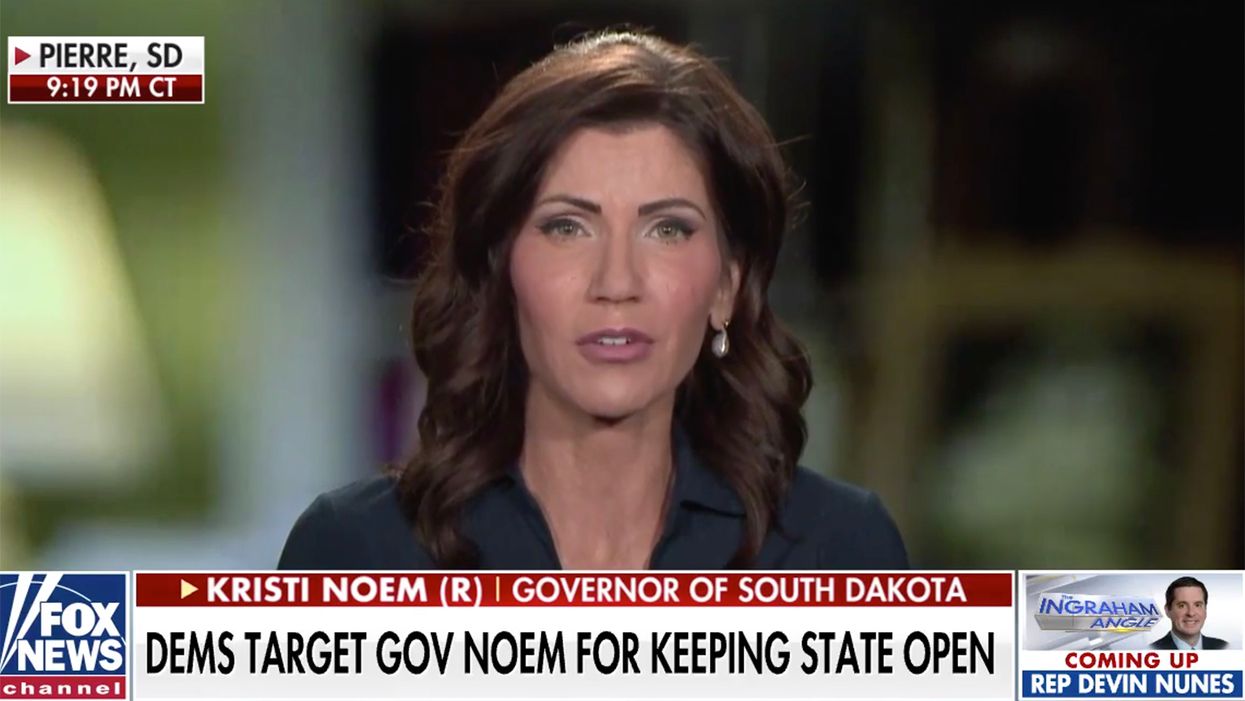
As the Jan. 6 insurrection recedes in time, media attention is beginning to focus on potential 2024 Republican presidential candidates, including "new faces" like Kristi Noem and Josh Hawley, old also-ran Ted Cruz and others and, of course, Donald Trump. In a representative democracy, it's only natural that elected leaders — or credible potential ones — should be a significant focus of attention.

But there's an air of unreality hovering over all such portrait-mode coverage when a broader landscape view shows that the very survival of democracy is up for grabs — not just in the U.S., where GOP House members are in deep denial about the Jan. 6 insurrection while Republican legislators have introduced voter suppression bills in 47 states, but around the world. The Swedish-based V-Dem Institute's 2021 annual report notes that "the global decline in liberal democracy has been steep during the past 10 years and continues in 2020" and concludes that the "level of democracy enjoyed by the average global citizen in 2020" has fallen "to levels last found around 1990." At that time there was a jubilant buzz about the "End of History." Now there's an undertone of dread that we could "meanly lose, the last best hope of earth," as Abraham Lincoln warned.Talk of as many as 24 potential GOP candidates in the next cycle recalls pre-2016 talk about the GOP's "deep bench," which, as I noted at the time, was a media-hyped myth. Those andidates fell into three groups: governors with horrible to mediocre job-creation records plus some ex-governors who hadn't run in a while, first-term senators with paper-thin résumés in a particularly dysfunctional Congress, and assorted wild cards, including Ben Carson and Carly Fiorina, as well as a certain New York real estate developer turned reality-TV star. I focused primarily on the shared failure of GOP economics, the party's purported strong suit. "The degree to which key articles of GOP economic faith clash with overwhelming expert judgment is staggering — and there's nary a hint of it in most of the media," I wrote. "It's a disconnect reminiscent of global warming, but much less widely recognized."

The problem goes much deeper now, to the shared failure of Republican patriotism, as their party has turned against democracy. While media awareness may be better, without grounding coverage in a "landscape view" of the problem journalists are fumbling the biggest story of our time — the global threat to democracy, and the enormous potential for a renewal that could finally realize democracy's full promise for all.

America's place in a landscape of democratic decay

What's known as the "third wave of autocratization" — characterized by creeping democratic erosion rather than violent coups — continues to spread: V-Dem's report notes that "25 countries, home to 34% of the world's population (2.6 billion people), are in democratic decline by 2020." One especially disturbing highlight "is that India — formerly the world's largest democracy with 1.37 billion inhabitants — turned into an electoral autocracy," meaning a system in which elections continue to be held but the chance of power changing hands is virtually nil. Prior to Jan. 6, the U.S. seemed far from being in a similar situation, but that is effectively what the new wave of GOP voter suppression laws could accomplish, especially with added provisions that jeopardize the post-election process.

America is still a long way from becoming India — but things can change quickly. The U.S. score on V-Dems "Liberal Democracy Index" or LDI is 0.73 (out of a possible 1) while India is less than half that, at 0.34, a precipitous decline since 2010 that places it among the planet's top 10 major "autocratizers." While the U.S. doesn't make that ignominious list, it's marked in red to "signify cases of significant and substantial autocratization." In 2010, the U.S. was among the highest-ranked nations, and is now no longer in the top 30, falling below Chile and Greece, countries with recent histories of military rule."The U.S. is somewhat unusual among the decliners," a trio of V-Dem researchers — Anna LührmannDan Pemstein and Juraj Medzihorsky — told Salon via email. "Most of the decliners are reasonably young democracies," they wrote, adding that the U.S. has had a high and stable LDI in their rankings since the civil rights era. "The U.S. is a very different case than India or Brazil and also the various Eastern European countries [which] have much shorter democratic histories, despite being at similar levels in 2010."The American case, they note, "shows that it is possible for this illiberal playbook, which we're seeing play out in diverse places ranging from Brazil to India, Hungary and Poland, to gain traction even in consolidated liberal democracies."

The party landscape: Even starker

Things look even more perilous from two other landscape views: the landscape of parties across the world, and the landscape of state-level government. A V-Dem briefing paper and its followup, entitled "Walking the Talk: How to Identify Anti-Pluralist Parties," found that the Republican Party has shifted dramatically in recent decades, from being in the same ideological territory as the British Conservative Party in 2000 to the neighborhood of India's Hindu nationalist BJP now, while the Democratic Party has barely moved at all."We did not see any sufficiently similar examples that we could bring up," Medzihorsky responded. "Given the information that we have, we refrained from speculation."

The red-state landscape of democratic decay

Another landscape perspective that can shed some light is that of state-level government, explored by University of Washington political scientist Jacob M. Grumbach in a paper called "Laboratories of Democratic Backsliding." Inspired by the V-Dem model, Grumbach developed a measure of subnational democratic performance called the State Democracy Index. He tested a range of different theories about what might contribute to democratic erosion over the period from 2000 to 2018, "based in party competition, polarization, demographic change, and the group interests of national party coalitions." Strikingly, he found "a minimal role for all factors except Republican control of state government, which dramatically reduces states' democratic performance during this period."

I reached out to Grumbach to ask about his findings and their significance. He began by discussing certain consequences of the American federal system:Even compared to other countries with federalism, American federalism is especially decentralized, giving more control over political institutions to the lower subnational units. This means that the U.S. can experience extreme regional differences in democratic performance, as it did during the slavery and Jim Crow periods. Current regional differences in U.S. democracy aren't as big as they were in Jim Crow, but they're substantial and growing.

Grumbach's data only goes through 2018, but we're now seeing a vast wave of Republican efforts to suppress democracy and crack down on dissent and education, as I discussed in a recent Salon story on conservative "cancel culture." I asked Grumbach where he thought we might be headed.

We've seen 300-something new voter suppression bills out of Republican state legislatures since the 2020 election, as well as anti-protest bills and bills to outlaw particular forms of educational content that challenge nationalistic interpretations of U.S. history. We've also heard continued claims that the 2020 presidential election was stolen. All of these are threats to key tenets of democracy, including free and fair elections and civil rights and liberties. Although the politics and policy moves have been distinct, we've seen similar threats to democracy in Hungary and Brazil in recent years, which makes me concerned about the global trends.

The V-Dem 2021 report outlines a typical pattern to the process of "autocratization": "Ruling governments first attack the media and civil society and polarize societies by disrespecting opponents and spreading false information, then undermine elections." That seems like a strikingly accurate description of what happened during Trump's four years in the White House. But Grumbach's work points to a lengthy prehistory as well. I asked how we should understand the whole story, from the state-level story he describes through Trump's time in office to the fall-out today. He responded:

This is such an important question. I argue that Trump — and the [Jan. 6] insurrection — were just the latest and most visible manifestations of a longer term antidemocratic trend in the GOP. We've heard about "Stop the Steal" since 2020, but the GOP has for decades been selling conspiracies about mass voter fraud and suggesting that Democratic governance is illegitimate. The GOP currently is a coalition of two groups, an elite coalition of the very wealthy and an electoral base motivated by white identity politics. Both of these groups have an interest in pursuing minority rule through voter suppression, norm erosion, gerrymandering and other tactics.

Finally, Grumbach noted another dimension where partisan differences were minimal:

It's important to note that my main State Democracy Index focuses on electoral democracy, and there you see the GOP leading democratic backsliding. However, when I focus the measure on civil liberties and freedom from state authoritarianism, this kind of illiberalism has been bipartisan. American federalism puts policing and incarceration authority at the state level, and Democratic, divided and Republican state governments have all pursued "tough on crime" policy that has led the U.S. to become the most heavily incarcerated country on earth (more than dictatorships with larger populations).

How that came about is one of three interconnected social policy strands described by Cornell historian Julilly Kohler-Hausmann in her 2017 book, "Getting Tough: Welfare and Imprisonment in 1970s America." (I'll be interviewing her for a forthcoming Salon feature.) Last year's Black Lives Matter demonstrations signaled a long-overdue challenge to that wretched bipartisan consensus, forged in the aftermath of the civil rights movement. Because national Democrats have shown at least some willingness to respond to this challenge, Trump and the Republicans have sought to demonize them for it, so this may become another party-polarized dimension — or, more optimistically, part of a new consensus, as suggested by various public opinion polls, as well as the almost 2-to-1 passage of Florida's Amendment 4, which restored ex-felons' voting rights (although that was later gutted by the Republican legislature and governor, an issue now in litigation).

Discerning the differences between the two realms — electoral democracy and civil liberties — is precisely what a landscape view of politics makes possible: differences of history, agency, motivation and possible futures. Making sense of these different landscapes and their relationships is crucial to navigating them — and perhaps making meaningful democratic governance possible.

Denialism vs. democratic decay

Perhaps inevitably, there's a nascent right-wing denialist response that tries to reject any such analysis of democratic decay. At the Free Beacon, Aaron Sibarium wrote a story criticizing Grumbach's scoring system, and more broadly all such systems, called "The Myth of Measuring Democracy." But simply claiming bias and crafting a self-comforting narrative doesn't exactly prove a counter-argument.

Bias could emerge, Sibarium argued, through "the choice of variables used as proxies for democracy and the process by which those proxies are assessed." He attacked Grumbach for the first, and V-Dem for the second:

At least three of the factors that decrease a state's democracy score — voter ID laws, high incarceration rates, and denying felons the right to vote — are things that large majorities of Americans support. According to Grumbach, maximizing democracy means defying the popular will.

Sibarium called V-Dem's framework, "the most balanced," then went on to say that "it too reflects the liberal consensus — because the indicators are all scored by liberal academics."

Both Grumbach and V-Dem offered detailed responses. In essence, Grumbach said, Sibarium assumes that democratic support would make slavery democratic — one answer to what's known as "Wollheim's paradox." Grumbach also said his index includes measures that capture both sides of the paradox, meaning "policy responsiveness to majority opinion and procedural indicators of how costly it is to vote, how gerrymandered districts are, etc.""Because people might have different opinions on how to measure democracy, I simulate 100,000 different measures that weight indicators differently," Grumbach explained. "Across the 100,000 measures, it is clear that GOP control of state government reduces democratic performance. This finding isn't an artifact of some particular way that I measured democracy."

The V-Dem trio called Sibarium's criticism "part incorrect and part banal." It was incorrect in labeling the expert scorers "liberal academics," they said: Many are outside the academy and they come from all over the world. "Ascribing all of these experts from different countries and backgrounds the same ideology — 'liberal' or otherwise — is simply silly," they said.

The criticism is banal, they said, "because of course the values are a mathematical representation of expert opinion. ... The purpose of the project is to measure concepts that are incredibly important but inherently difficult to observe."

"Scholars have subjected the V-Dem data to a multitude of validity tests, and it has generally held up well," they said. "We also emphasize that our measures exhibit uncertainty — experts disagree! — and provide public estimates of the scale of that uncertainty."

In short, the measures used by V-Dem, Grumbach and others are meant to inform our understanding of how well or poorly democracies are functioning, not to dictate judgments. They don't pretend to tell us everything. The unique status of the U.S. as the highest-ranked democracy to undergo "significant and substantial autocratization," its two-party system with only one party radicalizing, its decentralized federalism and its distinctive, highly contested racial history, among other factors, mean that it's imperative to seek out other approaches as well.

Leaders, norms and violence: A different landscape view

One of the most helpful of those is to look back at our own history, as in Nathan Kalmoe's book "With Ballots and Bullets: Partisanship and Violence in the American Civil War" (Salon interview here). Kalmoe has a lot to say about how political leaders and partisan media affect the potential for violence — another example of a "landscape mode" effect, as opposed to a "portrait mode" direct-causation account.

"Whether looking at U.S. history or cross-nationally at politics around the world," Kalmoe said in a more recent exchange, "party leaders, including media figures, play a key role in how ordinary partisans think and act. That extends to extremes like violence."

Leaders both embody and influence group thinking in multiple ways, he said:

Leaders are experts whose judgment their followers trust, and leaders are seen as definitional group members whose words and deeds set the norms for the group. Party leaders are especially influential when they simultaneously represent multiple political and social identities (e.g., race, religion), and those group alignments make violence more likely.
Leaders mobilize violence in many ways, not just direct calls for violence, though those may be most powerful. They also encourage violence with their failure to condemn violence by their own group, by violent metaphors and coy remarks implicitly supporting that violence, and by using vilifying and dehumanizing language that makes it easier for group members to rationalize harming their opponents.
Leaders set norms for the group and those norms can shift overnight. In conventional politics, for example, we see instant 10 or 15 point swings in policy views among partisans when top leaders endorse a policy, even when it goes against the party's ideology. In the historical context of Civil War violence, northern Democrats followed their party in initially supporting and then violently rejecting the war to uphold Lincoln's election, including a change in their willingness to kill and die in that war.

Once a new group norm is established, Kalmoe continued, "leaders and group members then police the new bounds, silencing and expelling dissidents within the group. We're seeing that now with Republicans rallying around defense of Trump's multifaceted attempts to reject his loss in a free and fair election."

In short, despite the unique situation we find ourselves in, there's nothing exceptional, or even especially unusual, about the partisan leadership dynamics involved.

Profound change? Landscape of a possible future

But in a broader sense our situation may be historically unique, as suggested by Ian Hughes, author of "Disordered Minds: How Dangerous Personalities Are Destroying Democracy" (Salon interview here.) Hughes combines studies of key 20th-century pathocracies (Hitler's Germany, Stalin's Soviet Union, Mao's China, etc.) through the lens of the "the toxic triangle" — destructive leaders, susceptible followers and conducive environments — with an argument that democracy can be understood as a multi-layer defense system against such disordered leaders and the pathocracies they create.

"This system of defenses comprises the rule of law, electoral democracy, the principle of liberal individualism that underpins the separation of church and state, social democracy and legal protection for human rights," Hughes explains. Those principles have all come under relentless attack during the Trump era, in ways for which we were woefully unprepared. But now there's a chance to recover, and rebuild. Now that he's stripped of official power, "Trump is not the real issue anymore," Hughes told me via email. He sees "an opportunity to step back, understand the big picture" and "move the U.S. and the world onto a better path," not just a slightly improved one.

"We are at a historic moment of profound change," Hughes said, going on to explain:

Most of the social institutions that have been holding society together, however brutally and inequitably, are failing. They are failing in two senses. First, they have contributed to what Biden referred to in his Inaugural Address as the cascading crises of our time — climate change, species extinction, levels of inequality within and between nations that are undermining social cohesion and international order, the erosion of democracy and the persistence of authoritarianism, and the emergence of cultures of animosity, polarization and blame. The list goes on. These cascading crises are the fruit of failing systems of economics, politics, technology, gender, religion and education.
These social institutions are also failing in a second sense. Not only have they helped create the multiple crises we face, they are also (as Einstein might have said) incapable of resolving these crisis, given the level of thinking they are trapped within.

Hughes sees much more than a landscape of failures. "There is also hope, enormous hope," he said. "For each of the social institutions I listed above there is a global movement aimed at building something new, of making that radical rupture with existing paradigms." He continued:

In economics, for example, there is a whole variety of movements exploring "beyond growth" economics, circular economies, economies where care is recognized and rewarded, an economics that can rein in the parasitic and destructive system of contemporary financial capitalism, and so on. The same is true for gender and race with the #MeToo movement and Black Lives Matter movement being part of a much broader reimagining of societies where participation and diversity lead to radical system transformations. Well-being and spiritual movements are questioning the valorization of material wealth as the epitome of human development and are reclaiming values of empathy, cooperation and love from their monopolization by organized religion. In the area of technology, movements demanding the responsible development of new technologies and the taming of the destructive uses of existing technologies now have global reach.

Conventional, portrait-mode analysts look at Joe Biden's agenda in terms of distinct issue categories — pandemic relief, infrastructure, voting rights and so on, and consider the major political actors in each realm. But Hughes' description of democracy as a multi-layer defense system suggests a more expansive landscape viewpoint, with a powerful central theme.

From that perspective, Hughes said, "Biden's agenda can be assessed by the degree to which it can successfully join up all the 'rivers of progressive change' and empowers them further as a means of dismantling the structures that continue to shore up Trump and the pathological incarnation of the GOP," Hughes said. The central question, then, is "to what extent can Biden not bring the U.S. back to normal, but help bring about something new."

The portrait-mode approach to politics naturally favors the "return to normal" orientation. Familiar figures doing familiar things, to familiar praise, regardless of the medium- or long-term results. But a landscape view more readily accommodates change: We can at least potentially see different pathways, different destinations and even imagine different landscapes that might become visible if we stood on different, distant peaks.

"The degree to which Biden is able to empower these forces for building something new is also the degree to which he will have successfully constrained the former guy and his yesterday's men in the GOP," Hughes said. "In a sense, Trump and the GOP are a perfect fit for our dysfunctional times. Biden's challenge — and the challenge of any democratic leader at this historic moment — is to change our times so that Trump and his fellow authoritarian narcissists stand out as the misfits they truly are."

Monday, December 21, 2020

Social Democracy- An Unworthy Goal ~~ Kacey SW

https://usa.anarchistlibraries.net/library/kacey-sw-social-democracy-an-unworthy-goal

SOCIAL DEMOCRACY IS NOT DESIRABLE


(bolding emphasis mine, NB)

We write this to live in a world against misery and false hope. Politics in our world come in 10 second sound-bytes spun to obfuscate truth, and we seek to reach out our hands to those who are trying to see past illusions. Social democracy (as opposed to “democratic socialism” or “actually existing socialism”) as a political goal has been gaining popularity in American politics since the onset of the #Occupy movement in 2011.[1] This phenomenon of demanding social and economic reforms comes as no surprise to us with one simple look at the current climate of America. People are fed up with the contradictions of “the billionaire class” while the rest of us work most of our waking lives for sub-par housing and sub-par nutrition if we’re “lucky” enough to find work at all. Meanwhile, others still are pushed into prisons or deal with the trauma induced by wars at home and abroad.

To want a better world, one free from capitalist misery makes perfect sense to us, but we need to critically examine the political and social movements involved in trying to change the world in order for us not to end up in this same mess all over again. We are not writing this to say that social-democrats are the enemy, but rather that social democracy falls into the trap of structuring itself through a capitalist nation-state. We understand that those involved in social-democratic organizations and movements have been comrades alongside us in recent years, particularly in the struggle against fascism, authoritarianism, exploitation, and hate, but we must take the opportunity to show why social democracy as a political system is fundamentally undesirable.

Social democrats would like to believe that we can use electoral power to vote these monsters out. It’s a belief that if we rally, protest, lobby, and vote enough times, then we will win our demands. The problem with social democrats is not necessarily only in their long-term idea of how they want the world to be, but also with the fact that on the one hand they say capitalism is wrong/socialism is right, and on the other hand, focusing their damnedest of efforts into a losing battle-- a battle of electoral politics that has already been decided by the parties of the ruling class.

The game has been rigged, and we working people have no need to play it. How many hundreds of years of bourgeois elections will it take for us to realize that this stage is a farce, and that our time would be better spent breaking that fourth wall from the audience rather than begging our way on stage? The liberals and conservatives know this stage well, and their deliberate maintenance of capitalism is only more proof that the arena they built is the arena on which they, and only they, will win. To be a social democrat in this world is to ignore the fact that lines have been drawn, the stage has been set, other working people have their places, and so do you.

Some who gravitate towards the social-democratic position genuinely want a better world. Why then, does this better world come through the same channels of government? Why then, would this better world maintain the roots of private property? Surely the soft-anti-capitalists are misunderstood!


SOCIAL DEMOCRACY REAFFIRMS THE NATION-STATE


Social democracy as an ideology is one primarily concerned with domestic policy, i.e. the distribution of resources and legislation of individuals and morality within an established nation-state. Thus, it is unable to address a particular nation state’s role in upholding imperialism and global power dynamics. Individual social-democrats may pay lip service to decolonization movements and anti-imperialism, but as a whole, social democracy fails to challenge the overarching structures of global capitalism. Even the Scandanavian socialists, who are talked about so much and loved so dearly are contributors as nation-states to global capitalist and imperialist institutions such as the IMF, WTO, and NATO.[2]


The ideology and implementation of social democracy fundamentally relies on the state form as an agent of social change. Citizens within the state territory work (or own businesses) and pay taxes much like our current system; they are then afforded quality food, shelter, education, and healthcare with less corruption in government. The idea is that if we rightfully tax the capitalist class-- those idle financiers and titans of industry--their fair share, then we can start living a life of comfort rather than toil. Those who are part of the state, which is viewed as a citizen’s public entity from the social-democratic point of view, can simply do their part for society through labor or capitalist innovation, and they can rest assured that all of their needs and more will be met.


The issue again, is not necessarily that we don’t believe our lives would materially be better under social democracy, but that we cannot and should not ignore the base structure providing the framework for our needs to be met. Any state, even a friendly happy social democracy, relies on borders. Borders are nothing more than imaginary lines drawn by those with the power to enforce them in order to divide and define humans according to who pays taxes to which ruling party.[3] Borders, as well as the complications and misery which accompany them, are necessary for social democracy as the state still needs some way to territorially define who is paying into the system and who is reaping the benefits. Such an enforcement of a state’s definition of both their territory and their citizenship can only be accomplished through a hierarchical and stratified armed organization operating under the implicit understanding that they hold a monopoly on legitimate violence- be it called an “army”, “police force”, or “Department of Homeland Security”, etc.

Though social democrats engaging in activism may have pragmatic beginnings of campaigns on a local level, the campaigns themselves as well as the end-goals of the campaigns are all contained within and reach no further than the nation-state as a form. We see this evidenced by their calls for clean water which neatly fit into pre-existing municipal state forms, their demands for universal healthcare which also contain themselves to the particular American nation-state, various school board races as a “bottom-up” approach for a more honest and credible way to enter politics, and the promotions of other such state-run and state-funded programs which unfortunately are unable to be envisioned as programs that could exist in a reality of a society beyond the state. They fail to see that the nation-state form--the political form which takes the imagined community, rather than class solidarity or humanity itself, as its primacy-- is the exact enemy of their goals ,yet they wish to use it as a political carriage for delivery.[4]


No doubt, the social democrats are largely against war, concentration camps, and violent border disputers, but they fail to see that the more-humane system they promote will lead to similar issues as the fundamental structure remains unchanged even under the new form. Social democracy is beholden and specific to the modern capitalist nation-state. Their desired political form still requires a documented citizenry, inclusion/exclusion to and from the republic, and quite literally, above all else, a police apparatus (separate from the workers themselves) to oversee and enforce such a territory-based economy. They want a better world, but fail to see that the system of the nation-state cannot and will never provide all that can be offered.


SOCIAL DEMOCRACY RELIES ON REPRESENTATION


Before every positive structural change to the world is a mass movement. Mass movements start from collective demands, in our cases, material collective demands, to seek direct and immediate change to conditions while resulting in opening further social dialogue. Mass movements against capitalist structures or entities do just that, and the solution requires nothing less than a total restructuring or abolition of current socio-economic relations. Social democracy seeks and achieves mass movement and engages with collective demands, yet the movement becomes separated from its own foundational power by turning to state power and political figures for the end solutions.


It should be seen as fact that the question of Bernie Sanders’ presidency and the United States as a social democracy could have only been made possible by the political conditions created by the #Occupy movement. What started from a simple call and sporadic recent history of radicals using occupation as a tactic, quickly became a massive grassroots movement of “have-nots” (and the occasional conspiracy wingnut or small business owner who was unhappy with the financial system). We attempted to disrupt Wall St., question public and private property relations, and bring the question of class to the front of the American political landscape. By no means were the camps and ideologies of the movement monolithic, but actions to freely distribute resources, provide mutual aid, fight evictions, and disrupt commerce were direct, concrete, and targeted. Undoubtedly, some in the movement sought right off the bat to channel the movement into electoral politics, and we recognize that was one of its downfalls. Electoral politics through the Democratic Party is “the graveyard of social movements” as the saying goes.


The movement for social democracy, by having a long-term goal of functioning through democratic statehood relies on a representation of the ‘will of the people’ so to speak. Once again, to say this is not to challenge that their demands are popular or materially beneficial to the working class; instead it is to point out that when we as individuals or collectives entrust our needs and desires to a political figure, or ‘higher power’ if you will, we functionally separate ourselves from our own power which initially created the conditions for such a representative or statesman to thrive in the first place.[5] If one is elected for a full time position to represent your interests against those billionaires while no longer (if ever) living the way you do and knowing your day-to-day struggles, how can they possibly be entrusted to represent you not only accurately, but effectively?


For these reasons, we recognize political representation as fundamentally false. One, or even a reasonably sized group of people, may entrust a person with a political, economic, or moral responsibility and delegate to them a task to engage in politics with others who are delegated. A difference between delegation and representation, we should point out, is that a delegate is one who is elected to carry out tasks for the collective while a representative is one who is elected to derive will/power from a group and then be entrusted to legislate freely as an individual regarding policy and stakes. To rely on a system of territorially-based elections in which one person would then represent that territory/state/locality and engage in politics on your behalf with other territorially-based representatives will either be laden with corruption or be a series of follies at best. “The workers have no country.”[6]


SOCIAL DEMOCRACY RELIES ON PRIVATE PROPERTY


The movement for social democracy fails to challenge property as a system. We might have such a better world where some property is held in common, while other property is privately owned.[7] This notion is fundamentally capitalist/liberal as it recognizes that the means of production and distribution are still able to be profitable for individuals or small groups of individuals. Certainly under social democracy, the “essential workers” would be under industries owned by “the public,” but there is no question raised as to why any non-essential industry should be profitable. Moreso, what is considered “essential” (literacy, internet, public transportation, etc) is continuously shifting through both the demands of Capital and the demands of workers. In this regard, social democrats mediate between the two parties using state-based politics to offer “essential” services as if such wealth and services weren’t already a collective product of the workers ourselves.


The nationalization of industry not only reaffirms the nation-state form which we discussed earlier as being undesirable (lest we also forget about the many indigenous people who are opposed to resource extraction in their localities under capitalist and “socialist” governments alike), but it also relies on the basic hierarchy and power discrepancy of boss and subordinate, owner and worker, producer and consumer. Apart from a gamble on potential material benefit, what good could come from having “one big boss instead of lots of little bosses. Someone will be in control of course, and either way, you will be working.”[8] This system is surely not cut out for any desirable way a free being would choose to live their life.


The slogans of “tax the rich,” “tax the 1%/we are the 99%” and even “Chop From The Top” from more radical groups engaging against austerity at the time (pre-and circa #Occupy), are still slogans which demonstrate the needs for changing processes within the system and what the system can offer us, rather than the acknowledgement that we, as working people, simply do not need this system nor its playbook, however creative and accommodating it may be.[9] When we say “we need to tax the rich,” of course, in our current nation-state’s way of doing things, that is the best option. When we say “we need to tax the rich,” we also lend ourselves to the belief that we are not able to access the resources and wealth which we’ve created and are rightfully entitled to; the demands themselves imply that such power implicitly lies within either governance or markets, rather than in our human activity itself.


Our call is not to take such an easy task as to beg for crumbs among the billionaires and millionaires; our call is for us and every other working person to take the whole damn pie! There might even be agreement among us and social democrats regarding such a statement, but we need to understand that any wealth which is created, is never created by any individual. All wealth, all society, everything which exists is a product of all living activity which came before it. All goods and services produced and exchanged carry with them, not just the labor of those who worked and provided the raw materials we deal with, but the labor of the entire history of humanity and earth which provides us the materials to work with in the first place. So long as you speak a language, any at all, your being in this world is at least partially a product of who and what came before you.


The land we toil and rest upon, the knowledge we crave and learn, and all of the various consumer goods which allow the continuation of our existence as we know it, are all products and developments of those who came before us. There is no possible way to quantify such a thing-- this is why property is impossible. I may say that I will defend what is proper to me, that which I find in this world to be of my belonging and will, and hold truth to my rights as an individual, but we would be fools to pretend we are alone in this world.

This is why we do not settle for simple reforms of “tax the rich,” but why we struggle for nothing less than a full-scale social revolution--a revolution which understands that everything we have has been made possible by others, and everything others have, has been made possible by ourselves and people like us. Social democracy’s insistence on maintaining even a sliver of private property is a maintenance that is either ignorant of, or refuses to acknowledge the facts which have been stated prior.


WE WANT IT ALL


We hope our message above properly illustrates that social democracy is not only not feasible as a revolutionary ideology, but more importantly, is undesirable in itself because the only cure for the social ills in this world is nothing less than full-scale social revolution. Even the most “humane” societies that fall under the umbrella of social-democracy are either participants of, or trapped within, the larger social structure of global capitalism and nation states. Rather than demanding measures that “work” for this or that population, we need to organize ourselves as workers against our work being seen and experienced as a commodity form.

We need to damn the nation-state form which pits one nation’s workers against another. We need to eschew attempts of representation; such attempts are a falsehood. A properly organized proletariat needs no representation in government. We need to end the relationship of property and capital- that relationship which realizes land, labor, and capital to be held privately for profit rather than for a recognition of communal organization. And for us to be true to ourselves through our needs, we must take an organizational attitude which refuses class collaboration.

We need revolution now, lest people keep suffering and the world keeps burning.

=====

Notes at link above


Friday, November 13, 2020

The Envy of the World Still has no Functioning Democracy ~~ Paul Street

https://www.counterpunch.org/2020/11/11/the-envy-of-the-world-still-no-functioning-democracy-here/

~~ posted for dmorista ~~

Nobody Said Biden’s Name

I walked up to Chicago’s Trump Tower down the middle of Michigan Avenue last Saturday night. Within four blocks of the hated structure, both sides of the street were jammed with cars full of young LatinX, Black, and white folks honking their horns, hanging out car windows, waving, roaring their engines, playing YG’s chart-topping hit “(FTD) Fuck Donald Trump,” and aiming bird flips at the Trump building. Young people of all races and ethnicities danced on all four corners of Michigan and Wacker.

It was one Hell of a celebration. As well it should have been. Donald Trump is a vicious, pandemic-spreading white-supremacist, eco-exterminist, uber-narcissist, and instinctual fascist who richly deserves Noam Chomsky’s description of him as “the most dangerous criminal in human history.” A second Trump term would be a tragedy from which the nation and world might never recover.

Anyone on the “the left” who wouldn’t like to see Trump removed from the world’s most dangerous job is morally and intellectually comatose.

I say “like to see” because Trump is challenging the election with the backing of much if not most of the Republican Party. A Trump coup seems like a bridge too far to me but so did a Trump presidency and I see little basis for confidence in the supposed “resilience” of America’s “democratic” and constitutional institutions and values in light of recent history. I’ll believe the orange beast is out the door when he gets flown off the White House Lawn for the final time.

Contrary to news broadcasters who called the demonstrators “Biden supporters,” there were few Biden-Harris signs on display. There were lots American flags, Mexican national flags, and Black Lives Matter banners.

I didn’t hear one person say Biden’s name. Not one.

“Stop Counting”

Assuming he is ushered out of power next year (sooner would be better), the wannabe fascist dictator Donald Trump will be remembered, among other terrible things, as the one-term president who wanted the country to stop counting. Stop counting COVID-19 cases and deaths Americans needed to keep track of because they made him look bad. Stop counting poor and nonwhite people in the U.S Census because completing a credible count and categorization of the populace would hurt the white-nationalist agenda. Stop counting the disastrous amount of carbon in the atmosphere. And, of course, stop counting the millions of mail-in ballots required by the pandemic he spread.

How pathetic. A letter writer in last Saturday’s New York Times puts it very well: “Trump’s early claim of a victory on the night of the election and his news conference Thursday night reminded me of playing Candy Land with my 5-year-old nephew. It only counts if he wins and forget about the rules. If disappointment ensues, the whole board will be flipped upside down. Is this what the United States of America has come to? When is the intervention?” (NYT, November 7, 2020, A18).

“We Are Still in a Very Dangerous Moment”

When indeed. The orange-brushed authoritarian man-child will never willingly concede. As his psychologist niece Mary Trump warned and has been saying the last few days, acknowledging defeat is simply not in Trump’s make-up. The Narcissist-in-Chief is incapable of humility.

Like the fact that 71 million people voted to give this lethal fascist lunatic a second term, this nothing to laugh about. “He still has the power of the presidency for 76 days and we need to be prepared for anything that he might have in mind,” Ms. Trump told an interviewer five days ago.” If he thinks he’s going down, he’s going to try to take the rest of us with him.” Trump is engaged in “an attempted coup. “We can’t be delicate about this. We need to be very straightforward about what’s going on here,” Ms. Trump said.

Trump and his dead-enders – his two demented sons, his personal attorney general William Barr, fascist propagandists Tucker Carlson and Sean Hannity, the re-installed Nazi Senator Lindsey Graham et al. – are apparently playing along with his effort to use Republifascist control of the Supreme Court and some state legislatures to reverse the will of the voters. Along the way, Trump is trying to spark his hard-core Amerikaner base – including the near-third of U.S. citizens who would welcome a right-wing military dictatorship in the U.S. – to rush into the streets and wage “cival war” on the “radical Left Democrats.”

On Tuesday, the nefarious white nationalist neo-McCarthyite Senate Majority Leader Mitch McConnell (R-KY) endorsed Trump’s refusal to concede. The Republifascist Party is aligning with the final madness of their Dear Leader, who has 70% (!) of the nation’s Republicans behind his baseless claim that Biden’s victory was fraudulent.

Axios’s Alayna Treen reported Monday that “Trump plans to brandish obituaries of people who supposedly voted but are dead — plus hold campaign-style rallies — in an effort to prolong his fight against apparent insurmountable election results, four Trump advisers told me during a conference call this afternoon.”

“These actions could amount to inciting insurrection,” a friend writes me: “He’s not done, and we are still in a very dangerous moment.”

“God Help Us”: Fired for Failing to Crush Civil Rights Protest with Federal Troops

Consistent with these warnings, Trump on Monday Twitter-“terminated” Defense Secretary Mark Esper. Trump nearly fired Esper last June 3rd for publicly contradicting the fascistic president over the possible activation of the 1807 Insurrection Act to deploy active-duty military units against protests in Washington and other cities. Esper said the circumstances did not merit use of the act, which Trump had threatened to invoke two days earlier. It was widely understood in Washington that Esper would resign before he would agree to deploy U.S. troops against U.S. citizens protesting the theft of the 2020 presidential election.

It is an extraordinary move for a president to fire his Defense Secretary just days after losing an election. Esper’s replacement, Christopher C. Miller, is head of the National Counterterrorism Center. It is reasonable to guess that Miller is a racist Trump-fellator who will be more amenable to using military personnel to quash “civil unrest.”

The Esper firing could just be payback for his earlier public contradiction of Trump and his determination to move ahead with stripping of Confederate names from U.S. military bases. Or it could be about something more ominous.

You never really know with a frenzied, power-mad maniac like Trump.

Esper offered some interesting commentary to Military Times on his potential firing just days before it occurred: “Who’s going to come in behind me? It’s going to be a real ‘yes man.’ And then God help us.”

“A System of Governance That’s Been the Envy of the World” for 240 Years

With the December 8th “safe harbor” deadline for states to choose Electoral College electors just one month away, millions of Americans should prepare to stop all paid work and take to the streets, town plazas, public squares, and central cities and highways to make it clear to the American ruling class that this nation will be ungovernable and unprofitable if the terrible tangerine-tinted, tiny-fingered, Twitter-tantruming tyrant insists on trying to stay in office past his formal expiration. (My own preference is for Trump and Pence to be forced out now, before the orange monstrosity can do any more damage).

Don’t look for Joe “Nothing Will Fundamentally Change” Biden, a died-in-the-wool defender of the status quo, or any of his fellow corporate and imperialist Democrats, to spark or endorse such mass action. Keeping the people off the streets is very much at the heart of their core institutional and ideological mission. The corporate-captive Democrats are about conciliation, pacification, and inauthentic opposition.

Last Thursday night, the soon-to-be President Elect told Americans to cool their jets while Trump tried to invalidate the election. “Democracy’s sometimes messy,” Biden said, in words that could easily (and may well) have been written by Barack Obama or one of Obama’s speechwriters[1]“It sometimes requires a little patience as well. But that patience has been rewarded now for more than 240 years with a system of governance that’s been the envy of the world.” (NYT, November 6, 2020, A1)

What an offensive and idiotic comment – nothing new for Joe Biden, who said earlier this year that Trump was “America’s first racist president.” There’s little real and functioning “democracy” in the United States. And there was never supposed to be as far as the U.S. Founders were concerned “more than 240 years” ago. Popular self-governance, the rule of the people, was the last thing the new nation’s aristo-republican slave-owner, merchant capitalist, and publicist rulers wanted to see break out in their “infant republic.” Popular sovereignty was the Founders’ nightmare, a threat to their wealth and proper class rule in their militantly propertarian world view. Leading Constitution advocate John Jay put it very well: “those who own the country ought to govern it.” The new nation’s leading intellectuals and politicians were very explicit about this in The Federalist Papers and in the proceedings of the Constitutional Convention, where the framers constructed a government dedicated to keeping We the People at bay.

The openly anti-democratic Electoral College, required to appease southern slaveowners, was just one of the many ways in which the Founders’ holy parchment was designed to check the power of the people. Under its openly absurd reign, Americans still don’t elect their president through a national popular vote and presidential elections come down to winner-take-all Elector slate contests in a small number of contested states. Constitutionally speaking, by the way state governments are technically free to send to Elector slates that contradict the popular presidential vote in their jurisdictions (more on this below).

How enviable.

“It’s Like You Want to Stop People from Voting”

New York Times editorial published last Saturday reflected on the curious difficulty of getting one’s tally properly taken and tabulated under Biden’s “system of governance that has been the envy of the world” for 240 years:

“From the endless lines to the pre-election legal wrangling to the president’s constant effort to undermine the process, every ballot cast this year was a leap of faith: Would it get there in time? Would it get there at all? Would they try to toss it out because you voted from a car? Would they throw it out because you signed your name carelessly? Would judges be called upon to alter the mail-in deadline after the election had already begun? Would you ever be able to find the one drop-box in your sprawling county? And, after all that, would anyone believe the count, anyway? All of this uncertainty is unworthy of the ‘world’s oldest democracy.’ American elections are broken, and because the legitimacy of the entire political system rests upon our votes, their brokenness mars every other part of our democracy” (NYT, November 7, 2020, A18).

A short Times video on How U.S. Elections Look Abroad” showed people from other nations reacting to various pathetic aspects of the United States’ bizarre and byzantine voting system(s)” “From gerrymandering to voter roll purges,” the Times reported, “we showed people around the world how the American system works. It didn’t go well.” The foreign interview subjects shook their heads and rolled their eyes in disbelief over numerous voting rules and practices that plague elections in the nation that calls itself the homeland and headquarters of democracy: partisan gerrymandering, replete with bizarre “Jackson Pollack” voting districts; absurd voter registration deadlines; absurdly low voter registration; rampant non-voting; voter purging; absurdly long lines at minority polling places; the failure to make elections a national holiday and to otherwise make voting convenient; discriminatory and unnecessary voter ID laws; felony disenfranchisement laws and more.

The judgement of a New Zealander: the American voting regime “is just not acceptable in a democratic country.” A woman from India said, “it’s like you want to stop people from voting.”

That’s not exactly “the envy of the world.” More like global laughingstock. Or worse.

More Fully Constitutional Absurdity

Sadly, the Times video and editorial said nothing about the Electoral College, the systematic disablement of third and fourth parties, and the United States’ preposterous and only plutocratic campaign finance laws and (see below) rulings. Even if voting itself was made more suitable, practical, and efficient in the U.S, these authoritarian characteristics of America’s supposedly grand “system of governance” would continue to badly dilute the supposedly sacred power of the American ballot.

1 State with 40 Million People and 2 U.S. Senators v. 22 States with 37 Million People and 44 U.S. Senators

Another anti-democratic legacy of the Founders’ supposedly glorious “system of governance” ignored by the Times video and editorial is the assignment of two U.S. Senators to every state regardless of state population size. California has nearly 40 million people. Wyoming is home to less than 600,000 citizens. Both have 2 U.S. Senators – a brazen violation of the elementary democratic principle of one-person one vote. As the Atlantic noted last year, “Today the voting power of a citizen in Wyoming, the smallest state in terms of population, is about 67 times that of a citizen in the largest state of California, and the disparities among the states are only increasing.” The nation’s 22 least populous states are home to roughly 37 million people and 44 U.S. Senators. On top of this grotesque absurdity (from a democratic, one person, one vote perspective), neither the U.S. taxpaying province of Puerto Rico (more populous than 20 U.S. states!) nor the U.S.-taxpaying District of Columbia (home to a total population greater than that of 2 U.S. states – Wyoming and Vermont) has a single representative with voting power in the U.S. Senate.

The nation’s small-population states are disproportionately white, rural, and Republifascist. This abjectly authoritarian set-up grossly overrepresents the nation’s most backwards and racist, right-wing regions.

Thanks to this open violation of democracy’s most elementary principle – one person, one vote – the Senate stands far to the portside of the U.S. populace.

How enviable.

Never forget the absurdly venerated U.S. aristo-republican Founder James Madison’s case for the U.S. Senate (originally beyond any popular election) at the 1787 Constitutional Convention:  

“In England, at this day, if elections were open to all classes of people, the property of landed proprietors would be insecure. An agrarian law would soon take place. If these observations be just, our government ought to secure the permanent interests of the country against innovation. Landholders ought to have a share in the government, to support these invaluable interests, and to balance and check the other. They ought to be so constituted as to protect the minority of the opulent against the majority. The senate, therefore, ought to be this body; and to answer these purposes, they ought to have permanency and stability.”

Senate Confirmation and Judicial Review/Veto

To make things yet more egregiously reactionary, the Senate holds confirmation power over the president’s appointments to the federal judiciary, including the absurdly all-powerful appointed-for-life Supreme Court, which has (under the 1976 Buckley Valeo and 2010 Citizens United decisions) granted giant corporations unlimited financial input on the American candidate selection and election processes.

The 6-3 right wing Supreme Court crated malignant sadist Trump could soon end American women’s right to an abortion and remove millions of Americans from health insurance in the middle of a pandemic. It has the technical power to invalidate Biden’s election, something the Trump administration says it’s still counting on while ginning up its ugly, heavily armed Amerikaner Death-Cult base with the evidence-free charge that the election was “rigged against Trump.”

The Supreme Court’s power of final judicial review – established as American legal doctrine in the 1804 Marbury v. Madison decision – effectively gives the right-wing the power to veto any policy it sees as antithetical to its white nationalist and oligarchic world view.

Envy that, world.

Another Ghost of 1804: The Twelfth Night Amendment

Yogi Berra was right: “it ain’t over ‘til it’s over.” One scheme for Trump staying in power is fully constitutional. It was explained concisely by the insufferable neoliberal Fareed Zakaria in The Washington Post five or so weeks ago:

“Imagine the scenario during election week: Trump is leading on Nov. 3, but Democratic nominee Joe Biden gains ground in the days following.  Republicans file objections to tens of thousands of mail-in ballots. Democrats file countersuits. Taking account of the confusion, legislatures decide to choose the electors themselves…Of the nine swing states, eight have Republican legislatures. If one or more decide that balloting is chaotic and marred by irregularities, they could send what they regard as the legitimate slate of electors, which would be Republican…Democrats may object and file lawsuits. In some of those states, Democratic governors or secretaries of state could send their own slates of electors to Washington. That would add to the confusion, but that might well be part of the Republican plan. When Congress convenes on Jan. 6 to tally the electors’ votes, there would be challenges to the legitimacy of some electors. Congressional Republicans would agree that disputed states should not be counted. That would ensure that neither candidate would get to 270 electoral votes…At that point, the Constitution directs that the House of Representatives vote to determine the presidential election. But it does so with each state casting a single vote. If the current numbers hold, there would be 26 state delegations that are Republican and 23 Democratic (with one tied), so the outcome would be to reelect Trump. Trump does not need to do anything other than accept this outcome, which is constitutional.”

While they maintained a total majority of individual representatives in the U.S. House, the Democrats failed to win a majority of the state delegations in the U.S. House of Representatives in the 2020 election.

It is true that most states have passed laws committing their Elector slates to the candidates who won the popular vote in their jurisdiction. But those are just state laws that have never ruled as federally constitutional by the Supreme Court, which is currently under the command of the right after Trump’s three appointments (Gorsuch, Kavanaugh, and Coney-Barrett).

The specific part of the Constitution that would send the election to the House is the Twelfth Amendment, passed in 1804. “But in choosing the president,” the amendment reads, “the [House] votes shall be taken by States, the representation from each State having one vote.”

I’m not saying that the election is going to the U.S. House of Representatives. But I’m also not ruling out the possibility and cannot help but sadly register some agreement with the title of Zakaria’s reflection: “Trump could stay in power even if he doesn’t win the election. The Constitution allows it.”

Wow. Something to make the world green with envy!

Whether five Republican-appointed justices (Thomas, Alito, Gorsuch, Kavanaugh, and Coney-Barrett) have the courage to spark a mass popular rebellion by backing Trump’s Ahab-like war on the electoral process is another question altogether. They probably do not have the guts to pull something as fascist as that (part of me hopes they do: it would put millions in the streets, where they belong until racist, sexist, eco-cidal, capitalist and imperialist American regime is overthrown). But maybe they do. Never say never.

“The General Public Has Been Virtually Powerless”

What “democracy,” Joe Biden? Where is it, New York Times? Twenty-three decades after the Constitutional Convention, the Founders’ nightmare has yet to break out and take over in “the world’s oldest democracy.” University of Kentucky history department chair Ronald Formisamo’s published a book titled American Oligarchy.  By Formisamo’s detailed account, U.S. politics and policy are under the control of a “permanent political class” – a “networked layer of high-income people” including Congressional representatives (half of whom are millionaires), elected officials, campaign funders, lobbyists, consultants, appointed bureaucrats, pollsters, television celebrity journalists, university presidents, and executives at well-funded nonprofit institutions.

This “permanent political class,” Formisamo warns, is taking the nation “beyond [mere] plutocracy” to “the hegemony of an aristocracy of inherited wealth.”  It “drives economic and political inequality not only with the policies it has constructed over the past four decades, such as federal and state tax systems rigged to favor corporations and the wealthy; it also increases inequality by its self-dealing, acquisitive behavior as it enables, emulates, and enmeshes itself with the wealthiest One Percent and .01 percent,” creating “levels of poverty and disadvantage for millions that exceed almost all advanced nations.”

Formisamo is one of many astute and mainstream U.S.-American experts who understand that the U.S. is an oligarchic nation. As the distinguished liberal political scientists Benjamin Page (Northwestern) and Marin Gilens (Princeton) showed in their expertly researched 2017 book Democracy in America?:

“the best evidence indicates that the wishes of ordinary Americans actually have had little or no impact on the making of federal government policy.  Wealthy individuals and organized interest groups – especially business corporations – have had much more political clout…[so that] the general public has been virtually powerless…Majorities of Americans favor…programs to help provide jobs, increase wages, help the unemployed, provide universal medical insurance, ensure decent retirement pensions, and pay for such programs with progressive taxes.  Most Americans also want to cut ‘corporate welfare.’ Yet the wealthy, business groups, and structural gridlock have mostly blocked such new policies [and programs].”

Even conservative elites like the veteran federal jurist and economist Richard Posner acknowledge this elementary reality, which is well understood and relished in ruling class circles.

A perfect example of American oligarchy was the arch-regressive Republican tax bill signed by Trump in late 2017. Predictably enough in a nation where the top tenth of the upper One Percent already possessed nearly as much wealth as the bottom 90 percent, the tax law was opposed by three in four U.S. citizens.

So what? Who cared? The oligarchy wanted a tax-cut the nation hated. Money talked and bullshit walked.

Seven in ten Americans back Single Payer health insurance, Medicare for All (M4A). Super. So what? Who cares? M4A wasn’t on the 2020 presidential ballot and barely made it into more than a tiny percentage of Congressional races, thanks to the longstanding capture of the Democratic Party by the nation’s unelected dictatorship of capital.

Money screams, quietly, behind the scenes, rendering the mere citizenry “virtually powerless.” As George Carlin used to say, we don’t have “choices” in America, we have “owners.”

How enviable. How jealous people outside the United States must be!

The Democrats’ corporate establishment is already launching rhetorical assaults on their party’s small progressive contingent, accusing mild social democrats like Bernie Sanders and Alexandria Ocasio-Cortez (AOC) of supposedly evil purported “socialism” and other forms of alleged “radical extremism.” In the wake of its painfully narrow defeat of Trump’s large and absurdly over-represented minority and with an eye to appeasing the right wing, corporate Democrats are already reaching out to the nation’s reactionaries while playing along with the Republifascists’ neo-McCarthyite rhetoric when it comes to demonize those who would seriously advance decent humanistic and egalitarian policies supported by most Americans.

So what if progressive Democrats like Sanders and AOC busted their butts to defeat Trump and elect Biden? Who cares?

Money talks. So does corporate media, where huge commercial revenues from the insurance companies mean that AOC and Sanders are considered to be wild-eyed “bomb-throwing Marxists” (to use the language of the insufferably arrogant CNN anchor Jake Tapper) for wanting to save the human race from climatological self-immolation with a Green New Deal. No wonder AOC is floating the possibility of getting out of American major party politics altogether.

“A Dark Cloud Enveloping Society and the Political System”

In 1932, during another moment of crisis, the great American philosopher John Dewey observed that “politics is the shadow cast on society by big business.” Dewey significantly observed that U.S. politics would stay that way as long as power resided in “business for private profit through private control of banking, land, industry, reinforced by commend of the press, press agents, and other means of publicity and propaganda.” Four and a half decades into the neoliberal era, the moneyed elite’s domination of the nation’s political and policy processes reached a level that almost defied belief. Noam Chomsky put it well during the first Obama administration, in the wake of the elite-manufactured debt-ceiling crisis, when the leaders of both of the major parties agreed to slash government expenditures in defiance of majority citizen support for increased public investment to address mass unemployment and poverty. “Since the 1970s,” Chomsky observed, “[Dewey’s] shadow has become a dark cloud enveloping society and the political system. Corporate power, by now largely financial capital, has reached the point that both political organizations, which now barely resemble traditional parties, are far to the right of the population on the major issues under debate.”

Envy that, world.

“Nothing Will Fundamentally Change”

Chomsky’s “dark cloud” is how and why the fake-populist racist monster Donald Trump got elected in the first place [2] – and how he damn-near pulled off a second term with no coup required. The cloud darkened and grew during the Trump years. Fresh from a profit bonanza thanks to de-regulation, tax-cuts and bail-outs under Trump and Pelosi, the corporate and financial oligarchy eagerly anticipates a center-right Biden presidency combined with a persistently Republican Senate and a far-right Supreme Court. American “democracy’s” owners will be quite content with that configuration. Investors are pushing the stock market up in expectancy of a “calming” corporate president (Biden) who will be “prevented” by the Senate and judiciary from acting to any significant degree on progressive pressure from “the left” and the technically irrelevant citizenry.

Not that Biden is a threat in that regard. He’s a “reach across the aisle” conservative Democrat in the Clinton-Obama mode. Like the last two Democratic presidents, Biden will be all about mollifying the ever more fascistic American right and corporate/financial capital while dismissing and denigrating progressive Democrats. “Reaching out to your opponents” means extending a hand of appeasement to the right-wing while refusing solidarity with the hated left inside your own party. Think Rahm Emanuel. If he becomes president, Biden he will be happily “hamstrung” by a Republifacist Senate and Supreme Court. That will give him cover he wants to more easily be the center-right corporatist and imperialist he is: he can tell the populace and progressives that he can’t act on their demands for urgently needed policies like Single Payer, seriously progressive taxation, a peace dividend, free public college, a Green New Deal, and the re-legalization of union organizing.

So what if those policies are backed by most Americans? Who cares? An open tool of big insurance capital, candidate Biden suggested that he would veto M4A, extraneously backed by a super-majority of American citizens, if it if came to his presidential desk.

This was consistent with his promise to elite Manhattan campaign donors last year: “nothing would fundamentally change in a Biden presidency

That’s right: nothing would fundamentally change. He meant that.

How about that great “democracy,” that “envy of the world” for 240 years!

It has worked out nicely for America’s oligarchs. The masters of capital preferred the stable Goldman Sachs neoliberal Hillary Clinton to the destabilizing fascist oligarch Trump in 2016 but they got a sweet deal from the tangerine hate machine: a bunch of deregulation and tax cuts along with huge military budgets and a populace ready for “relief” from a malevolent, pandemic-spreading provocateur in the form of a sleepy corporatist like Grandpa Joe.

On Patience

Imagine how Frederick Douglass would have responded to Biden’s claim that Americans’ “patience” with their propertied masters’ “system of governance” has been “rewarded for 240 years.” Black chattel slavery lived on for nine decades after the American Revolution, which was driven in no small part by North American leaders’ desire to preserve and expand slavery. Slavery was deeply protected in the Founders’ holy charter, which continues to cripple American “democracy” well into the 21st Century. Black slavery came back with another name after another contested election – 1876, which finalized the death of Reconstruction, of the nation’s final retreat from any lingering commitment to freeing and empowering the Black masses of the South.

Maybe one of Biden’s staffers can get him a synopsis of historian Edward Baptiste’s prize-winning study The Half Has Never Been Told: Slavery and the Making of American Capitalism. Baptiste’s remarkable volume shows that the cotton slave system that thrived in the South a half century after the American “revolution” was a forced labor regime of pure racist terror and murderous torture. Just exactly how was Black Americans’ supposed “patience” rewarded under the American “system of governance” during the long nightmare of slavery and its horrific Jim Crow aftermath, not to mention up through contemporary mass ghettoization, mass incarceration, and persistent race-class residential and educational apartheid?

How is patience is working in regard to the capitalogenic climate crisis, the biggest issue of our or any time, slated to cancel hopes for a decent future and organized human existence in the near future? The officially unchallengeable, growth-addicted profits system, the underlying cause of the COVID-19 crisis, is hard-wired to poison livable ecology beyond repair.

It’s good that Trump, a malignant fascist, may soon be removed from the world’s most deadly office, but his nightmare presidency is a clear outcome and reflection of an underlying and insidious, bipartisan, corporate, imperial, patriarchal, white-supremacist and eco-cidal authoritarianism. The “real issue to be faced” remains, in the words of the democratic socialist Dr. Martin Luther King, Jr., “the radical reconstruction of society itself.” That will mean a thoroughgoing overhaul of the nation’s “system of governance” in accord with the Founders’ ultimate nightmare: popular sovereignty. And that will mean tearing down the corporate state. It is a matter of life and death for the whole species now.

We must do what young Frederick Douglass did: rise up against our owners.

Endnote

1. Consistent with my suspicion, Biden in his Saturday victory speech stole a moronic but emotionally potent line from Obama’s instantly famous, career-making speech to the 2004 Democratic National Convention: “there’s no Blue State America and Red State America, there’s only a United States of America.” Really? Sleepy Joe might want to take another look at the 2020 Electoral College map: there is a clear division between blue and red states. Biden has received congratulations for his clear election victory from a grand total of four Republican U.S. Senators as the GOP has rallied around the absurd claim that his victory was fraudulent. There’s a Red State America and a Blue State America.

2. Please see Chapter 3 (titled “Barack Von Obombdenburg”) of my new book Hollow Resistance: Obama, Trump, and the Politics of Appeasement (CounterPunch Books, October 2020)