Showing posts with label Protests. Show all posts

Friday, July 23, 2021

“We Can’t Make the Bleeding Stop on Our Own”: Interview with a Native Water Protector in Minnesota ~~ Sam Carliner

https://www.leftvoice.org/we-cant-make-the-bleeding-stop-on-our-own-interview-with-a-native-water-protector-in-minnesota/

A Native water protector at the #StopLine3 actions in Minnesota spoke with Left Voice about 
how fossil fuel extraction connects to the history of violence against Indigenous Communities.

~~ posted for dmorista ~~

Native-led water protectors have been fighting to stop construction on the Line 3 pipeline in Minnesota. Enbridge, the Canadian multinational behind the pipeline, is violating Native treaties and is already responsible for one of the worst inland oil spills in U.S. history. Line 3 now threatens spillage in Indigenous environments as well as the Mississippi River.

One Native participant in these actions, Jaike SpottedWolf, traveled from the Pacific Northwest

 to Minnesota to support this fight, and spoke about this experience with Left Voice’s Sam 

Carliner. The interview covers the character of the actions on the ground and how they connect 

to the larger history of colonial genocide against Native communities, which persists today.


SC: What is Line 3 and why are there a lot of actions around it right now?

JS: Line 3 is a pipeline from Canada down into the Gulf of Mexico through the state of 

Minnesota. And it’s a perpetuation of pipelines that run through key reservation land throughout 

the United States. It’s like a new form of genocide. Every pipeline so far that has been 

implemented in the United States threatens water. This is stuff that you can’t just clean up and 

get back to normal in terms of resource extraction. For example, there are uranium mines in 

DinĂ© nation that poison the water so much that there’s not enough drinking water and there are

 exorbitant cancer rates. So where pipelines and mines are concerned, people who live near the

m, i.e., Native Americans, are left with having to survive in those really hostile environmental 

conditions. Minnesota is in a state of emergency in terms of drought because they don’t have 

enough water. The Pacific Northwest, where I live, does have water. But we also have record 

fire seasons. Small towns on reservations are literally burning up. So this is all oriented around 

climate change and indigeneity.


SC: What is your background as an activist, and why is it important for you to show 

solidarity with these protests in Minnesota?

JS: I am Indigenous. I grew up in southern Idaho and moved to Seattle, where I lived, in 1997.

 And I guess my own connection is to generational trauma and what I’ve been exposed to in my

 native family in terms of preventable deaths. Not to say that that’s necessarily related to the 

environment, but when treaties are broken and the government comes in and says, “We don’t 

care what the treaty said or what your tribe said about the treaty. We are going to let this 

company do what it’s going to do anyway” — it’s violating that Indigenous person’s culture, 

their tradition, and everything that they know. Poverty is extremely high because the economy 

doesn’t exist the way it does in white America. So the depression, the anxiety, the mental health

 issues lead to self medicating, which leads to the bigger picture, which is, you know, youth 

dying, very young, suicide rates skyrocketing, and we’ve all lost our culture. Sorrow, heartbreak,

 devastation exist in Indigenous communities across the United States, but again, the 

surrounding culture isn’t even aware of it. So that’s what compelled me to become active in my 

own circles. And then, of course, when the riots broke out last year, the protests, I found an 

opportunity to expose more of what’s happening in indigeneity and begin speaking at a couple 

of different marches. I couldn’t make it out to Standing Rock, so I saw this opportunity and I just 

took it to come out and help.


SC: What type of response have you gotten from the cops, the state, and Enbridge 

surrounding these actions?

JS: I’ve heard of an activist who was in the media recently who was taken out of a car, put into 

a headlock, and had bruises on them. Their camera was confiscated for evidence. This is a 

known media person with credentials that was videoing a different action. So they’ll go to those

 lengths. On somebody’s private camp where they own the land, cops came in from Hubbard 

County and kettled the protesters overnight. They restricted people from being able to come 

and go, and they restricted food and drink from being brought into the camp as a means of 

keeping people quiet. So it can be really violent. We had one sheriff, however, up in a different

 county that honors the treaties. That is how we were allowed to create what they call Camp 

Fire Light and hold a ceremony there for eight days. He allowed us — I shouldn’t even say he 

allowed us. He didn’t abuse the law. And we were able to occupy a space Enbridge had built. 

When we knew we were able to hold that space, we started a ceremony. Some ceremonies 

lasted for days. We were able to be there for eight days until Enbridge delivered a letter of 

eviction, saying that we needed to remove ourselves from the land.

They are hustling to build this pipeline on the ground because they know the deadline is coming

. They know we’ve been talking to the EPA. They know I flew down to Washington, DC, with 

three other activists from Minnesota. We did speak with the head of the EPA. Biden was 

supposed to be there. They know that we’re talking to these people and that they’ve got a very 

short timetable. So we’ve got about two weeks before the pipe is laid, and then things are 

closer to up and running than they ever have been within this particular pipeline.


SC: Biden painted himself as much better on climate issues, and there was a lot of hype

 around him appointing Deb Haaland to his cabinet and his talk of actually discussing 

racism. What do you think his response to Line 3 or perhaps lack thereof says?

JS: I mean, he lied. I’m not shocked. He’s another white male president. He’s another in a long

 line of politicians who have had to say what they knew the United States needed to hear at that

 time in order to get elected. He knew that he had to be the opposite of Trump, and that that 

would mean protecting the climate. That would mean talking about race, electing people into his

 cabinet, appointing them. But when we look at his history, he’s not a huge fan of critical race 

theory or intersectionality or doing anything to benefit communities. So why would he change all 

of a sudden? You know, like, I don’t really believe that somebody who’s as old as he is, who has 

been in office as long as he has, is all of a sudden going to change. He still has to please a large

 part of the House and the Senate. And he’s going to do that because politicians love to kowtow. 

And I hate to admit that, but I see him as nothing but a complete fake and a liar at this point. And

 if I could have him hear those words, I would be elated. He’s destroying Indigenous communities

 by doing nothing.


SC: What is it like at the camp?

JS: Camp Fire Light was shut down by an eviction notice almost three weeks ago. But the other 

camp still stands. So I’ve been a resident, if you will, of Camp Migizi since May 19. What that 

looks like, you know, the people do tend to shift weekly, sometimes daily. Some people can be 

there for Saturday and Sunday. Some people are able to stay for months. We’re bringing in our 

own supplies and everything from tents to lanterns to bathroom supplies to aid, anything that you

 know is essential for survival. And it looks a lot like Indigenous femmes running this movement. 

Three of us are Two Spirit, that’s essentially what your nonbinary equivalent would be in 

Indigenous circles. So these camps are being run by Indigenous people, so there’s that element


 to it that’s very different from that white patriarchy that we’re used to seeing in boardrooms and 

places of authority and politics. There’s no hierarchy in decision-making. It’s not up to one 

person. There’s a lot of community hashing all this out with a lot of discussion. Depending on 

what job needs to be done, people will show up and contribute. This community is coming back 

to Indigenous roots where you’re trading again, you’re pitching in because the job needs to be 

done, not because you’re making money for it. The labor is not exploitative. It’s whatever your 

body is able to bring at the moment and within your abilities. And there’s no shame around what

 you can or can’t do.


SC: Did some of the discussions of racism from last summer have an impact on some of 

the people who are showing up to these actions?

JS: I do have to believe that, because it was long and ongoing and as much as, you know, Covid

 devastated many, many communities, we would not have had long sustained protests without 

being locked down. With all of that protest happening, all the education that was happening,

 especially on social media, you couldn’t avoid the perspective. That allowed especially white cult

ure to finally put to use all that agony or despair that they were having about feeling hopeless 

and helpless in this moment and gave them a direction, I guess, in which to run in order to be 

able to better help these communities. So when they started touching base with housing and with

 food insecurity and with poverty and mental health or the lack of health care in the country on a

really extreme level, because they finally had the time. They were able to investigate a little more

 thoroughly, you know, not just Black issues, but Indigenous issues, Asian American issues. And

 that’s what gave them this information that resource extraction is another form of genocide and

 that genocide is still continuing in America today. So this was another way that they could show

 up and help.


SC: What else can be done to raise awareness of and build solidarity with Native issues?

JS: It almost feels like people become paralyzed or they feel so guilty because maybe their 

ancestors had something to do with genocide or maybe they currently are living on Native land.

 Like, I lived on Duwamish territory, but now I live on Ojibwe territory out here in Minnesota. So 

maybe they feel so guilty that they are currently existing on Native land that if they don’t say 

anything at all, they won’t be at risk of losing what they have or they won’t have to reconcile what

 their ancestors did. As much as we weren’t taught the true history of what they call the “Indian 

Wars,” which were really cultural genocide and colonization, I think that still everybody knows 

deep down inside that the Native Americans were murdered for land and resources. There’s no 

way around that. So having to admit that on your own turf? I can’t get people to come to the table

 to have these discussions and to own up to how we are still suffering in a genocidal way. That 

has to be my biggest frustration and my own biggest heartbreak.

I do want to mention the residential school situation. Those stories broke before I came out here

 in May. It is almost the middle of July, and the United States has not started their search. There

 are over 300 schools in this country that held Native babies, children, teenagers, and on those 

grounds, you’ll find dead bodies from all of the abuse, the sexual abuse, the physical abuse, the

 starvation, lack of resources because they refused to treat these children like human beings, 

and that isn’t being discussed. We need to pay attention to these schools. It’s really concerning 

in terms of how Native erasure occurs and how we are always swept under the rug. And if this 

was a white community and hundreds of bodies had been found anywhere, there would have 

been a full-on search. The Catholic Church would have been brought to a fucking trial at this 

point, and they would have pushed that along very fast and very hard. I don’t know that we’ll 

ever see an actual investigation because America would have to reconcile its hands in genocide 

against Native Americans.

Today it’s the pipeline, but 120 years ago it was that they just wanted our land. So they were

 taking these children away from their families in order to assimilate them to American culture, 

to Christianity. So it may not feel like it had a lot to do with climate change, but in a roundabout 

way it does.

And pipeline construction is continuing Native abductions. Two pipeline workers were found to 

have young children, teenagers, and women in their capacity for sex trafficking. This is very

 current and not talked about. Native women, teens, and children are the most trafficked 

demographic in the United States percentage-wise. We saw a lot of it in North Dakota. Pipeline 

workers come out of state to work these jobs. They get lonely, they can’t handle their sexual 

impulses, and they get involved in trafficking of these women and children. And they go off the 

map completely because these areas are so rural, because oftentimes law enforcement is in on

 it. And they’re turning their heads or sometimes taking hush money in order to keep the 

trafficking going. This has been an epidemic in Indigenous communities for decades, where you

 can look up a list of Indigenous people that have gone missing over the course of the past 50 

years. Very few of them have been found, and many are found horribly mangled. It doesn’t 

necessarily always have to do with pipeline work, but within the past 10 to 15 years, pipeline 

owners bring in people that are making a lot of money that feel like it’s OK to exploit these bodies

 and will pay a trafficker whatever it will take.


SC: What can people do to help those of you protesting Line 3?

JS: There’s ways that people can support in an auxiliary way, less physical than showing up at 

camp. As much as we would love to see the bodies. The actual physical support of showing up 

at a camp gives us the opportunity to share what’s going on in Indigenous communities. But if 

you can’t come in person, because this is the middle of America and nobody wants to be in 

Minnesota in July, I understand. And donate whatever you can to the cause, because we are

 traveling all over the state all the time. Donate to a bail fund, because at one point or another a

 Brown body is going to be arrested who should not be in jail. And for anybody who can’t do 

those, get the word out. Whoever is paying attention and who has those networking connections,

 please, please get the word out to people that can do something. Make it known to those people

 in those circles that there is a human rights crisis here in America, and it’s not just Black lives. 

I’ll support Black lives till the day I die. But Native communities also need help. We need help. It’s really severe, and we are dying every day, and we can’t make the bleeding stop on our own.

Saturday, July 17, 2021

BLESS THE TRAITORS~~ Chris Hedges

https://popularresistance.org/bless-the-traitors/

~~ posted for dmorista ~~

Daniel Hale Exposed The Widespread And Indiscriminate Murder Of Noncombatants In The Global US Drone War.

For his heroism, he faces ten years in prison while those who oversee these war crimes continue their killing spree.

Daniel Hale, an active-duty Air Force intelligence analyst, stood in the Occupy encampment in Zuccotti Park in October 2011 in his military uniform. He held up a sign that read “Free Bradley Manning,” who had not yet announced her transition. It was a singular act of conscience few in uniform had the strength to replicate. He had taken a week off from his job to join the protestors in the park. He was present at 6:00 am on October 14 when Mayor Michael Bloomberg made his first attempt to clear the park. He stood in solidarity with thousands of protestors, including many unionized transit workers, teachers, Teamsters and communications workers, who formed a ring around the park. He watched the police back down as the crowd erupted into cheers. But this act of defiance and moral courage was only the beginning.

At the time, Hale was stationed at Fort Bragg. A few months later he deployed to Afghanistan’s Bagram Air Force Base. He would later learn that that while he was in Zuccotti Park, Barack Obama ordered a drone strike some 12,000 miles away in Yemen that killed Abdulrahman Anwar al-Awlaki, the 16-year-old son of the radical cleric and US citizen Anwar al-Awlaki, who had been killed by a drone strike two weeks earlier. The Obama administration claimed it was targeting the leader of Al Qaeda in the Arabian Peninsula, Ibrahim al-Banna, who it believed, incorrectly, was with the boy and his cousins, all of whom were also killed in the attack. That massacre of innocents became public, but there were thousands more such attacks that wantonly killed noncombatants that only Hale and those with top-security clearances knew about.

Starting in 2013, Hale, while working as a private contractor, leaked some 17 classified documents about the drone program to investigative reporter Jeremy Scahill, although the reporter is not named in court documents. The leaked documents, published by The Intercept on October 15, 2015, exposed that between January 2012 and February 2013, US special operations airstrikes killed more than 200 people. Of those, only 35 were the intended targets. For one five-month period of the operation, according to the documents, nearly 90 percent of the people killed in airstrikes were not the intended targets. The civilian dead, usually innocent bystanders, were routinely classified as “enemies killed in action.”

Hale was coerced by Biden’s Justice Department on March 31 to plead guilty to one count of violating the Espionage Act, a law passed in 1917 designed to prosecute those who passed on state secrets to a hostile power, not those who expose to the public government lies and crimes. Hale admitted as part of the plea deal to “retention and transmission of national security information” and leaking 11 classified documents to a journalist. He is being held in the Alexandria Adult Detention Center in Virginia, awaiting sentencing on July 27. If he had refused the plea deal, he could have spent 50 years in prison. He now faces up to a decade in prison.

Tragically, his case has not garnered the attention it should. When Nick Mottern, of the Ban Killer Drones campaign, accompanied artists projecting Hale’s image on downtown walls in Washington, D.C., he found that everyone he spoke to was unaware of Hale’s plight. Prominent human rights organizations, such as the ACLU and PEN, have largely remained silent and uninvolved. The group Stand with Daniel Hale has called on President Biden to pardon Hale and end the use of the Espionage Act to punish whistleblowers, mounted a letter-writing campaign to the judge to request leniency and is collecting donations for Hale’s legal fund.

“Daniel Hale is one of the most consequential whistleblowers,” Edward Snowden said on a May Day panel held at the University of Massachusetts-Amherst on the fiftieth anniversary of the release of the Pentagon Papers.  “He sacrificed everything — an incredibly courageous person — to tell us that the drone war, that, you know, is so obviously occurring to everyone else, but the government was still officially denying in so many ways, is here, it is happening, and 90 percent of the casualties in one five-month period were innocents or bystanders or not the target of the drone strike. We could not establish that, we could not prove that, without Daniel Hale’s voice.”

Speaking on Democracy Now! with host Amy Goodman a few weeks later, Daniel Ellsberg agreed that Hale “acted very admirably, in a way that very, very few officials have ever done in showing the moral courage to separate themselves from criminal activities and wrongful activities of their own administration, and resist them, as well as exposing them.”

Because Hale was charged under the Espionage Act, he, like other whistleblowers, including Chelsea Manning, Jeffrey Sterling, Thomas Drake and John Kiriakou, who spent two-and-a-half years in prison for exposing the routine torture of suspects held in black sites, was not permitted to explain his motivations and intent to the court. Nor could he provide evidence to the court that the drone assassination program killed and wounded large numbers of noncombatants, including children. He faced trial in the Eastern District of Virginia, much of whose population has links to the military or intelligence community, and whose courts have become notorious for their harsh sentences on behalf of the government.

The 2012 “Living Under Drones” report by the Stanford International Human Rights and Conflict Resolution Clinic provides a detailed documentation of the human impact of US drone strikes in Pakistan. Drones often fire Hellfire missiles that are equipped with an explosive warhead of about 20 pounds. A Hellfire variant, known as the R9X, carries “an inert warhead,” The New York Times reported. Instead of exploding, it hurls about 100 pounds of metal through a vehicle. The missile’s other feature includes “six long blades tucked inside,” which deploy “seconds before impact to slice up anything in its path” — including, of course, people.

The numbers of civilian dead from US drone strikes run into the thousands, if not tens of thousands. The Bureau of Investigative Journalism (TBIJ), an independent journalist organization, for example, reported that from June 2004 through mid-September 2012, drone strikes killed between 2,562 and 3,325 people in Pakistan, of whom an estimated 474 to 881 were civilians, including 176 children.

Drones hover 24 hours a day in the skies over Iraq, Somalia, Yemen, Afghanistan, Pakistan and Syria. Without warning, the drones, operated remotely from Air Force bases as far away as Nevada, fire ordinance that obliterates homes and vehicles or kills whole groups of people in fields or attending community gatherings, funerals and weddings. The leaked banter of the young drone operators, who often treat the killings as if they are an enhanced video game, exposes the callousness of the indiscriminate killings. Drone operators refer to child victims of drone attacks as “fun-sized terrorists.”

Ever step on ants and never give it another thought?” Michael Hass, a former drone operator for the Air Force told The Guardian“That’s what you are made to think of the targets — as just black blobs on a screen. You start to do these psychological gymnastics to make it easier to do what you have to do — they deserved it, they chose their side. You had to kill part of your conscience to keep doing your job every day — and ignore those voices telling you this wasn’t right.

The ubiquitous presence of drones in the skies, and the awareness that at any moment these drones can kill you and your family, induces feelings of helplessness, anxiety and constant fear.

“Their presence terrorizes men, women, and children, giving rise to anxiety and psychological trauma among civilian communities,” the 2012 report reads of the drone war in Pakistan. “Those living under drones have to face the constant worry that a deadly strike may be fired at any moment and the knowledge that they are powerless to protect themselves. These fears have affected behavior. The US practice of striking one area multiple times, and evidence that it has killed rescuers, makes both community members and humanitarian workers afraid or unwilling to assist injured victims. Some community members shy away from gathering in groups, including important tribal dispute-resolution bodies, out of fear that they may attract the attention of drone operators. Some parents choose to keep their children home, and children injured or traumatized by strikes have dropped out of school.”

Drones have become killing machines that mete out random death and usually permanently cripple those victims who survive.

“The missiles fired from drones kill or injure in several ways, including through incineration, shrapnel, and the release of powerful blast waves capable of crushing internal organs,” the report reads.  “Those who do survive drone strikes often suffer disfiguring burns and shrapnel wounds, limb amputations, as well as vision and hearing loss.”

Hale, now 33, always had doubts about the war, but he enlisted in 2009 when Obama assumed office. He hoped that Obama would undo the excesses and lawlessness of the Bush administration. Instead, Obama, a few weeks after he took office, approved the deployment of an additional 17,000 troops to Afghanistan where 36,000 U.S. troops and 32,000 NATO troops were already deployed. By the end of the year, Obama increased troop levels in Afghanistan again by 30,000, doubling U.S. casualties. He also massively expanded the drone program, raising the number of drone strikes from several dozen the year before he took office to 117 by his second year in office.  By the time he left office Obama had presided over the killing of at least 3,000 suspected militants and hundreds of civilians. He authorized what are known as “signature strikes” allowing the CIA to carry out drone attacks against groups of suspected militants without getting positive identification. He spread the footprint of the drone war, establishing drone bases in Saudi Arabia, Turkey and other overseas locations to expand attacks to Syria and Yemen. The Obama administration also indicted eight whistleblowers under the Espionage Act, more than all previous administrations combined. The Biden administration, like the Trump and Obama administrations, continues to launch widespread global drone strikes.

“Before I joined the military, I was well aware that what I was about to enter was something I was against, that I disagreed with,” Hale says in the 2016 documentary film “National Bird.” “I joined anyway out of desperation. I was homeless. I was desperate. I had nowhere else to go. I was on my last leg. The Air Force was ready to accept me.”

In the film, Hale alludes to a difficult and chaotic childhood.

“It’s kind of funny, a little ironic too, because so far I’m the only adult male in my entire family, immediate and external, who had not been to prison so far,” he says. “I come from a long lineage of prisoners, actually, a very proud tradition of fuck-ups who get drunk and go driving, or sell pot, or carry a gun when they shouldn’t be carrying a gun, in the wrong place at the wrong time, a lot of that where I’m from.”

He was assigned to the Joint Special Operations Command at Fort Bragg and underwent language and intelligence training. He worked for the National Security Agency (NSA) in Afghanistan as an intelligence analyst identifying targets for the drone program. His Top Secret/Sensitive Compartmented Information (TS/SCI) security clearance gave him access to the vast, global drone war hidden from public view and Obama’s huge secret “kill lists.”

“There are several such lists, used to target individuals for different reasons,” he wrote in an essay titled “Why I Leaked the Watchlist Documents,” originally published anonymously in the book “The Assassination Complex: Inside the Government’s Secret Drone Warfare Program” by Jeremy Scahill and the staff of The Intercept. The book is based on the leaked documents provided by Hale that first appeared as an eight-part series called “The Drone Papers” published by The Intercept.

“Some lists are closely kept; others span multiple intelligence and local law enforcement agencies,” Hale writes in the essay. “There are lists used to kill or capture supposed ‘high-value targets,’ and others intended to threaten, coerce, or simply monitor a person’s activity. However, all the lists, whether to kill or silence, originate from the Terrorist Identities Datamart Environment, and they are maintained by the Terrorist Screening Center at the National Counterterrorism Center. The existence of TIDE is unclassified, yet details about how it functions in our government are completely unknown to the public. In August 2013 the database reached a milestone of one million entries. Today it is thousands of entries larger and is growing faster than it has since its inception in 2003.”

The Terrorist Screening Center, he writes, not only stores names, dates of birth, and other identifying information of potential targets, but also stores “medical records, transcripts, and passport data; license plate numbers, email, and cell-phone numbers (along with the phone’s International Mobile Subscriber Identity and International Mobile Station Equipment Identity numbers); your bank account numbers and purchases; and other sensitive information, including DNA and photographs capable of identifying you using facial recognition software.”

Data on suspects is collected and pooled by the intelligence agencies known as the Five Eyes, the intelligence alliance formed by Australia, Canada, New Zealand, the United Kingdom and the United States. Each person on the list is assigned a TIDE personal number, or TPN.

“From Osama bin Laden (TPN 1063599) to Abdulrahman Awlaki (TPN 26350617), the American son of Anwar al Awlaki, anyone who has ever been the target of a covert operation was first assigned a TPN and closely monitored by all agencies who follow that TPN long before they were eventually put on a separate list and extrajudicially sentenced to death,” Hale wrote.

He also exposed that the more than one million entries in the TIDE database includes about 21,000 United States citizens.

After leaving the Air Force in July 2013, Hale was employed by the private defense contractor National Geospatial-Intelligence Agency as a political geography analyst between December 2013 and August 2014. He said he took the job, which paid $80,000 a year, because he was in desperate need of money and hoped to go to college. But by then he was disgusted with the drone program and determined to make the public aware of its abuses and lawlessness. Inspired by the peace activist David Dellinger, he, like Dellinger, had decided to become a traitor to “the American way of death.” He would make amends for his complicity in the killings, even at the cost of his own security and freedom.

“When the president gets up in front of the nation and says they are doing everything they can to ensure there is near certainty there will be no civilians killed, he is saying that because he can’t say otherwise, because anytime an action is taken to finish a target there is a certain amount of guesswork in that action,” Hale says in the film. “It’s only in the aftermath of any kind of ordinance being dropped that you know how much actual damage was done. Oftentimes, the intelligence community is reliant, the Joint Special Operations Command, the CIA included, is reliant on intelligence coming afterwards that confirms that who they were targeting was killed in the strike, or that they weren’t killed in that strike.”

“The people who defend drones, and the way they are used, say they protect American lives by not putting them in harm’s way,” he says. “What they really do is embolden decision makers, because there is no threat, there is no immediate consequence. They can do this strike. They can potentially kill this person they are so desperate to eliminate because of how potentially dangerous they could be to the US. But if it just so happens that they don’t kill that person, or some other people involved in the strike get killed as well, there are no consequences for it. When it comes to high-value targets, every mission you go after one person at a time, but anybody else killed in that strike is blanketly assumed to be an associate of the targeted individual. So as long as they can reasonably identify that all of the people in the field view of the camera are military-aged males, meaning anybody who is believed to be age 16 or older, they are a legitimate target under the rules of engagement. If that strike occurs and kills all of them, they just say they got them all.”

Drones, he warns, make remote killing “too easy, too convenient.”

On August 8, 2014, the FBI raided his home. It was his last day of work for the private contractor. A male and female FBI agent shoved their badges in his face when he opened the door.

“Immediately behind them came about 20 agents, basically all of them with pistols drawn, some wearing body armor,” he says in the film. “At this point I was extremely scared. I did not understand what was going on. Altogether, there might have been at least 30 to 50 agents in and out of the house at different points throughout the evening taking photos of every room and everything, searching for different things.”

By the time they finished his house was stripped of all electronics, including his cell phone.

For the next five years he lived with the uncertainty of his fate. He struggled to find work, fought off depression and contemplated suicide. He was barred, by law, from speaking about his plight, even with a therapist. In 2019, the Trump administration indicted Hale on four counts of violating the Espionage Act and one count of theft of government property.

The thousands of targeted assassinations carried out by drones, often in countries that are not at war with the United States, are an egregious violation of international law. They are turning huge swathos of the planet against us. The secret kill lists, which include US citizens, have transformed the executive branch into judge, jury and executioner, obliterating the right to due process. Those that commit these killings are unaccountable. Hale sacrificed his career and his freedom to warn us. He is not a danger to the country. The danger we face comes from the secret drone program, which is spiraling out of control and ominously being adopted by domestic law enforcement agencies. If left unchecked, the terror we impose on others we will soon impose on ourselves.


Sunday, July 4, 2021

WATER PROTECTORS OCCUPY WORK SITES AND LOCK DOWN TO LINE 3 PIPELINE ~~ Unicorn Riot.

https://popularresistance.org/water-protectors-occupy-work-sites-and-lock-down-to-line-3-pipeline-construction/

~ posted for dmorista ~~ 

Hubbard County, MN – Dozens of water protectors descended on two work sites for Line 3 construction in Northern Minnesota this morning, stopping construction at both sites for the day. Around 14 people locked down to various construction vehicles and even the pipeline itself.

Unicorn Riot documented the situation live from the ground. Watch nearly nine hours of streams from today, including this morning’s five-plus hours stream and the late afternoon police response below:

Final approvals in November 2020 gave Enbridge, a Canadian energy corporation, the go-ahead to complete construction of what the company is calling the Line 3 Replacement Pipeline. The planned pipeline route stretches across 337 miles of traditional Anishinaabe Territory in Northern Minnesota, beginning at tar sands mines in Alberta, Canada and ending at refineries in Superior, Wisconsin.

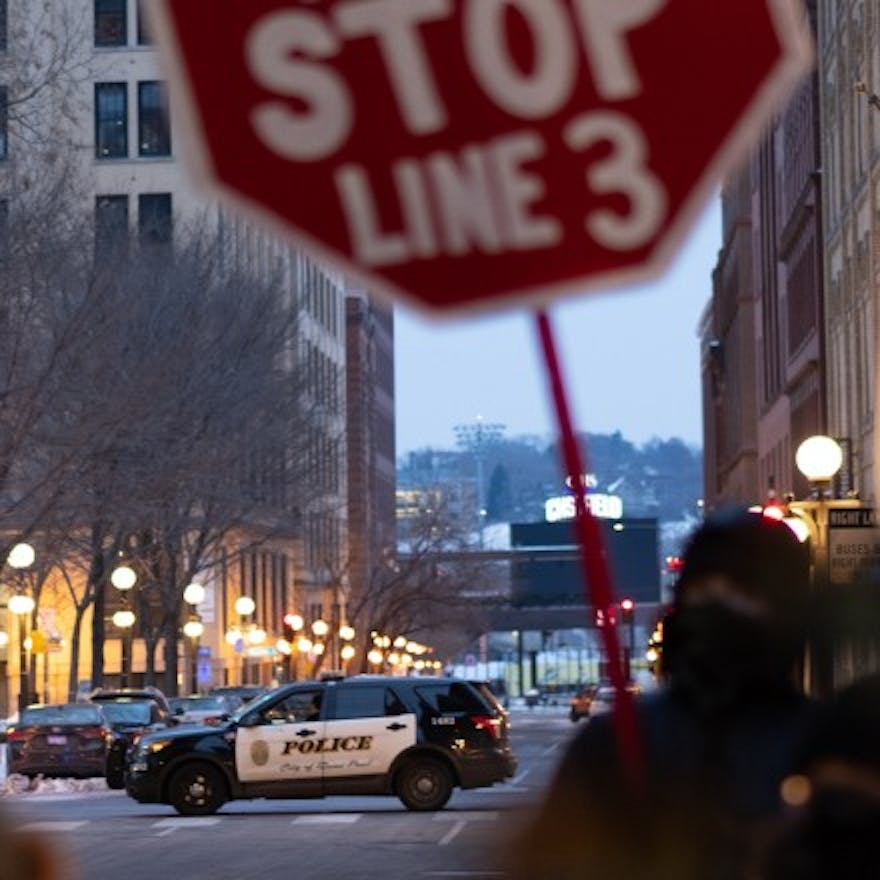
Water protectors opposed to the contentious Line 3 pipeline project have regularly staged non-violent direct actions that stop construction, with several hundred arrested in in action campaigns over the last year. In June, 179 people were arrested when thousands of water protectors shut down an Enbridge pumping station for two days as part of a multi-pronged Treaty People Gathering in Northern Minnesota.

Participating in the July 1 lockdown, Ginger Cassady, the Executive Director of the Rainforest Action Network, called on President Joe Biden and the financiers of the pipeline project to stop Line 3 construction.

“Im in Northern Minnesota at the Headwaters of the Mississippi protesting Enbridge’s toxic pipeline. This pipeline is not only a direct assault on Indigenous people but it’s also an assault on their local land treaty rights.”– Ginger Cassady, E.D. Rainforest Action Network

Earlier in the week on June 28, dozens of Hubbard County Sheriffs barricaded the entry into the Namewag Camp, a privately-owned property used by water protectors. This prompted a wave of supporters showing up to the land in solidarity. Nearly a dozen people were arrested near the roadway by authorities during a two-day span before the sheriffs left the property. Some believe the Hubbard County Sheriff’s aggressive, unusual enforcement of a minor clerical issue involving a county road easement by the camp property was timed to coincide with Enbridge drilling nearby under the Mississippi River.

Enbridge plans to have construction completed by the end of the year. Meanwhile, direct actions by water protectors seeking to halt construction are expected to continue through the summer.

Friday, June 18, 2021

LOCAL COPS SAID PIPELINE COMPANY HAD INFLUENCE OVER GOVERNMENT APPOINTMENT ~~ Alleen Brown

~~ posted for dmorista ~~

AS THE CANADIAN oil pipeline company Enbridge awaited its final permits last summer to begin construction on the Line 3 tar sands oil transport project, Minnesota sheriff’s offices along the route fretted. With an Anishinaabe-led movement pledging to carry out nonviolent blockades and demonstrations to prevent the pipeline’s construction, local police worried they’d be stuck with the costs of policing and wanted Enbridge to pay instead.

As part of its permit to build Line 3, the Minnesota Public Utilities Commission, or PUC, created a special Enbridge-funded account that public safety officials could use to pay for policing Enbridge’s political opponents. The police were concerned about who state officials would hire to decide which invoices to pay or reject.

Last June, Kanabec County Sheriff Brian Smith wrote an email to other sheriffs along the pipeline route. “I think we need to let the PUC know that the person selected needs to be someone that we also agree upon,” Smith wrote. “Not a member of the PUC, not a state, county or federal employee, but someone that has an understanding of rioting and MFF operations” — referring to mobile field force operations, or anti-riot policing.

In response, Enbridge offered reassurances, according to other police on the email chain. “I had a discussion with Troy Kirby (Enbridge Chief of Security) this morning, and expressed concern over that position and the escrow account,” Aitkin County Sheriff Daniel Guida replied. “He indicated they have some influence on the hiring of that positon [sic] and he would be involved to ensure we are taken care of, one way or another.”

“They are being incentivized to carry out the goals of a foreign corporation, and they’re being taken care of for doing it.”

The exchange between the sheriffs is an example of the public-private collaborations between law enforcement and fossil fuel companies that have raised alarms for civil rights advocates and environmental activists across the U.S. Oil, gas, and pipeline corporations have forged a range of creative strategies for funding the police who respond to their political opponents, from paying elected constables for work as private security to creating an entire police unit dedicated to protecting infrastructure. Other industries have found ways to route money to police, but corporate law enforcement funding related to pipeline projects is among the most pervasive. Civil liberties advocates say the corporate cash raises troubling questions about private influence over the public institution of policing, noting that growing anti-pipeline protest movements have been met by heavy-handed police tactics.

With opposition to the Line 3 pipeline mounting, public records obtained by The Intercept shed new light on the depths of the cooperation between Enbridge and public safety officials in Minnesota — especially law enforcement agencies along the route. “They are being incentivized to carry out the goals of a foreign corporation, and they’re being taken care of for doing it,” said Mara Verheyden-Hilliard, director of the Partnership for Civil Justice Fund’s Center for Protest Law and Litigation, which is representing Line 3 pipeline opponents. She said the dynamic was on view in the sheriff’s description of Enbridge influence over the escrow account hire: “That communication is defining of the relationship between the Enbridge corporation and law enforcement in Northern Minnesota.”

Guida, the Aitkin County sheriff, told The Intercept that, at the time of the email, sheriffs were concerned the account liaison appointment was taking too long and believed Kirby, the Enbridge security head, could speed up the process. Asked for comment, Enbridge directed questions about the account to the Minnesota Public Utilities Commission. In a statement, PUC spokesperson Will Seuffert said, “Enbridge had no input into the Escrow Account Manager selection.” The panel that made the appointment included two commission staff members and one from the Minnesota Department of Public Safety who worked “without any involvement from Enbridge, or any other parties,” he said.

In February, Richard Hart, a former official at the Hennepin County Sheriff’s Office and a former deputy chief of police in Bloomington, Minnesota, was hired for the role. So far, he has approved more than $900,000 in Enbridge funding for law enforcement agencies and other public safety institutions.

For Indigenous water protectors, the cooperation between law enforcement and pipeline companies is part of a long history of public security forces being leveraged against Native tribes for private gain, going back to the violent westward expansion of the United States. Tania Aubid, an anti-Line 3 organizer and a member of the Rice Lake Band, which is part of the Mille Lacs Band of Ojibwe, said, “It’s keeping on with the Indian Wars.”

Money for Tear Gas

Chief among the law enforcement officers’ concerns about the escrow account, according to emails obtained through public records requests, was a rule in the Line 3 permit limiting how the funds can be used. Sheriff’s offices can use the account to pay for any public safety services “provided in and about the construction site as a direct result of the construction and removal of the pipeline,” but they cannot use it to pay for equipment, unless it’s personal protective gear.

It was widely understood — and a particular source of frustration — that so-called less-lethal munitions, such as tear gas, would not be reimbursed through the account. “We do know for absolute certain that munitions will NOT be an allowable expense,” noted Carlton County Sheriff Kelly Lake in a November 19 email to fellow members of the Northern Lights Task Force, a coalition of law enforcement and public safety officials set up primarily to respond to anti-pipeline demonstrations.

“So, we can get reimbursed for trafficking but not equipment needed to protect our community’s? [sic]” wrote Cass County Sheriff Tom Burch a few days later, in reply to an email that said Enbridge funds could be used to address an expected increase in human trafficking related to the arrival of hundreds of temporary workers.

protectors protest at a construction site for Enbridge’s Line 3 oil pipeline near Palisade, Minn., on Jan. 9, 2021.


Photo: Kerem Yucel/AFP via Getty Images

The funding gap for less-lethal munitions was important enough that law enforcement officials raised it with Minnesota Gov. Tim Walz. In early October, Walz set up a phone call with the sheriffs along the Line 3 route. Ahead of the calls, Lake, the Carlton County sheriff, distributed a handful of talking points to the group. Among them was the problem of tear gas funding.

“One identified resource we know that will aid in response should the protests become violent and out of control is the use of less lethal munitions such as gas,” the talking points said. “We have been told by the PUC that this absolutely will not be an allowable expense for reimbursement through the Public Safety Escrow Account. Enbridge has said they would not directly reimburse this expense as they have put funds aside into the Public Safety Escrow Account already to be utilized to reimburse public safety for response.”

It continues, “If counties along the pipeline route face mass crowds of violent protests that are prolonged events, the small resources of munitions that we may have will be very quickly depleted. Without these less lethal options, there is an incredibly increased risk for responders, protestors, and the community as a whole.”

The governor apparently offered words of comfort. “Dave’s assessment is that it went very well and he believes that the Governor will figure out the funding piece and the munitions,” Lake said in an email after the call, referring to Dave Olmstead, a retired Bloomington police commander who serves as Minnesota’s special events preparedness coordinator for Line 3, overseeing the public safety response to the project. “It sounds like his staff was already trying to line up a meeting internally for them to discuss it.”

A spokesperson for the governor’s office did not answer a question about the phone call and directed all queries about state funding to the Department of Public Safety, which did not respond to a request for comment. Guida told The Intercept that his department has received no additional funding from the state to pay for less-lethal weapons.

Enbridge Funding Equipment

Regardless of what funding the governor arranged, less-lethal weapons, including tear gas, are baked into law enforcement’s plans for Line 3.

A Northern Lights Task Force document laying out the overarching police strategy for Line 3 protests, also obtained through a public information request, repeatedly notes the importance of protecting free speech rights, urging officers to “make reasonable efforts to employ ‘non-arrest’ methods of crowd management” and to target leaders and agitators, rather than detaining people en masse.

If targeted arrests fail to disperse a group, according to the document, then chemical weapons are allowed, including smoke, pepper spray, or a combination of the two, followed by longer-range pepper spray, pepper blast balls, and tear gas. Impact munitions, firearms-fired projectiles in the less-lethal category like sponge rounds, marking rounds, and pepper spray-tipped rounds can only be targeted at individuals whose actions put others in danger of injury. The use of dogs requires permission from local law enforcement commanders.

Guida justified planning for the use of less-lethal munitions by comparing the Line 3 opposition to the movement against the Dakota Access pipeline at the Standing Rock Sioux reservation. “It seemed that without less than lethal munitions, when they lost control, that things would have continued to spiral out of control,” Guida said.

Verheyden-Hilliard is part of the legal team representing Dakota Access pipeline opponents in a class-action civil rights lawsuit against law enforcement officials in North Dakota, including a woman who lost vision in one eye after police shot her in the face with a tear gas canister. “If we want to look at what happened with DAPL, I think that’s a good idea,” she said. “The lesson we can learn from there is in fact that equipping all these local sheriffs with these very powerful and very indiscriminate and very dangerous weapons causes substantial injury and harm to people.”

None of the weapons have yet been deployed, but counties have stocked up. Beltrami County, which is located near but not on the pipeline route, even submitted an invoice requesting reimbursement from the Enbridge-funded escrow account for more than $10,000 in less-lethal weapons, including batons, pepper spray, impact munitions, and tear gas grenades, despite the restriction.

Hart rejected those requests but approved $911,060 in other reimbursements, including approximately $170,00 worth of equipment: mostly tactical and crowd control gear, as well as miscellaneous items. Reimbursements, for example, were made for port-a-potty rentals, which are considered personal protective equipment because, according to Hart, “the toilets protect jail employees from biological exposure during jail overcrowding.” Among other approved “personal protective equipment” are baton stops, which attach a baton to officers’ duty belts, and gas masks, which protect officers from the tear gas they deploy.

Shanai Matteson, an opponent of the Line 3 who is from Guida’s county, said it feels inevitable that tear gas and other munitions will be used. “What you practice for, and the mindset you have, is what you bring. They’re soldiering up to protect a private company’s assets, so what do we think is going to happen?” Matteson said. “Stopping work on a project that’s destroying the place that we live is not the same as violence that would warrant this kind of a response.”