Sunday, September 12, 2021

Saturday, September 11, 2021
Time to End the Medicare Advantage Scam ~~ Thom Hartman
https://hartmannreport.com/p/time-to-end-the-medicare-advantage
The simple solution to the Medicare Advantage problem is to kill off the program. It was just a Trojan horse to privatize Medicare
 |

Over 100 Democratic lawmakers last week introduced legislation to lower the Medicare eligibility age to 60. There is one small problem that needs fixing, though: so-called “Medicare Advantage.”
This week my new book, The Hidden History of American Healthcare: Why Sickness Bankrupts You and Makes Others Insanely Rich is officially available in bookstores nationwide and online. Here’s a chapter excerpt I think you’ll find interesting, particularly after all those awful TV ads with former football and sitcom stars we’ve had to endure the past few years…
The “Advantage” War against Medicare
Medicare Advantage is a massive, trillion-dollar rip-off, of the federal government and of taxpayers, and of many of the people buying the so-called Advantage plans.
It’s also one of the most effective ways that insurance companies could try to kill Medicare For All, since about a third of all people who think they’re on Medicare are actually on these privatized plans instead.
Nearly from its beginning, Medicare has allowed private companies to offer plans that essentially compete with it, but they were an obscure corner of the market and didn’t really take off until the Bush administration and Republicans in Congress rolled out the Medicare Modernization Act of 2003. This was the GOP’s (and a few corporatist Democrats’) big chance to finally privatize Medicare, albeit one bite at a time.
That law created a brand known as Medicare Advantage under the Medicare Part C provision, and a year later it phased in what are known as risk-adjusted large-batch payments to insurance companies offering Advantage plans.
Medicare Advantage plans are not Medicare. They’re private health insurance most often offered by the big for-profit insurance companies (although some nonprofits participate, particularly the larger HMOs), and the rules they must live by are considerably looser than those for Medicare.
Even more consequential, they don’t get reimbursed directly on a person-by-person, procedure-by-procedure basis. Instead, every year, Advantage providers submit a summary to the federal government of the aggregate risk score of all their customers and, practically speaking, are paid in a massive lump sum.
The higher their risk score, the larger the payment. A plan with mostly very ill people in it will get much larger reimbursements than a plan with mostly healthy people. After all, the former will be costly to keep alive and healthy, while the latter won’t cost much at all.
Profit-seeking insurance companies, being the predators that they are, have found a number of ways to raise their risk scores without raising their expenses. The classical strategies of tying people to in-network providers, denying procedures routinely during first-pass authorization attempts, and having very high out-of-pocket caps are carried over from regular health insurance systems to keep costs low and profits high.
But with Medicare Advantage, the big insurance companies have invented a whole new way to rip us all off while padding their bottom lines.
For example, many Medicare Advantage plans promote an annual home visit by a nurse or physician’s assistant as a “benefit” of the plan. What the companies are doing, though, is trying to upcode their customers to make them seem sicker than they are to increase their overall Medicare reimbursement risk score.
“Heart failure,” for example, can be a severe and expensive condition to treat . . . or a barely perceptible tic on an EKG that represents little or no threat to a person for years or even decades. Depression is similarly variable; if it lasts less than two weeks, there’s no reimbursement; if it lasts longer than two weeks, it’s called a “major depressive episode” and rapidly jacks up a risk score.
The home health visits are designed more to look for illnesses or codings that can increase risk scores than to find conditions that require medical intervention. They’re so profitable that an entire industry has sprung up of companies that send nurses out on behalf of the smaller insurance companies.
In summer 2014, the Center for Public Integrity (CPI) published an in-depth investigative report titled Why Medicare Advantage Costs Taxpayers Billions More Than It Should.
They found, among other things, that one of the most common scams companies were running involved that very scoring of their customers as being sicker than they actually were, so that their reimbursements were way above the cost of caring for those people.
Here are a few quotes from the report:
“Risk scores of Medicare Advantage patients rose sharply in plans in at least 1,000 counties nationwide between 2007 and 2011, boosting taxpayer costs by more than $36 billion over estimated costs for caring for patients in standard Medicare.”
“In more than 200 of these counties, the cost of some Medicare Advantage plans was at least 25 percent higher than the cost of providing standard Medicare coverage.”
The report documents how risk scores rose twice as fast for people who joined a Medicare Advantage health plan as for those who didn’t.
Patients, the report lays out, never know how their health is rated because neither the health plan nor Medicare shares risk scores with them—and the process itself is so arcane and secretive that it remains unfathomable to many health professionals.
“By 2009, government officials were estimating that just over 15 percent of total Medicare Advantage payments were inaccurate, about $12 billion that year.”
Based on its own sampling of data from health plans, the report shows how CMS has estimated that faulty risk scores triggered nearly $70 billion in what officials deemed “improper” payments to Medicare Advantage plans from 2008 through 2013.
CMS decided, according to the report, not to chase after overcharges from 2008 through 2010 even though the agency estimated through sampling that it made more than $32 billion in “improper” payments to Medicare Advantage plans over those three years. CMS did not explain its reasoning.
The report documents how Medicare expects to pay the health plans more than $150 billion this year [2014, the year the study was published].
Companies are almost never nailed for these overcharges, and when they are, they usually pay back pennies on the dollar.
For example, when the Office of Inspector General, Health and Human Services (which oversees Medicare), audited six out of the hundreds of plans on the market in 2007, they found that just those six companies “had been overpaid by an estimated $650 million” for that one year. As the Center for Public Integrity states, “CMS settled five of the six audits for a total repayment of just over $1.3 million.”
The Centers for Medicare and Medicaid Services also, in 2012, decided to audit only 30 plans a year going forward. As CPI noted, “At that rate, it would take CMS more than 15 years to review the hundreds of Medicare Advantage contracts now in force.” And that’s 15 years to audit just one year’s activity!
Things haven’t improved since that 2014 investigative report from CPI. In September 2019, Senator Sherrod Brown of Ohio and five Democratic colleagues sent a letter to President Donald Trump’s CMS administrator, Seema Verma.
“The recent HHS Payment Accuracy Report exposes that taxpayers have overpaid Medicare Advantage plans more than $30 billion dollars over the last three years,” Brown wrote. “This report comes on the heels of a 2016 Government Accountability Office (GAO) report and a 2013 GAO report on [Medicare Advantage] plan overcharges and the failure of the Centers for Medicare and Medicaid (CMS) to recoup billions of dollars of improper payments from MA plans.”
Meanwhile, during the four years of the Trump administration, CMS went out of their way to illegally promote Medicare Advantage plans (which typically cost CMS far more than a regular Medicare plan).
A February 2020 report in the New York Times stated, “Under President Trump, some critics contend, the Centers for Medicare and Medicaid Services, which administers Medicare, has become a cheerleader for Advantage plans at the expense of original Medicare.”
The report pointed to the draft release of the 2019 Medicare & You handbook, which is mailed every year to all enrollees and posted online. “Advocates and some lawmakers criticized language describing Advantage as a less expensive alternative to original Medicare.”
The National Bureau of Economic Research (NBER) compared Medicare Advantage with traditional Medicare and found the Advantage programs to be mind-bogglingly profitable: “MA insurer revenues are 30 percent higher than their healthcare spending. Healthcare spending for enrollees in MA is 25 percent lower than for enrollees in [traditional Medicare] in the same county and [with the same] risk score.”
At the same time, Medicare Advantage often screws its customers. According to the NBER study, people with Medicare Advantage got 15 percent fewer colon cancer screening tests, 24 percent fewer diagnostic tests, and 38 percent fewer flu shots.
Speculation is rife as to why CMS would allow—much less promote—privatized plans that cost Medicare far more than original Medicare to rip off taxpayers to the tune of billions of dollars a month.
One possibility is regulatory capture—people working in CMS know that if they go along and get along, very well-paid jobs are waiting for them at for-profit insurance companies after a few years of government service. This is a chronic problem at other regulatory agencies, particularly those overseeing pollution, pharmaceuticals, telecommunications, and banking.
Another answer is that the Bush administration—where Medicare Advantage started—was so enamored of the idea of privatizing Medicare to eventually destroy the program (George W. Bush campaigned extensively from the late 1970s through his presidency to privatize both Social Security and Medicare) that they turned a blind eye to abuses.
The Obama administration had other priorities, as they were trying to push through the Affordable Care Act and didn’t want to upset the apple cart. And when Trump came into power, his folks saw anything that drained resources out of Medicare and into the pockets of multimillionaire health insurance executives—a group notoriously generous when it comes to making political contributions—as a plus.
You Are Locked in to Medicare Advantage
A fellow I’d known decades ago recently bubbled back into conversation among a few of us who’d hung out together in New York back in the 1970s. Sam, I’ll call him, had turned 65 and hadn’t had employer-provided health insurance in years. He spent a few hours trying to figure out how to sign up for Medicare and then gave up, totally confused, figuring he’d try again in a few months.
Unfortunately, his prostate intervened. When Sam started experiencing pain urinating, he visited a local “doc in a box” urgent care clinic, where they gave him a PSA test. The result was shocking: his PSA was so high that it was a virtual certainty he had prostate cancer, and possibly it had even metastasized, a situation that is the second-leading cause of cancer death in American men.
Telling him that he’d be facing hefty doctor and hospital bills regardless of the outcome, the urgent care clinic signed him up for a Medicare Advantage plan offered by an affiliate that almost certainly paid them a commission for the sign-up. Sam was excited, though, because he now had insurance, and it was a “no dollar” plan that didn’t cost him a penny.
Sam then got on the phone to find a urologist who specialized in cancer. He found that the best worked out of Memorial Sloan Kettering Cancer Center in New York, and, telling them he was “on Medicare,” he made an appointment to see one of their top docs. A month later, when his appointment finally opened up, the person who was checking him into the system told him that he’d have to pay cash because his Advantage plan didn’t include Sloan Kettering.
In fact, more than a third of all Medicare Advantage plans nationwide do not include any of the National Cancer Institute centers, and none of the Advantage plans offered in the New York City area include the nation’s most famous one, Memorial Sloan Kettering Cancer Center.
Shocked, Sam contacted Medicare to see if he could transfer from Medicare Advantage to regular Medicare. This all happened in fall 2020, so they told him that he could make the change during the “open enrollment period” of October 15 to December 7. He made the change and called Sloan Kettering back.
This time, they wanted to know what Medigap policy he’d signed up for to fill in the 20 percent of billing that Medicare doesn’t cover. That sent Sam back to the internet and, ultimately, to an insurance agent, who told him that while Medigap plans can’t refuse you because of preexisting conditions when you first sign up when you turn 65, if you shift from Medicare Advantage back to traditional Medicare after that first enrollment, particularly if you’re older or sick, they can simply refuse to cover you.
Reporter Mark Miller wrote for the New York Times in February 2020 about Ed Stein, a 72-year-old man with bladder cancer and a Medicare Advantage plan that didn’t cover the cancer docs in his area who specialized in his type of cancer. He tried to shift back to traditional Medicare to cover what promised to be complex and expensive surgery and chemotherapy. As Miller wrote, “That was when he ran up against one of the least understood implications of selecting Advantage when you enroll in Medicare: The decision is effectively irrevocable.”
As of this writing (November 2020), my friend Sam still hasn’t seen a doctor. This is the state of healthcare in America as it’s been sliced and diced by the multibillion-dollar insurance industry.
Meanwhile, every fall, Americans are inundated with hundreds of millions of dollars’ worth of TV, direct mail, and internet advertising for Medicare Advantage plans. And where does the money come from to pay for that advertising?
It comes from the same place that provided over $1 billion in wealth to the former CEO of United Healthcare, and over $100 million a month in compensation to senior executives in the largest health insurance companies: denying claims while collecting risk adjustment claims from your tax dollars and mine.
The simple solution to the Medicare Advantage problem is to kill off the program. It was just a Trojan horse to privatize Medicare, and its presence will make Medicare for All even harder to implement. At the same time, the 20 percent hole that the GOP insisted on for skin in the game with real Medicare needs to go, too.
A comprehensive Medicare for All program will eliminate both of these problems.
Saturday, September 4, 2021
A Food Pandemic Infects America ~~ L. ALI KHAN
https://www.counterpunch.org/2021/09/02/a-food-pandemic-infects-america/
~~ posted for collectivist ~~

A food pandemic means the abundance of disease-causing foods (pathogenic foods) people consume regularly and consequently develop life-threatening morbidities. The U.S. has been infected with a food pandemic for many years, now spreading to other countries.
In 2020, the U.S. life expectancy dropped by 1.5 years from 78.8 to 77.3 years, which is facially attributable to the Covid-19 pandemic. However, the backstory points to a previously bursting food pandemic that covertly joined forces with the invading virus. For example, the Covid-19 patients with type-2 diabetes, a food disease, have been much more vulnerable to severe effects of the virus. With the number of deaths exceeding 616,000, the food plus virus pandemics have hit the U.S. hard. Even if the virus goes away, the food pandemic will continue to exact harm in the foreseeable future. Sadly, the pandemics deniers remain bountifully ignorant.
Public health is much more complicated than the mere availability of low-cost food. Food pandemics hit nations where food scarcity is infrequent, food production is high, distributions systems are efficient, but a massive amount of affordable food is pathogenic. Nutritional ignorance, overeating, Information perplexity, and food industry-sponsored smokescreens extend the reach and duration of the pandemic.
One may argue that even unhealthy food is better than prolonged starvation. The recent famines in history killed millions of people worldwide. In the 18th century, due to drought, crop failure, and poverty, Mughal India faced two famines that killed 21 million people, nearly ten percent of the population. In the 20th century, China faced two major famines, one in 1907 due to high rains that prevented crop production, another during 1959-61 primarily due to flawed government policy. These two famines wiped out at least 70 million people, mostly in rural areas. In 1921, amid a civil war and railroad disruptions, Russia suffered from a catastrophic famine that killed nearly 10 million people, breeding episodic cannibalism.
Ironically, in their effect on human life, food famines and food pandemics are distressingly similar. A famine emaciates the human body, causing mental distress, poor mobility, vulnerability to pathogens, multiple diseases, and premature death. A food pandemic fattens up the human body, causing the same morbidities as famine, including mental distress, compromised mobility, susceptibility to pathogens, numerous diseases, and early death. Sorrowfully, food pandemics are deadlier as they persist for decades, way longer than famines. Famine deaths are swift and dramatic. By contrast, food pandemics cause slow grinding but lethal diseases.
This study analyzes the four intertwined elements that precipitate a food pandemic: (1) a significant range of foods contain pathogenic ingredients; (2) pathogenic foods are readily available and affordable; (3) food consumption stimulates quantitative overloading (overeating) by altering biochemistry and generating food addiction; (4) foods cause life-threatening morbidities, such as diabetes, cardiovascular disease, kidney disease, vision loss, and cancer.
Pathogenic Ingredients
Research singles out two primary pathogenic ingredients found in most packaged foods, restaurant foods, and home-cooked foods: seed oils (corn oil, soybean oil, sunflower oil, canola oil, and others) and added sugars (fructose, corn syrup, maple syrup, and others). Of these two ingredients, added sugars come out on top as the main villain in producing type 2 diabetes and the associated cardiovascular disease, pancreatic malfunction, and kidney failure. “The people of the U.S. consume more sugar than any other country in the world. On average, Americans consume 126.4 grams of sugar daily.” The recommended dose varies from a lower limit of 11 grams to a higher limit of 25 grams. No nutrition expert contends that added sugars benefit human health.
Seed oils (vegetable oils) offer an alternative to animal fats, such as butter and lard. However, the debate over seed oils is confusing and controversial. The critics of seed oils contend that these oils disturb the balance between omega-6 and omega-3 fats. Excessive ingestion of omega-6 fats through seed oils produces chronic inflammation in the human body, leading to numerous diseases. Animal fats, too, remain controversial, but influential experts recommend “cutting back” on these fats.
On the factual level, the use of seed oils has dramatically increased in the past fifty years (1970-2020). According to the data that the Economic Research Service (ERS) of the U.S. Department of Agriculture collects, American consumers are ingesting more than 400 average daily calories per capita from vegetable oils in recent years. In contrast, in 1970, they drew 115 average daily calories per capita from salad and cooking oils. This increase is nearly four-fold. (see graph) Over these fifty years, the average daily calories from butter, lard, and dairy fats have varied small amounts. However, as good news, the average daily calories from margarine (trans fats) have plummeted from 58 to less than 15 per capita.
In addition to seed oils and sugars, pathogenic foods also contain pesticides, growth hormones, and heavy metals. Furthermore, regardless of antibiotics and steroid injections, all meat contains sex steroid hormones, and all chicken contains drug-resistant bacteria. (A more health-conscious European Union (E.U.) permits only hormone-free U.S. beef. The U.S. exports poultry products (chicken and turkey) to more than 120 countries around the world. The E.U. refuses to accept U.S. poultry washed with chlorine and antimicrobial chemicals.) In recent years, chemicals in agriculture increased from below 3 billion in 1970 to over 15 billion. (see graph).
The distinction between organic and inorganic foods has created a new pricey market for organic foods beyond the pocketbook reach of most Americans. Non-organic foods–whether fruits, vegetables, dairy, and meat–are produced with synthetic chemicals to boost growth. By contrast, organic foods face less exposure to pesticides and antibiotics. Yet, cross-contamination between organic and non-organic foods weakens the distinction.
According to ERS, in 2018, on average, people in the U.S. consumed more meat, eggs, nuts, grains, and refined sugars than the recommended amounts. Chicken consumption has doubled since 1970. The consumption of vegetables and fruits falls short of 2020-2025 dietary guidelines. For the most part, Americans are eating a nutritionally deficient diet infected with pesticides, hormones, and numerous chemicals used in preservation, processing, packaging, coloring, and canning. It is no relief that the food is affordable.
Affordability
The food pandemic sets in motion when the pathogenic food is readily available and affordable. Affordable food consists of grains, sugars, vegetables, fruits, and meat, mainly carrying pathogenic ingredients. In most states, the lowest average food cost per month for one person ranges from $200 to $233.
From time immemorial, the food available to the rich has been of much higher quality than the food available to the poor. This dichotomy continues to bedevil many nations worldwide, including the U.S. The disadvantaged communities invariably have insufficient food of lower grade, not conducive to good health. There are historical examples of famine when food was available, but it was too expensive for poor people to buy. While food affordability is a desirable social objective, the question remains whether affordable food is healthy.
Food available to most U.S. inhabitants is affordable, though some families struggle with meager incomes. In 2019, around 34 million people, 10.5 percent of the U.S. population, lived in poverty. However, the poverty rate for Black communities stood at nearly 19%, for Hispanics at 16%, exceeding the national poverty rate. The poverty rate for minors under the age of 18 was over 14%.
In sum, Black communities, Hispanics, and children face food insecurity. In addition to the 34 million under the poverty level, millions of Americans above the poverty line have little choice but to consume affordable foods of questionable quality. Whether these numbers and communities have improved or worsened in the past two Covid-19 years remains to be seen.
The invasion of Covid-19 has complicated social dynamics and food ingestion. For decades, people are eating pathogenic foods far too much and far too often for many reasons, including physical immobility, mental distress, and loneliness. Unfortunately, quantitative overloading of the body breeds numerous diseases.
Quantitative Overloading
“Eat as much as your heart desires” is the siren song of American Argonautica.
Under evolutionary constraints, the human body has evolved to bear periods of starvation. For centuries, humans did not eat every day, certainly not three or more times a day. Food was scarce. Animals were challenging to hunt. Seasons, mainly winters, complicated the availability of fruits and plants. Food preservation was elementary. Consequently, early humans mostly remained in a fasted rather than fed state.
The 21st-century humans face a different challenge: quantitative overloading of the digestive system with unhealthy foods. Americans are in a fed state for nearly 16 to 18 hours a day and do not allow the pancreas to take a break from releasing insulin and digestive enzymes. The stomach carries a Sisyphean boulder. Obesity is the inevitable consequence of quantitative overloading. In 2017-2018, U.S. obesity hit 42.4%. This figure is a nearly four-fold increase from 1970 (see graph). Furthermore, millions more are overweight. This increase in obesity varies little across income, gender, and racial groups
For decades, the U.S. has been at the cutting edge of accelerating the plentiful availability of food. Thanks to scientific agriculture, farming, food processing, food preservation, refrigeration, storage, packaging, canning, faster transportation, the U.S. has solved almost all problems related to food availability. Furthermore, the ready-to-eat food, fast food, restaurant food, and the food available at grocery stores in cities, towns, and gas stations on highways have revolutionized the convenience at which food is available any time of any day, 24/7. Some urban communities are “food deserts” where the food is available only at convenience stores.
The food industry stimulates quantitative overloading with aggressive marketing, deceptive labeling, and faulty research. Kids and teens are susceptible to food advertising. For example, Black-targeted TV shows overwhelmingly advertise “fast food, candy, sugary drinks, and unhealthy snacks.” The food labeling confuses rather than informs the consumers as food manufacturers hide pathogenic ingredients with unfamiliar technical names. For example, dextrose and treacle are sugars. Even organic sugar is sugar.
The most controversial feature of the food pandemic is the industry-sponsored research that promotes dairy, eggs, meat, cereals, and seed oils. For example, because of conflicting research findings, the consumers do not know how many eggs they should consume per week. Keto and carnivore diets promote animal sources of protein as weight loss strategies. Even some internet physicians enter the scene with podcasts promoting their books and supplements to further confuse the consumers about healthy foods.
Research controversies are a godsend for advertising all sorts of foods, as confusion benefits the food industry rather than the public. Frustrated with conflicting mantras, “fat is bad,” “fat is good,” most consumers give up on guidance and decide to eat what they like without regard to health consequences. This eating crisis mired in utter uncertainty obliterates the distinction between good food and bad food.
Furthermore, the food industry engages in manipulative research to find chemicals that promote the overeating of products, a concept like an addiction. Select chemicals included in processed foods release dopamine, a neurotransmitter that furnishes pleasure and yearning for more. Studies demonstrate that foods with added sweeteners and fats have “the greatest addictive potential. Much like the tobacco industry, the food industry emphasizes “personal responsibility” in craving pathogenic foods.
Food Pathologies
Contaminating consumer products with pathogenic ingredients is dishonorable. Willfully doing so is a crime. The pathogenic seed oils, sugars, and foods infected with pesticides, hormones, and chemicals kneaded into food introduce the invisible, even delicious, poisons in mainstream staples. Sodas, donuts, chips, cookies, and ice creams (rightfully) get the bad rap. However, even relatively healthier foods contain overt and covert pathogenic ingredients.
There is a near consensus among nutrition experts that refined carbohydrates and sugar consumption leads to type 2 diabetes. This mother disease gives birth to obesity, cardiovascular disease, kidney failure, vision loss, and other systems pathologies. Once considered morbidity of mature age, diabetes is now penetrating children and adolescents younger than age 20. Diabetes begins to weaken the immune systems long before it surfaces in blood tests.
The nutrition debate over dietary fat is confusing and controversial, benefitting the food industry. Keto diets emphasizing the replacement of carbohydrates with fats complicate the discussion. However, the critics assert that “Dietary fat induces overconsumption and weight gain through its low satiety properties and high caloric density.” Since ingested fats must first pass through the lymphatic vascular system, quantitative overloading of fats can overwhelm the lymph nodes.
Food processing chemicals aggravate the villainy of foods derived from sugars and seed oils. For example, nitrates and nitrites, extensively used to process food, correlate with various forms of cancer. Bisphenols used in soda cans and food lining interferes with puberty and fertility. Perchlorate, a chemical released from defense and military operations and found in drinking water and surface waters, attacks thyroid function. Artificial food coloring to attract children worsens the symptoms of attention deficit disorder.
Most Americans live in a monster Skinner Box in which no matter which lever you press, the food you get is pathogenic.
Conclusion
The food pandemic has been slowly gaining momentum in the past few decades and will continue to spawn lethal pathologies in the years to come. Humans engage in quantitative overloading of pathogenic foods derived from sugars and seed oils for various personal, social, and economic reasons. The preservatives introduce a toxic chemical load to healthy and unhealthy foods. Obesity and the consequent morbidities are strongly correlated to the food pandemic. The affordability of food is a legitimate social goal. But affordable food must not be toxic. Unfortunately, nutrition research, some sponsored by the food industry, confuses consumers with conflicting findings. Frustrated consumers, not knowing what is good for their health, fall back on what taste buds crave, thus ingesting pleasurable poison. Jack Lalanne (1914-2011), the legendary nutrition maharishi, cautioned people about processed food in a provocative warning: “If it tastes good, spit it out.” Even if the food is entirely healthy, eating less is evolutionary more protective of the human body.
Meet the influencers making millions by dealing doubt about the coronavirus vaccines.~~ Liz Essley Whyte
~~ posted for collectivist ~~
Heather Simpson never thought to question vaccines. Her parents vaccinated her when she was a child, and she got tetanus and flu shots as an adult.
But when she and her husband were thinking about starting a family, she saw an ad for the documentary series “The Truth about Vaccines,” and “fear crept in,” she later wrote.
Simpson paid about $200 for the series, which taught her the tenets of vaccine skepticism.
“I left that docuseries just thinking this is it. This is how autism happens. This is how allergies happen,” the 30-year-old Texan said. “How else would it happen?”
When her daughter was born in 2017, Simpson decided not to immunize her. She began posting on social media about her vaccine fears. She then went viral in 2019 for uploading a photo of her Halloween costume of, as she put it, “the least scary thing she could think of — the measles.”
Scientists widely agree vaccines prevent dangerous diseases and do not cause autism or allergies. But in a few years Simpson had gone from accepting that consensus to preaching against it. And it all started with the documentary series made by Tennessee couple Ty and Charlene Bollinger, who got their start by questioning mainstream cancer treatments such as chemotherapy.
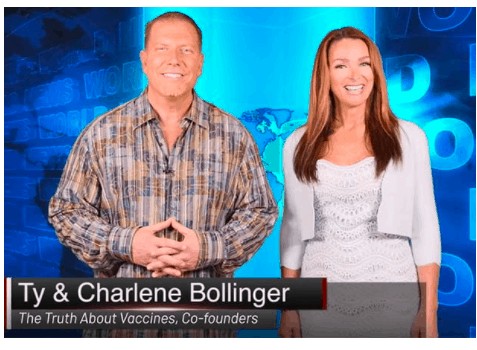
More than 450,000 people signed up to view the series the year it debuted, according to figures the Bollingers posted online, and 25,000 bought copies. At the price Simpson paid, the couple would have grossed $5 million in sales.
For the Bollingers and a network of similar influencers, speaking out against vaccines, including the coronavirus shots, is not just a personal crusade. It’s also a profitable business.
The Bollingers, for example, sell documentaries and books; other influencers hawk dietary supplements, essential oils or online “bootcamps” designed to train followers in anti-vaccine talking points. They frequently share links to each other’s content and products. Although the total value of anti-vaccine businesses is unknown, records indicate that the top influencers alone make up a multimillion-dollar industry. In 2020, the Bollingers told a court their cancer business had raked in $25 million in transactions since 2014.
In their videos, the Bollingers speak in earnest, unscripted, Southern-accented tones, as if they were friendly neighbors sharing lawn-care tips. Evangelicals with four children, they pepper their messages with Bible verses. They are among the most influential conduits for anti-vaccine messages online, with more than 1.6 million followers on various social media platforms and 2 million they say subscribe to their emails. The Center for Countering Digital Hate, a U.K.-based organization that fights misinformation, has counted them among the dozen personalities responsible for most of the anti-vaccine misinformation on the intthe internet
“The bottom line is we have such a large following,” Charlene said recently in an interview with conspiracy hub InfoWars. “People are listening to us. They know that we care about them.”
Their latest target: the coronavirus vaccines.
The Bollingers have falsely claimed that the COVID-19 vaccines edit a recipient’s genes. They’ve insinuated that the shots caused an uptick in COVID-19 deaths in Tennessee. They’ve called vaccination “this abominable COVID shot.”
Anti-vaccine messages from influencers like the Bollingers reach more than their most devoted followers, and are a major reason scientists worry the U.S. will continue to see coronavirus outbreaks.
“The anti-vax and vaccine-hesitant community has been very loud on social media,” said Jessica Malaty Rivera, a science communicator with the COVID Tracking Project who dispels vaccine myths on Instagram. “They’ve had a steady drumbeat of doubt, and we’re just playing catch-up.”
FINDING FOLLOWERS
Before he became an outspoken vaccine opponent, Ty Bollinger was a Texas accountant and former bodybuilder wondering why so many of his relatives had died of cancer.
A Baylor University graduate, he was five years into his accounting career and newly married when his 52-year-old father doubled over in pain while eating, as Ty has often recounted. Doctors suspected gallstones but instead during surgery found extensive, cancerous stomach tumors. His father died 25 days later. (The Center for Public Integrity reached out multiple times, but the Bollingers did not agree to be interviewed for this story. This account is based on public records and what the couple has shared online.)
Cancer killed five more of Ty’s relatives, and finally, in 2004, his mother. He began to research the disease at libraries and bookstores. The result was his first book, “Cancer: Step Outside the Box,” which argued that “Mother Nature” could treat cancer better than doctors and medications.
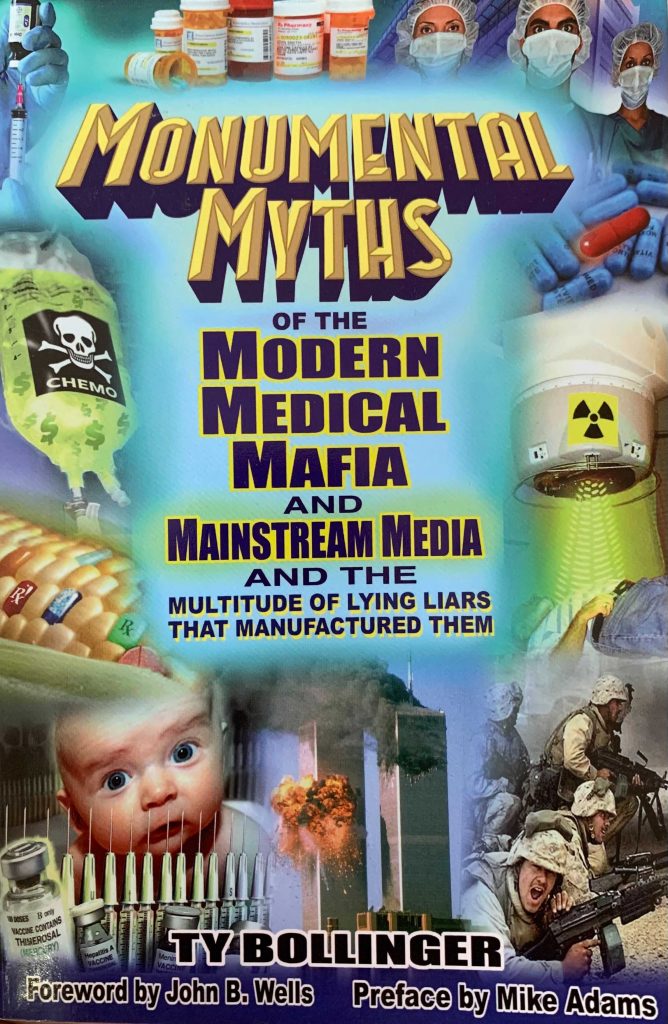
His next book, “Monumental Myths of the Modern Medical Mafia and the Mainstream Media and Multitude of Lying Liars that Manufactured Them,” recounted how he “woke up” while researching cancer, convinced that federal agencies like the Food and Drug Administration were suppressing information about natural treatments for the disease. A California doctor he’d consulted for his research then sent him a DVD claiming that 9/11 was an inside job. “You’re crazy!” Ty remembered telling the doctor. But he and Charlene watched. “We were sickened by the fact that, for the first time in our lives, we realized that the USA wasn’t what we always thought it was,” he wrote. “Little did we know that many people love being deceived and living in the matrix.”
Bollinger went on in the 2013 book to detail more of his false, conspiratorial beliefs: that HIV tests are meaningless and common AIDS medications are toxic; that planes spew poisonous “chemtrails” across the sky to control the weather; and that everything from the Oklahoma City bombing to the Boston Marathon bombing to 9/11 were inside jobs meant to strengthen government power. Bollinger also alleged that elites were covering up the true extent of the Fukushima nuclear disaster: “I’d bet that by 2020, Tokyo is uninhabitable.” (In 2021, central Tokyo is still inhabited by more than 9 million people.)
Bollinger’s new career skyrocketed with a 2015 docuseries, “The Truth about Cancer.” In addition to raking in millions of dollars in sales, the couple later said all their films had been watched by more than 20 million people combined. A 2016 followup book was a New York Times bestseller. Cancer also became the center of their growing social media empire. More than 1.1 million people now follow The Truth About Cancer on Facebook, and another 500,000 follow the Bollingers via other online pages or social media platforms.
In 2017, the couple launched “The Truth About Vaccines,” the docuseries Simpson, the Texas mom, watched. The Bollingers framed the documentary as an earnest search for truth from both sides of a debate, but really the episodes strung together dozens of interviews with vaccine skeptics.
Around the same time, the couple began to sell dietary supplements. “[We want to] make sure that you have a reliable source of bioavailable, whole-food-based supplements,” the Bollingers told their customers. But in 2018 the Environmental Research Center, a California environmental group, notified the Bollingers’ supplement company of an impending lawsuit alleging that some of their products contained dangerous amounts of lead, a poison that can cause brain and kidney damage. Shortly after, the Bollingers announced they had parted ways with the supplement business they helped start with a partner and said they couldn’t go into detail due to a non-disclosure agreement. A month later, their former firm agreed to pay $119,500 to settle the California case, without admitting to selling contaminated products. The Bollingers subsequently sealed what they called a “strategic alliance” with a competing supplement brand, Ancient Nutrition, which they still promote.
In a March article on his vaccines website, Ty Bollinger recommended five substances he said would “mitigate damage” in those who had already taken certain coronavirus vaccines. The article contained affiliate links for iodine, zinc and quercetin, which suggests that Bollinger likely received a cut of the sales. But the article did not disclose in close proximity to the links that they were advertisements, as required by Federal Trade Commission regulations. The site contains only this general disclaimer if users scroll to the bottom of the page: “If you purchase anything through this website, you should assume that we have an affiliate relationship with the company providing the product or service that you purchase, and that we will be paid in some way.”
“We’ve already reached millions, but we want to reach billions, because everybody deserves the truth.”
CHARLENE BOLLINGER
The Bollingers’ work has made them wealthy. Their 10,000-square-foot home with a pool and pool house in rural middle Tennessee is valued at more than $1.4 million. “While we have generated income from our documentary films, we find nothing wrong with making a living,” Ty wrote this year.
In recent months, the Bollingers have increasingly discussed vague, right-wing conspiracies via online videos and platforms such as Telegram, though they keep much of that content off their prominent cancer website. “Italy, it goes through the Vatican. We know that [former president Barack] Obama is in on this with [left-leaning billionaire George] Soros,” Charlene said in a video in January. It was unclear what she was referencing. “Something big is happening.”
And in July of last year, the Bollingers set up a political fundraising committee, the United Medical Freedom Super PAC, to support candidates for public office who want to “transform the medical and health systems in America.” To date, they’ve used it to raise more than $60,000, Federal Election Commission records show, but have not donated any funds to candidates or other political campaigns. Instead, the PAC has paid out honorariums to various anti-vaccine or right-wing activists — including more than $11,000 to Roger Stone, President Donald Trump’s long-time friend and confidant who was convicted of lying to Congress and pardoned by Trump.
January 6 found the Bollingers outside the U.S. Capitol, speaking at a rally they helped organize, as insurrectionists stormed the building. “We pray for the patriots that are there now inside, they’re trying to get inside that Capitol,” Charlene said on a flag-draped stage in a video that was later aired on CNN. “Lord, use these people to eradicate this evil, these swamp creatures, this cesspool of filth and waste.” (The Bollingers later called the CNN report a “fake news media hit job.”) There’s no indication the Bollingers breached the Capitol building themselves, though vaccine critic and hydroxychloroquine booster Dr. Simone Gold later faced charges for doing so.
For now, the Bollingers continue to hawk their DVDs, post online and speak at conferences, spreading doubt about the coronavirus vaccines. “Our goal is to reach billions,” said Charlene in an April podcast. “We’ve reached millions, but we want to reach billions, because everybody deserves the truth.”
SOURCES OF MISINFORMATION
The vaccine-skeptical corners of the internet promote the same names again and again: the Bollingers; Dr. Joseph Mercola, who runs a supplement empire while dispatching near-daily anti-vaccine missives; Erin Elizabeth Finn, Mercola’s “better half,” who markets her own line of extracts and serums while airing vaccine doubts on her Health Nut News platforms; Dr. Sherri Tenpenny, who offers a $595, eight-week course in anti-vaccine talking points despite a federal judge having found her “unqualified” to weigh in as an expert witness on a vaccine-related lawsuit (“Television interviews do not an expert make,” he wrote).
Then there’s Mike Adams, “the Health Ranger,” whose online store offers everything from organic beans to a $439 juicer to a conspiracy-heavy newsletter (a recent headline: “Their real plan: The vaccinated will die; the unvaccinated will be hunted”). And there’s Dr. Rashid Buttar, a popular anti-vaccine evangelist despite being reprimanded twice by his state’s medical board in 2010 and 2019, including for treating autism in a child he had never met with an unproven skin medication. Or Larry Cook, who claims to reach 2 million people every month and whose “Stop Mandatory Vaccination” site sells memberships for up to $299 per month, accepts advertisements and solicits donations that go to pay his personal bills. Or Dr. Christiane Northrup, who rose to fame with her New York Times-bestselling books on women’s health and menopause and in recent months told her newsletter subscribers that “powers” have “suppressed” information on how to prevent coronavirus infection, which should really be done by taking vitamins and cleaning your cell phone.
The CCDH, the misinformation-fighting nonprofit, earlier this year estimated that about 65% of the social media content containing false claims about coronavirus vaccines could be traced back to a dozen influencers, including the Bollingers. Ten of them also sell products to their followers.
“These are old-fashioned snake-oil salesmen,” said Imran Ahmed, CEO of the CCDH. “They are willing to let people suffer death, disease in order to make profits for themselves.”
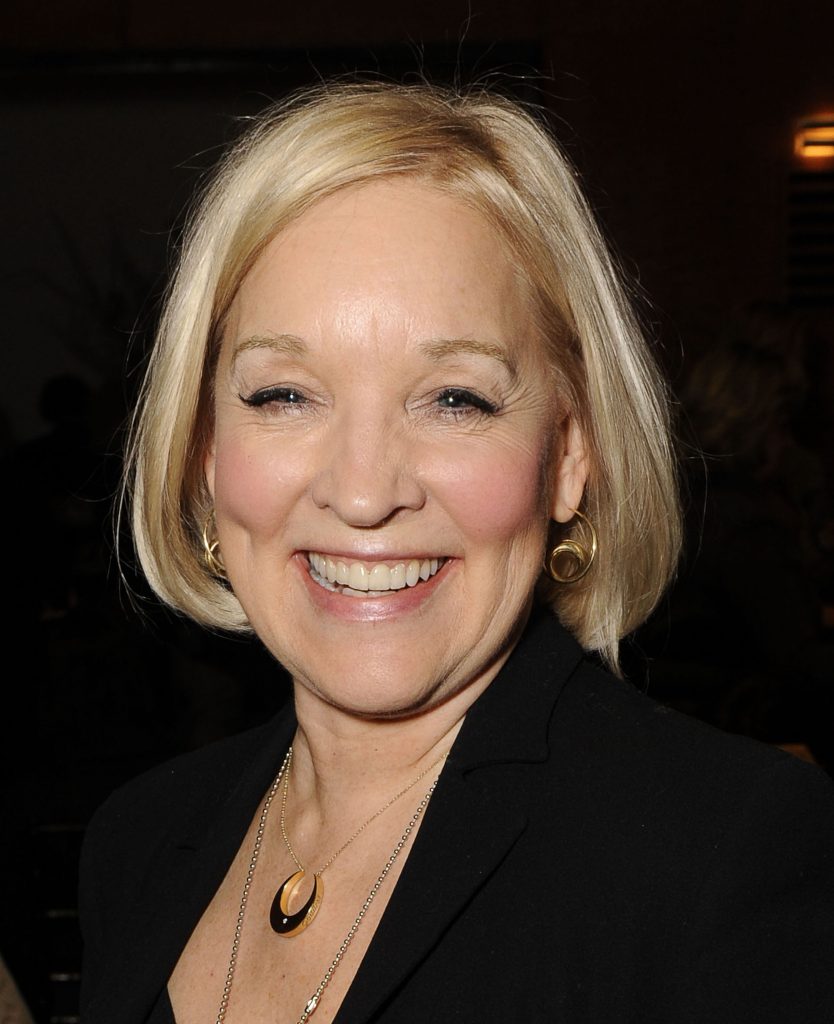
Northrup, for example, has more than half a million Facebook followers. She posts frequent videos of herself playing the harp, pausing to share details of her life or tidbits of health misinformation. In one recent video, she said without evidence that women who have “been around” those who have received coronavirus vaccines “suddenly the entire inside of their uterus just you know comes out,” then discussed the “[artificial intelligence] that has been put in the atmosphere by the dark ones” and an alfalfa bath she took that morning. On her website, she sells her books, audio lectures, her own line of dietary supplements and “vaginal moisturizers.” She also advertises products, such as “tea crystals,” for others who pay her for referrals, according to a disclosure on her site. Northrup attended Dartmouth Medical School in the 1970s and continues to introduce herself as a physician. But Maine records show she terminated her medical license in 2015.
Many of the anti-vaccine doctrines that Northrup and others trade in can be traced back to 1998, when British researcher Andrew Wakefield published a now-retracted and repeatedly debunked study linking the measles vaccine to autism. Fears snowballed, notoriously among affluent California parents, but also in other communities, as Somali immigrants in Minnesota and Orthodox Jews in New York began to refuse to immunize their children. Influencers such as the Bollingers and a sprinkling of celebrities embraced the anti-vaccine gospel, and the movement ballooned. A 2019 Gallup poll found that 84% of Americans thought it important to vaccinate children — down from 94% in 2001. Ten percent believed the scientifically discredited claim that vaccines cause autism, and another 46% weren’t sure.
The pandemic helped boost the influence of many of the anti-vaccine movement’s stars. CCDH found that anti-vaccine influencers gained 8 million social media followers in the first half of 2020, bringing their total to nearly 60 million by July. Social media platforms have taken steps in recent months to crack down on some of these personalities, removing certain pages or making them harder to find via searches, but much of their influence remains.
The coronavirus seems to have been good for business, too. “Warning: Due to Coronavirus (COVID-19), we are seeing record demand for this offer,” read a banner on Tenpenny’s website earlier this year, above an ad for a “hydrated zeolite” spray that promised to “fight back against heavy metals and toxins” ($79.95 for a 30-day supply).
Anti-vaccine influencers often point to pharmaceutical profits as a reason drugmakers can’t be trusted. But their own messaging is also lucrative. Cook once said he had made $40,000 in one week from sending out referral links to the Bollingers’ vaccines documentary, according to an acquaintance who preferred not to be named. He now sells $99 training videos to teach others how to make money from anti-vaccine messages. “People click over, they watch it, I make money,” he said about a link to an online anti-vaccine docuseries. “So it’s a win-win.”
Mercola, the owner of a major dietary supplement brand who has promoted what he called “nearly magical” alternative treatments for the coronavirus, through a foundation donated more than $2 million over five years to the leading anti-vaccine nonprofit, the National Vaccine Information Center, tax records show. He claimed in 2017 that his net worth exceeded $100 million, according to a Washington Post investigation.

Public Integrity reached out for comment to all the anti-vaccine influencers mentioned in this article, but only Finn and Mercola responded.
“For a matter of years I ran my website without selling one single product or carrying a single product,” Finn wrote in an April email. “I’ve never taken a single penny in donations like most health sites either (that would include most nonprofit and for-profit websites). Eventually I started a small boutique line because I couldn’t pay my team out of pocket forever.”
“Disagreeing with big pharma and the federal agencies they’ve captured is a detriment to anyone,” Mercola said in a statement. “Placing yourself in the crosshairs of these coordinated attacks is not financially or personally beneficial.”
Northrup did not respond to an email from Public Integrity directly, but posted an online video discussing it and calling the reporter one of “these people” who think “everyone can be bought.”
“What’s hard for these demons to believe is that there are those of us like you who are in this for humanity, who are in this to be light workers, who are doing God’s work on the earth,” Northrup said. “What’s in it for us? Our souls.”
Public Integrity requested interviews with individuals who know the Bollingers, including a man public records indicate is related to Ty. Adams, a friend of the Bollingers, then wrote on one of his websites that the reporter was using “mafia-style” “journo-terrorism” to promote “genocidal holocaust” by “targeting family members” of those in the anti-vaccine movement. Adams also posted the reporter’s email and cell phone number and requested that readers contact her, resulting in a days-long barrage of spam calls and more than 100 vulgar, insulting or threatening messages. The article was cross-posted on several other domains, including InfoWars. Commenters responded with more personal information about the reporter, as well as ideas on how to harm her family: “I butcher a family as easy as stepping on a roach,” one wrote.
“They HATE the truth because everything they do is rooted in lies,” the Bollingers wrote on their Telegram channel, telling followers to read Adams’ article about the reporter. “Do they not know that they will soon face God?”
Adams’ network of sites has singled out specific journalists on multiple occasions. He once called for a “website listing all the publishers, scientists and journalists who are now Monsanto propaganda collaborators,” compared them to Nazi war criminals and included a quote that suggested killing “those engaged in heinous crimes against humanity.” Even his article walking back his original post and decrying violence called a specific journalist a “shill” and defended the comparison to Nazis.
Anti-vaccine influencers are “a classic example of bad actors who are proficient in digital spaces, at creating outcomes which are bad for us and society,” Ahmed said. “They react the way you would expect them to.”
FALLOUT FROM FALSEHOODS
Early this year Connecticut mental health counselor Renee Rattray was dismayed to learn a close friend didn’t want to get a coronavirus vaccine. Her friend cited common false conspiracy theories — such as that the vaccines alter DNA or were designed by billionaire Bill Gates to track people — then sent her a video of Mercola interviewing another anti-vaccine influencer.
Rattray eventually gave up on persuasion, even though the friend has a job that requires close proximity to others and has a health condition that makes her more vulnerable to the coronavirus.
“I’m worried about her,” Rattray said. “She doesn’t admit that she’s been influenced by anyone. … The more I push her, the more she pushes back.”
Even when anti-vaccine influencers aren’t able to completely convince listeners, their messages plant seeds of doubt. A March Axios/Ipsos poll showed that a small slice of Americans believe conspiracy theories about the coronavirus vaccines, but between a quarter to half, depending on the question, weren’t sure whether they were true. And those people were less likely to say they would get vaccinated.
Some epidemiologists are optimistic that even if too many people refuse the vaccine for the U.S. to reach full herd immunity, the nation will soon be able to immunize enough people to minimize the disease’s spread.“People trying to reduce confidence through misinformation — that’s unfortunate and it’s something that’s sort of hard to fight,” said Ajay Sethi, an epidemiologist at the University of Wisconsin-Madison School of Medicine who teaches a class to future doctors on conspiracy theories. He urges his students to be compassionate and not condescending, since all of us are vulnerable to misinformation when it seems to confirm our prior beliefs. “It’s all innuendo, but it’s wrong, and it does spread like wildfire.”
“The more immunity we get, the better,” said Dr. Monica Gandhi of the University of California San Francisco School of Medicine.
Half of Americans have received at least one dose of coronavirus vaccine so far, according to the Centers for Disease Control and Prevention.
Scientists say it’s still important to reach those reluctant to get a coronavirus vaccine. Pockets of unvaccinated people could still see outbreaks, endangering the immunocompromised and those who are unable to be inoculated for medical reasons, such as those allergic to a vaccine ingredient. And the more chances the virus has to spread, the more opportunities it has to mutate.
Experts say that means they must reach the reluctant from all angles — talking about the safety data behind the vaccines, pushing back against conspiracy theories, emphasizing the years of scientific study behind the shots — while avoiding condescending or strident tones.
“It requires consistent messaging,” Malaty Rivera said. “It also requires a lot of empathy.”
Simpson is one person who has changed her mind. She reevaluated her distrust of science after she was hospitalized for endometriosis. “The western medicine they gave me helped me so much,” she wrote on Facebook. “I realized many anti-vaxxers are anti-vax based on the theory that scientists and doctors are in on a conspiracy to kill or maim children for money. It dawned on me that I definitely don’t believe that.”
Simpson said she lost three of her best friends since she posted on Facebook about coming around to vaccines. But other friends stuck by her side through her “anti-vax thing” for the past few years, patiently answering her questions and allaying her fears.
“It was people who actually cared about me and my kid,” she said. “That helped me the most.”
In April, she got her first dose of Pfizer’s coronavirus shot. And she’s started taking her daughter to receive her childhood immunizations.
-
Act like civilized adults, stay on topic, limit personal animosity. Moderation decisions will not be discussed on the threads. Send me a ...
-
Posted by Collectivist: https://monthlyreview.org/2020/07/01/race-is-about-more-than-discrimination/ By Bill Fletcher Jr. Though almost a cl...
-
https://mronline.org/2021/06/08/off-the-rails-new-report-by-corporate-funded-think-tank-reveals-how-profit-driven-motives-drive-new-cold-war...
