~~ posted for dmorista with introduction by dmorista ~~
Showing posts with label Imperialism. Show all posts
Showing posts with label Imperialism. Show all posts
Friday, September 17, 2021

Thursday, September 16, 2021
Wednesday, September 1, 2021
John Pilger: Afghanistan, The Great Game of Smashing Countries
https://www.mintpressnews.com/john-pilger-afganistan-great-game-smashing-countries/278289/
~~ posted for dmorista with introduction by dmorista ~~
Introduction:
In this article Pilger points out that “In 1978, a liberation movement led by the People’s Democratic Party of Afghanistan (PDPA) overthrew the dictatorship of Mohammad Dawd, the cousin of King Zahir Shar.” That new government immediately began a program of social reforms to improve the social conditions for the great majority of the population of Afghanistan. Even under Dawd and Zahir Shar the populations of the cities, particularly in Kabul, had already achieved major social advances for the middle classes. The hard core resistance was in the rural areas and the villages in the countryside where religious leaders had great influence.
The response of the U.S. was to nearly immediately begin working with far-right wing heroin traffickers who posed as Islamic fundamentalists (allied with the rural reactionaries and Islamic fundamentalists), and to work to overthrow that popular movement. This effort was led by Zbigniew Brzezinski who was a minor member of the Polish aristocracy who came to the U.S. and was President Jimmy Carter's main national security advisor. Brzezinski was fanatically anti Russian and anti Soviet. He openly bragged about luring the Soviets into “their Vietnam” in Afghanistan.
===============
Article
As a tsunami of crocodile tears engulfs Western politicians, history is suppressed. More than a generation ago, Afghanistan won its freedom, which the United States, Britain and their “allies” destroyed.
In 1978, a liberation movement led by the People’s Democratic Party of Afghanistan (PDPA) overthrew the dictatorship of Mohammad Dawd, the cousin of King Zahir Shar. It was an immensely popular revolution that took the British and Americans by surprise.
Foreign journalists in Kabul, reported the New York Times, were surprised to find that “nearly every Afghan they interviewed said [they were] delighted with the coup”. The Wall Street Journal reported that “150,000 persons … marched to honour the new flag …the participants appeared genuinely enthusiastic.”
The Washington Post reported that “Afghan loyalty to the government can scarcely be questioned”. Secular, modernist and, to a considerable degree, socialist, the government declared a programme of visionary reforms that included equal rights for women and minorities. Political prisoners were freed and police files publicly burned.
Under the monarchy, life expectancy was thirty-five; one in three children died in infancy. Ninety per cent of the population was illiterate. The new government introduced free medical care. A mass literacy campaign was launched.
For women, the gains had no precedent; by the late 1980s, half the university students were women, and women made up 40 per cent of Afghanistan’s doctors, 70 per cent of its teachers and 30 per cent of its civil servants.
So radical were the changes that they remain vivid in the memories of those who benefited. Saira Noorani, a female surgeon who fled Afghanistan in 2001, recalled:
“Every girl could go to high school and university. We could go where we wanted and wear what we liked … We used to go to cafes and the cinema to see the latest Indian films on a Friday … it all started to go wrong when the mujahedin started winning … these were the people the West supported.”
For the United States, the problem with the PDPA government was that it was supported by the Soviet Union. Yet it was never the “puppet” derided in the West, neither was the coup against the monarchy “Soviet-backed”, as the American and British press claimed at the time.
President Jimmy Carter’s Secretary of State, Cyrus Vance, later wrote in his memoirs: “We had no evidence of any Soviet complicity in the coup.”
In the same administration was Zbigniew Brzezinski, Carter’s National Security Adviser, a Polish émigré and fanatical anti-communist and moral extremist whose enduring influence on American presidents expired only with his death in 2017.
On 3 July 1979, unknown to the American people and Congress, Carter authorised a $500 million “covert action” programme to overthrow Afghanistan’s first secular, progressive government. This was code-named by the CIA Operation Cyclone.
The $500 million bought, bribed and armed a group of tribal and religious zealots known as the mujahedin. In his semi-official history, Washington Post reporter Bob Woodward wrote that the CIA spent $70 million on bribes alone. He describes a meeting between a CIA agent known as “Gary” and a warlord called Amniat-Melli:
“Gary placed a bundle of cash on the table: $500,000 in one-foot stacks of $100 bills. He believed it would be more impressive than the usual $200,000, the best way to say we’re here, we’re serious, here’s money, we know you need it … Gary would soon ask CIA headquarters for and receive $10 million in cash.”
Recruited from all over the Muslim world, America’s secret army was trained in camps in Pakistan run by Pakistani intelligence, the CIA and Britain’s MI6. Others were recruited at an Islamic College in Brooklyn, New York – within sight of the doomed Twin Towers. One of the recruits was a Saudi engineer called Osama bin Laden.
The aim was to spread Islamic fundamentalism in Central Asia and destabilise and eventually destroy the Soviet Union.
In August, 1979, the US Embassy in Kabul reported that “the United States’ larger interests … would be served by the demise of the PDPA government, despite whatever setbacks this might mean for future social and economic reforms in Afghanistan.”
Read again the words above I have italicised. It is not often that such cynical intent is spelt out as clearly. The US was saying that a genuinely progressive Afghan government and the rights of Afghan women could go to hell.
Six months later, the Soviets made their fatal move into Afghanistan in response to the American-created jihadist threat on their doorstep. Armed with CIA-supplied Stinger missiles and celebrated as “freedom fighters” by Margaret Thatcher, the mujahedin eventually drove the Red Army out of Afghanistan.
Calling themselves the Northern Alliance, the mujahedin were dominated by warlords who controlled the heroin trade and terrorised rural women. The Taliban were an ultra-puritanical faction, whose mullahs wore black and punished banditry, rape and murder but banished women from public life.
In the 1980s, I made contact with the Revolutionary Association of the Women of Afghanistan, known as RAWA, which had tried to alert the world to the suffering of Afghan women. During the Taliban time they concealed cameras beneath their burqas to film evidence of atrocities, and did the same to expose the brutality of the Western-backed mujahedin. “Marina” of RAWA told me, “We took the videotape to all the main media groups, but they didn’t want to know ….”
In1996, the enlightened PDPA government was overrun. The Prime Minister, Mohammad Najibullah, had gone to the United Nations to appeal to for help. On his return, he was hanged from a street light.
“I confess that [countries] are pieces on a chessboard,” said Lord Curzon in 1898, “upon which is being played out a great game for the domination of the world.”
The Viceroy of India was referring in particular to Afghanistan. A century later, Prime Minister Tony Blair used slightly different words.
“This is a moment to seize,” he said following 9/11. “The Kaleidoscope has been shaken. The pieces are in flux. Soon they will settle again. Before they do, let us re-order this world around us.”
On Afghanistan, he added this: “We will not walk away [but ensure] some way out of the poverty that is your miserable existence.”
Blair echoed his mentor, President George W. Bush, who spoke to the victims of his bombs from the Oval Office: “The oppressed people of Afghanistan will know the generosity of America. As we strike military targets, we will also drop food, medicine and supplies to the starving and suffering … “
Almost every word was false. Their declarations of concern were cruel illusions for an imperial savagery “we” in the West rarely recognise as such.
In 2001, Afghanistan was stricken and depended on emergency relief convoys from Pakistan. As the journalist Jonathan Steele reported, the invasion indirectly caused the deaths of some 20,000 people as supplies to drought victims stopped and people fled their homes.
Eighteen months later, I found unexploded American cluster bombs in the rubble of Kabul which were often mistaken for yellow relief packages dropped from the air. They blew the limbs off foraging, hungry children.
In the village of Bibi Maru, I watched a woman called Orifa kneel at the graves of her husband, Gul Ahmed, a carpet weaver, and seven other members of her family, including six children, and two children who were killed next door.
An American F-16 aircraft had come out of a clear blue sky and dropped a Mk82 500-pound bomb on Orifa’s mud, stone and straw house. Orifa was away at the time. When she returned, she gathered the body parts.
Months later, a group of Americans came from Kabul and gave her an envelope with fifteen notes: a total of 15 dollars. “Two dollars for each of my family killed,” she said.
The invasion of Afghanistan was a fraud. In the wake of 9/11, the Taliban sought to distant themselves from Osama bin Laden. They were, in many respects, an American client with which the administration of Bill Clinton had done a series of secret deals to allow the building of a $3 billion natural gas pipeline by a US oil company consortium.
In high secrecy, Taliban leaders had been invited to the US and entertained by the CEO of the Unocal company in his Texas mansion and by the CIA at its headquarters in Virginia. One of the deal-makers was Dick Cheney, later George W. Bush’s Vice-President.
In 2010, I was in Washington and arranged to interview the mastermind of Afghanistan’s modern era of suffering, Zbigniew Brzezinski. I quoted to him his autobiography in which he admitted that his grand scheme for drawing the Soviets into Afghanistan had created “a few stirred up Muslims”.
“Do you have any regrets?” I asked.
“Regrets! Regrets! What regrets?”
When we watch the current scenes of panic at Kabul airport, and listen to journalists and generals in distant TV studios bewailing the withdrawal of “our protection”, isn’t it time to heed the truth of the past so that all this suffering never happens again?
Monday, August 30, 2021
Off the Rails: New report by Corporate-funded think-tank reveals how profit-driven motives drive New Cold War against China ~~ Danny Haiphong
~~ posted for dmorista with introduction by dmorista ~~
Introduction by dmorista:
The crux of the arguments that Haiphong addresses in this article is that China used existing technology (manufactured under standard licensing agreements I hasten to add although Haiphong did not address that issue) but subsidizes it with their massive economic surpluses; and thereby they undercut Western (including Japanese and S. Korean) high speed rail companies. And to be honest, those are arguments that have some validity. Of course, the Capitalist/Western argument does not mention that, during the 2007-2008 Financial Crisis and Economic Collapse, that China began building its high-speed rail system along with other Keynesian investments; as the way to get out of the financial crisis and the resultant downturn in Western demand for China's industrial capital and consumer products. So in essence; while the U.S. and Western European Central Banks and Governments gave trillions of dollars to their failing financial institutions, to save their pals and donors, the Chinese spent their trillions of dollars on new infrastructure. China was widely criticized by U.S. / Western political and socioeconomic analysts for building “roads to nowhere” and “entire cities that sat empty”, and so on and so on. But in fact China, that did not have one kilometer of inter-city high speed rail line in 2007, started building the world's largest high-speed train system. They now have over 22,000 Kilometers of high-speed rail track.
It is ironic that the highly critical article in Railway Age, “Report: Chinese Policies Damaging HSR, Globally”, April 26, 2021, William C. Vantuono, Editor-in-Chief (for which there is a link in the first sentence of Haiphong's article) and the much longer actual report Heading Off Track: The Impact of China’s Mercantilist Policies on Global High-Speed Rail Innovation, (it was written by the Information Technology Innovation Foundation (ITIF) there is a link to the report at the bottom of the Railway Age article), are both featured in American publications.
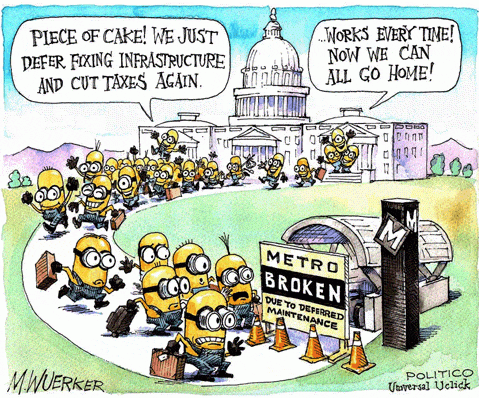
The irony is made all the more blatant as the U.S. does not have even one kilometer of true high speed rail track, the closest approximation being the Accela train in the NorthEast Corridor that runs from Washington D.C. to Boston. The Accela is not really a serious high-speed train line, it is not electrified, shares the ancient rail lines with slow-moving freight trains, actually had some collisions where doubled curving tracks were too close together and northbound and southbound Acella trains actually side-swiped each other, has a few spots where the trains can go 90 mph, but the route average speed is down around 50 mph. The only other U.S. high speed train is the line under construction in California that is bogged down in routing disputes and eminent domain battles. The U.S. does operate a massive freight train system (mostly to move Chinese goods from Pacific Coast Ports to the rest of the U.S.
Haiphong argues that the real dispute is that the Chinese are publicly funding their train system and the U.S / West want them to follow the discredited Neoliberal Privatization model. Also the Chinese, like other societies before them, built a new national system, in this case high-speed rail, by deciding on adopting a standard technology and widely implementing it. Both the Japanese and French before them built their high speed train systems while at the same time developing and perfecting the technology. By the time the Chinese decided to build a high-speed train system there was perfectly adequate technology available. The Chinese did decide to gradually replace the material bought from foreign suppliers with domestically produced equipment. The argument made in the ITIF report is that China should just buy high-speed rail equipment from the lowest priced foreign sources; China that suffered when the West was more developed and industrialized than they were has no intention of following the WTO Neoliberal model.
=============
Article:
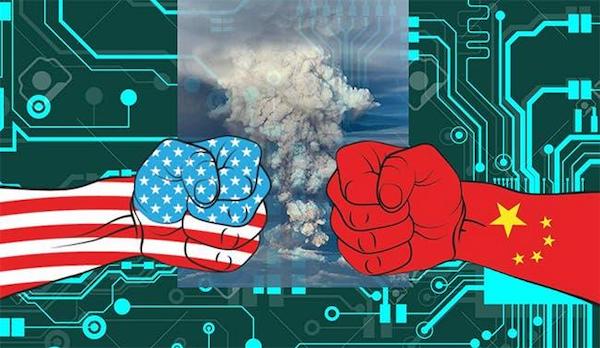
Anew report published in Railway Age magazine and written by the Information Technology Innovation Foundation (ITIF) has sounded the alarm about China’s growing high-speed rail sector. The report comes amid escalations in the U.S.’s New Cold War against China, of which technology is a key component.

High-speed bullet train in China. [Source: railwayage.com]
Since then, China has opened thousands of kilometers of high-speed lines with speeds ranging from 200 to 350 kph. To do this, China spent hundreds of billions of dollars on the world’s most expensive public-works project since President Eisenhower’s Interstate Highway System of the 1950s.
The United States might learn from China’s success in investing in high-speed rail and try and emulate it; however, according to the ITIF, China’s high-speed rail policies damage “innovation” by privileging domestic market development and state-owned enterprises over the interests of private, foreign firms primarily residing in the West. China is accused of employing a form of “mercantilism” to manipulate the global market at the expense of the superior capabilities of Western, Japanese, and American investors.
The term “mercantilism” has been used by big business interests in the U.S. and West to portray China’s policy of indigenous development as a high crime against the free market. In fact, the ITIF has been sounding the alarm about China’s prioritization of its own tech sector since 2013.
It lamented that China was no longer keeping its promise “to be a low-cost production platform for foreign multinational corporations (MNCs).” As if the Chinese government’s function was to serve the latter’s needs and not that of its own people.
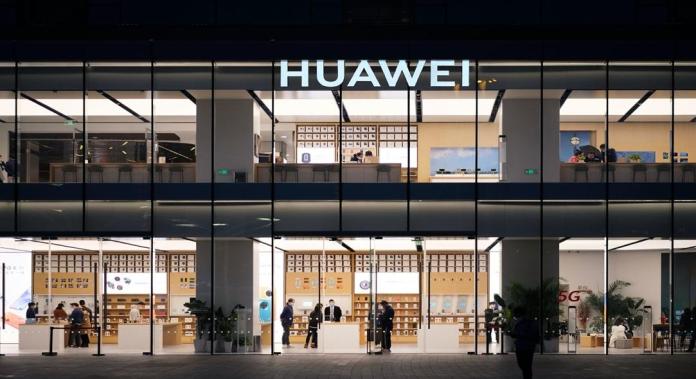
The telecommunications giant was a target of the Trump administration’s tech war on China. [Source: wired.com]
Biden has proclaimed that the U.S. is in a battle against China to “win the 21st century” and has expanded the list of Chinese telecommunications and supercomputing companies on the U.S.’s blacklist. In a recent speech to the UK-funded Chatham House, neo-con hawk and twice-failed presidential candidate Hillary Clinton passionately claimed that the U.S. is at “the mercy of China” and demanded that the U.S. “take back the means of production.”
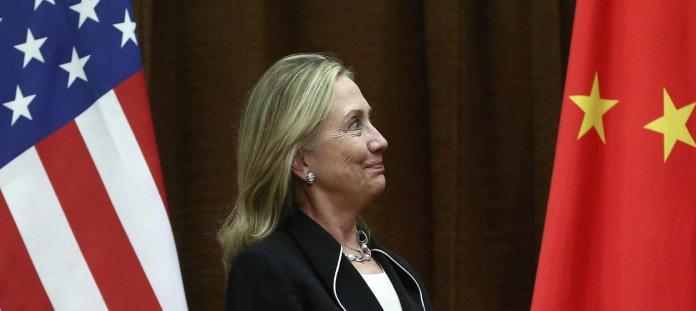
Hillary Clinton has supported the tech war against China. [Source: brookings.edu]
Who Is behind ITIF?

Richard Haass [Source: cfr.org]
What Haass leaves out is that the majority are funded by corporate and military interests to help condition the public and skew public policy in a direction that favors capitalist elites and not the public at large.
The Information Technology Innovation Foundation (ITIF) claims to be an independent public policy think-tank based in Washington, D.C. However, a closer look into its background demonstrates that ITIF is a pillar of free-market fundamentalism and the military and corporate domination in world affairs required to maintain the U.S.-led neoliberal order.
[Source: idealist.org]
The ITIF receives the vast majority of its funding from U.S. corporations in every sector of the economy. This includes the two largest employers in the United States, Walmart and Amazon.
More notable in the realm of technology and militarism is the host of donors from the defense and U.S. big-tech industries. Northrop Grumman, Boeing, and leading Silicon Valley corporations as well as the Charles Koch Institute join an alliance of U.S. monopolies and industry associations backing the ITIF.
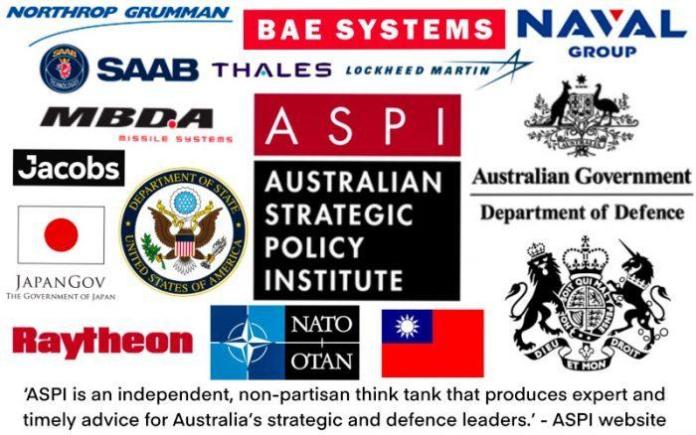
The same corporations backing the ITIF have led the charge in pressuring Washington to take a hostile approach to China’s tech sector, whose success threatens them. Amazon and Northrop Grumman, the major arms manufacturer also are top sponsors of the Australian Strategic Policy Institute (ASPI).
[Source: antinuclear.net]
ITIF founder and President Robert D. Atkinson is a champion of global neoliberalism who is regarded highly in elite circles as a tech policy guru.
Prior to founding the ITIF, Atkinson served as Vice President of the Progressive Policy Institute, a think-tank of the Bill Clinton-led Democratic Leadership Council (DLC) that sports initiatives such as the Neoliberal Project. Atkinson has served as an adviser for every U.S. administration from Bill Clinton to Donald Trump.
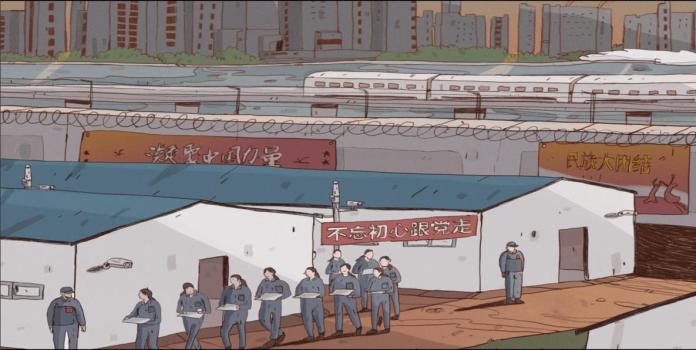
Cover of ASPI report on the persecution of Uyghurs in China’s Xinjiang province. Military-funded think-tanks are playing up China’s alleged human rights abuses in Xinjiang to mobilize public opinion against China. [Source: saveuighur.org]
In a testament to his commitment to Clinton-era neoliberalism, Atkinson argued in a 2011 article that progressives should drop social welfare policies and instead “support corporations” in their fight against “foreign mercantilism.”
More recently he has been warning about the China “threat” which he uses as a pretext for promoting the implementation of his conservative economic ideals.
Robert D. Atkinson [Source: youtube.com]
China’s High-Speed Rail Ascendency a Nightmare for Neoliberalism
Given Atkinson’s history, it should come as little surprise that the ITIF’s report Heading Off Track: The Impact of China’s Mercantilist Policies on Global High-Speed Rail Innovation reads like a cartoonish screed against public investment.
Authored by Nigel Cory, the report provides an inside look into the nightmare that China’s high-speed rail presents to the global order of neoliberalism.

Zoë Baird. [Source: twitter.com]
What is particularly troublesome to the ITIF is that China’s early reliance on foreign technology to develop its high-speed rail sector has been gradually replaced with domestic alternatives.
The report blames China’s dominance over its own market for the failures of European, Japanese, and U.S. rail manufacturers to keep up with high-speed rail production. European firms such as Alstom or Japanese firms such as Hitachi are described as “innovative” more than a dozen times yet have seen their market share in the industry decrease as much as fifty percent since 2007. The United States does not have a single high-speed rail firm capable of developing high-speed rail and has thus fallen the furthest behind.

Nigel Cory [Source: itif.org]
“Forced technology transfer” is a particular sore point for the ITIF and forms the basis of claims of “stolen” intellectual property constantly made by the United States and its allies. China is accused of forcing foreign firms to share technology on an unequal basis. Yet so-called “forced” technology transfers are not forced at all. Rather, as the report explains:
China’s ongoing requirement for 100 percent Chinese-owned technology in many procurement contracts, combined with foreign firms having to engage with majority-Chinese owned JVs [joint ventures] in order to submit a bid, amounts to a de facto mandate to transfer technology to local partners. Foreign firms continue to capitulate because they have no choice—they either give up their technology or lose out to other competitors in the growing Chinese market.
[Source: ushsr.net]
While the ITIF claims foreign rail firms had “no choice” in doing business with China, it also admits that these same firms entered into such agreements willingly in part because China was not expected to catch up to its foreign peers so fast.
Another particularly sore point for the ITIF is China’s bidding process. Foreign rail firms must partner with a Chinese firm just to hold a license to operate and compete for procurement contracts in the Chinese market. Foreign firms are allowed no more than forty-nine percent of the shares in any joint venture.
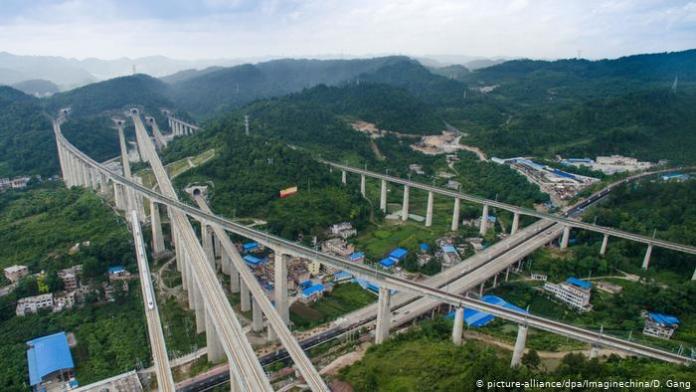
High-speed railways that are part of China’s New Silk Road project. [Source: dw.com]
A huge fear among the industrial and financial magnates that fund ITIF is that China’s model for infrastructure development in the high-speed rail sector will spread globally. The report expresses anguish over the Belt and Road Initiative directly, the massive government-led global infrastructure plan that China hopes will create sustained trade relations between itself and nations along the old Silk Road.
China has appointed CRRC, its foremost state-owned rail company, to develop rail projects abroad such as the Sino-Laos railway set to debut before 2021’s end.
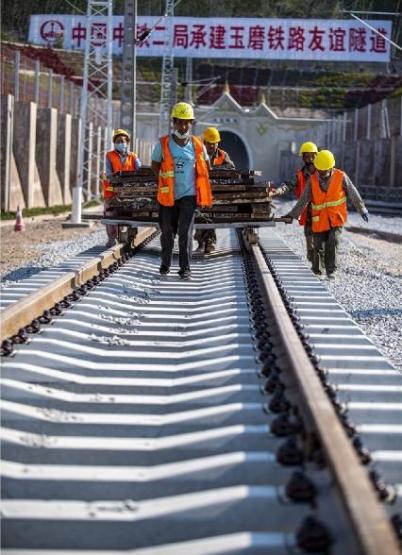
Workers carry out construction of the Sino-Laos railway. [Source: Kunming.cn]
In sum, China is accused by the ITIF of unfairly gobbling up market share from foreign firms by “stealing” intellectual property and “forcing” technology transfer. No proof is provided by the ITIF that verifies either claim. More importantly, the report simultaneously admits that foreign (read U.S. and EU) firms are unable to compete with China in large part because high-speed rail requires massive public investment rather than the prioritization of private profit.
Sanctions: Economic Weapon of the New Cold War
To punish China’s public investment in high-speed rail, the ITIF recommends first and foremost that foreign competitors, principally the United States and Europe, pursue sanctions against China. Thirty-nine countries around the world currently suffer from starvation sanctions imposed by the U.S. or EU. Sanctions are an act of war that cuts off a country’s access to the international market and, in the cases of Iran and Venezuela, prevent the import of crucial supplies necessary to sustain human life.
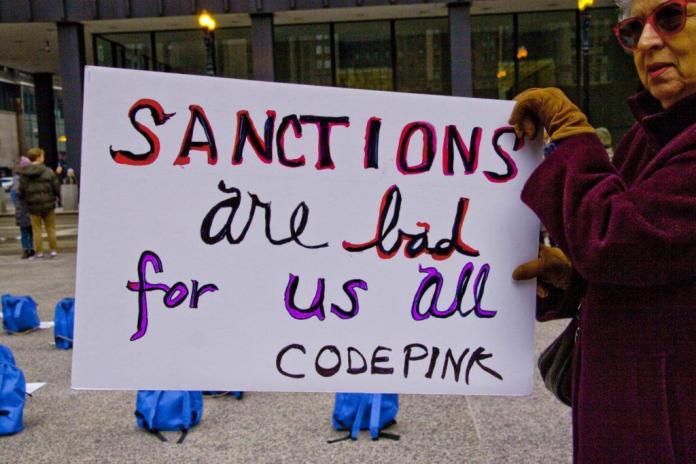
CodePink activist protests U.S. worldwide sanctions. [Source: globalresearch.ca]
The ITIF also suggests that U.S. and European governments adopt higher prices for public procurement contracts for foreign investment in rail projects and more stringent screening processes to essentially prevent China’s high-speed rail sector from expanding into the industrialized world.
Perhaps most damning is the ITIF’s inclusion of the demand that the World Bank withdraw financial support to China. Historically, the World Bank has operated alongside the IMF as an enforcer of global privatization, particularly in the Global South.
Structural adjustment programs implemented in countries across Asia, Latin America, and Africa have reinforced neocolonialism and massively increased extreme poverty around the world to the benefit of financial elites in the U.S. and Europe. That the ITIF would demand the withdrawal of World Bank funds from Chinese-backed high-speed rail projects demonstrates the lengths the U.S. and its allies will go to contain the rise of China.
Sanctions are indisputably the economic weapon of choice in the U.S.-led New Cold War on China. While many who politically identify as “left” in the U.S. and West see China as a “capitalist” country, it is clear that the U.S. and its allies employ targeted sanctions not on capitalist firms but on socialist development in China and elsewhere.
The ITIF specifically targets state-owned enterprises in China for sanctions in the same manner that the U.S. currently enforces targeted sanctions on state-owned enterprises in Belarus and Myanmar.
Regardless of whether the justification is “human rights” or “competition,” the effect of sanctions is to starve countries of their capacity to meet the needs of their people in the hopes that they will either “play ball” with U.S. and EU hegemony or see their political systems replaced with more compliant regimes.
China does not “play ball” with U.S. hegemony. China maintains public ownership over key sectors of the economy such as high-speed rail and disregards U.S. and European sanctions placed on poor nations across the Global South. This is evidenced by China’s massive bilateral relationships with Iran and Russia. China is also Europe’s, Latin America’s, and Africa’s largest trading partner.
Furthermore, high-speed rail marks only one area where China has surpassed the U.S. and European powers technologically. China leads the world in artificial intelligence, regenerative medicine, and a host of other sectors that once were dominated by private U.S. and European firms.

Visitors check their phones behind the screen advertising facial recognition software during the Global Mobile Internet Conference (GMIC) at the National Convention in Beijing, China, April 27, 2018. [Source: pri.org]
This article appeared to reflect a tacit admission of the failure of the economic model Atkinson and his ilk have tried to impose on the rest of the world, and reaffirmation of China’s policies.
Free-Market Fundamentalism Spells Doom for Humanity
The ITIF not only calls for sanctions but also for direct public investment to spur “innovation” and make the U.S. and its allies competitive again. The U.S. Senate Commerce Committee has followed these recommendations by approving $110 billion in basic research in the tech sector.

Michael Hudson [Source: michael-hudson.com]
As economist Michael Hudson remarks, the New Cold War on China is essentially a clash of two systems:
Today’s Cold War 2.0 aims to deter China and potentially other counties from socializing their financial systems, land and natural resources, and keeping infrastructure utilities public to prevent their being monopolized in private hands to siphon off economic rents at the expense of productive investment in economic growth.
Free-market fundamentalism spells doom for humanity. It is that which Secretary of State Tony Blinken chastised China when he said they were not following the “rules-based international order.”
Free-market fundamentalism is behind the massive bailouts and stock buybacks Biden supported under the Obama administration and the massively bloated U.S. military budgets, which pad the profits of private weapons manufacturers.
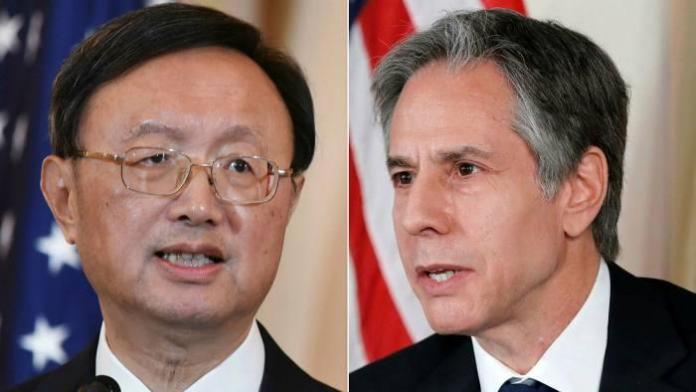
Yang Jiechi, the top Chinese foreign policy official, left, and Antony Blinken, U.S. Secretary of State, in Anchorage, Alaska, in March. Blinken angered the Chinese by lecturing them on human rights even before the meeting began. [Source: ft.com]
China’s high-speed rail sector is now under fire from the U.S.-led neoliberal order precisely because the titans of big tech and finance cannot imagine development that does not place the massive profits of capitalists such as Jeff Bezos and Bill Gates in command of international politics.
Think-tanks such as the ITIF serve as mouthpieces for their Wall Street and Silicon Valley funders. It is quite clear from ITIF’s report on high-speed rail that, beneath the bellicose rhetoric and policies of the U.S.-led New Cold War on China, is a very real attempt to stymie the progress of alternative economic arrangements to neoliberalism on the world stage.
Subscribe to:
Posts (Atom)