https://www.buzzfeednews.com/article/sarahmimms/matt-braynard-jan-6-counternarrative
~~ posted for dmorista ~~
"The Empire Strikes Back (Part One): The Largest Voter Suppression Campaign in US History Is Underway"
By Harvey Wasserman, Reader Supported News, 08 February 21
At < https://www.brennancenter.org/
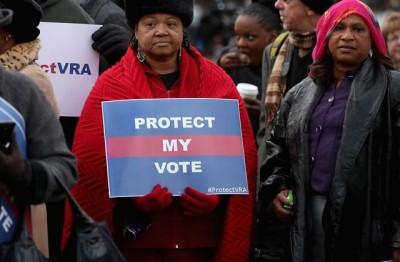
After historic turnout and increased mail voting in 2020, state lawmakers across the country are pulling in opposite directions by introducing restrictive and expansive voting legislation.
~~ posted for dmorista with introduction by dmorista ~~
Introduction:
There is an ongoing campaign to impose draconian extreme right-wing socioeconomic policies; that campaign is primarily centered in the U.S. State Legislatures, Governorships, and other organs of state government, in the various reactionary controlled states. A large number of those states are only controlled by the far-right through the use of pervasive voter suppression, computerized election fraud, voter intimidation, extreme gerrymandering, changes in the laws regulating elections that now allow state legislatures to over ride the counting and the results of elections, and other nefarious measures. Most recently bogus audits, conducted by partisan hit groups are being pushed. The most significant and most completely implemented being the faux audit being conducted by the far-right operatives known as the “Cyber Ninjas” in Phoenix, Arizona. This bogus operation has compromised the election machines of Maricopa County, the largest population county in the state where Phoenix is located. It will cost the governmental entities that maintain the voting equipment something around $20 million to replace these compromised voting machines.
Long time election watchdog and Ohio figure Harvey Wasserman wrote the article, “The Empire Strikes Back (Part One): The Largest Voter Suppression Campaign in US History Is Underway”, which is posted here in February, unfortunately I cannot find “Part 2”. He enumerated 25 ways in which the Republican Party is limiting and restricting the vote; targeted at people they don't like (primarily the poor and the young, especially if they are African-American or Hispanic). The Brennan Center posted the article, “Election Officials Under Attack”, about attacks, legal and physical, against election officials in June. At the top of that article there is a link to a more detailed 38 page report on this issue. Earlier, in January The Brennan Center posted the article, “Voting Laws Roundup: January 2021” that features lists and maps of the country that show where restrictive laws and in contrast laws seeking to make voting easier have been proposed and passed. It is telling that nearly all voter suppression measures have been proposed by Republicans. In the hubub about the recently enforced Texas Vigilante Abortion bill and recently passed Voter Suppression law it is pertinent to discuss how the left should view and act on these issues.
Many of the readers and commenters at Leftist Politics feel, and with some justification, that electoral politics is a dead end and not worth any effort, oftentimes of even bothering to vote. It is worth considering the consequences of allowing extremist right-wingers to take so much political power. Electoral politics alone is indeed a dead end, but when combined with a major mobilization of the Left that does not allow itself to be coopted by the Liberals, it could accomplish a significant amount of good.
~~ posted for dmorista with introduction by dmorista ~~
Introduction by dmorista
Introduction: I just noticed this fine article, written over 8 years ago for the Black Agenda Report, that speaks to the reality of U.S. electoral politics; and the never ending machinations of the right to maintain control of as much of the governmental apparatus as possible and to implement their agenda. As the article pointed out that agenda, (as embodied in the positions of the extreme right wingers that the Republicans managed to install on the Supreme Court in that period included then and still includes); “... Alito and Roberts were committed right wing extremists, and associated with the Federalist Society, a fraternity of lawyers founded in 1982 dedicated to repealing social security, the New Deal, antitrust law, the FDA, consumer protections and civil rights legislation of all sorts, basically (all the) civilized and civilizing reform passed in the 20th century.” (Emphasis added).
One of the main themes of the article is that there was a window of time, perhaps a decade or even a decade and a half, when the “right to vote” could very likely have been pushed over the high barriers to become a Constitutioinal Amendment. But the “liberal establishment”, notably including what the Black Agenda Report calls the Black Misleadership Class (who should have been in the forefront of such an effort) did not act decisively. That moment passed and with the increasingly unfavorable demographic trends there is no way that such an effort would be tolerated now by the right-wing Capitalist Leaders and their political lackeys. We see an avalanche of anti-voting rights legislation in State Legislatures and only a tepid response in the U.S. Congress to those about 400 proposed laws and as of June 30th 17 States had passed legislation that enacted 28 State Laws that implement various types of “Voter Suppression” measures. But long before the latest round of voter suppression legislation and other machinations began “modern” voter suppression operations were well underway.
Dixon also points out that:
“I worked with Barack Obama in a 1992 Project Vote Illinois registration drive that signed up 130,000 new voters and flogged them out to the polls. President Clinton signed a Motor Voter registration law to make voter registration easier in the brief period he had a congressional majority, but dozens of state governments dominated by Republicans including northern states like Illinois refused to implement it. By the late 1990s states like Florida were deploying legal barriers to the conduct of similar registration drives, such as levying huge fines on volunteer registrars for clerical errors and making mistakes on registration forms felonies. A decade later, the kinds of successful voter registration drives we conducted in Illinois in the 80s and 90s were legally impossible in much of the United States, thanks to nearly identical legislation introduced in state after state. A coordinated assault on voting rights was clearly underway. Alarm bells should have been ringing from one end of the black political class to the other, but the black political class was too lazy to hear them.” (Emphasis added)
But despite these efforts at voter suppresion, registration and mobilization to vote operations changed the results in two arch-conservative states, Arizona and Georgia. The razor thin margin in the Senate, that has made at least made it possible to pass some progressive legislation disguised as budget reconciliation bills was made possible by the voter registration and mobilization projects in those two states. Brad Raffensperger, thrown up as the great and ethical Secretary of State for Georgia, had approved the purging of around 200,000 Democratic leaning voters; that number proved to be insufficient and Biden, Warnock, and Ossof all won with narrow margins. What Raffensperger actually did was to stand solid against changing the votes after the election, a criminal offense he had absolutely no intention of committing to help Trump and the two Republican Senatorial candidates. Neither the Black Agenda Report, nor I, are tricked into believing that the Democrats will “save us”. But it is still always better to not allow the illusion of majority support for extreme reactionaries and outright fascists to be projected by election victories for people like Donald Trump.
Election results will not save us, but electing actually honest and forthright people, in combination with massive public pressure, can bring on some of the sorts of changes we desperately need here. Well meaning organizations like the ACLU and Stacey Abrams voter registration and mobilization operations can go to the courts, but the lower courts are now 1/3 stuffed with Trump Federalist Society cretins and the Supreme Court has a 6 – 3 reactionary majority. There will be no relief from the legal system. But the situation is not hopeless. The reaction of the younger part of the U.S. population has been promising. The largely White organizing around Occupy Wall Street, though defeated with ruthless police state tactics, was a favorable development. The Black Lives Matter organizing was a significant response to the ongoing police shootings of unarmed African American citizens. The response of the response of large numbers of young people, of all races and identity groups, to the George Floyd police killing was a major development. The essence of the Occupy Movement and the BLM movement cooperated and even the Corporate Controlled Media had to marvel at the fact that the crowds out protesting were composed of half or even more White Youths. This was a big deal, and the ruling class took notice. It is also worth noting that large numbers of “out of state license plates” (from Texas, Florida, California, and other states, all places with large numbers of right-wing extremists) showed up at various cities where demonstrations took place. These largely belonged to “agents' provocateurs” and left-leaning people posted several you tube videos that showed the “agents' provocateurs” destroying property and even starting fires. Those were actions the Corporate Controlled Media did everything they could to pin exclusively on those protesting police killings. This is a long-term struggle and it has been pursued by the right with a deadly and ruthless intensity.
Did the Supreme Court kneecapping of the Voting Rights Act have to happen? Could black leadership have seen it coming and prevented it? Why didn’t they, and what can we do now?
The June 25 Supreme Court ruling tearing the guts out of the Voting Rights Act of 1965 should be a surprise to nobody. As recently as 2009, Chief Justice John Roberts telegraphed his specific intent to kneecap the Voting Rights Act by invalidating its enforcement formula.
“Things have changed in the South. Voter turnout and registration rates now approach parity. Blatantly discriminatory evasions of federal decrees are rare. And minority candidates hold office at unprecedented levels…”
Enforcement of the Voting Rights Act rested on the history of open and legal Jim Crow in the south persisting right up until the 1960s, along with the enormous disparities between black and white voter registration and turnout. In 1965 for example, only 7% of African Americans in Mississippi were registered to vote, compared to 70% of whites.
By the early 1980s, when black registration and turnout in Chicago for the first time surpassed that of whites, enabling the election of that city’s first black mayor, it might have dawned on some that the rationale for the Voting Rights Act stood on increasingly shaky ground. If and when black voter participation reached similar levels nationwide, the victory of voting rights would have to be consolidated, put beyond the reach of succeeding Congresses, judges and executives. The only way to do that is by amending the US Constitution to make the vote a constitutional right.
The argument for putting the right to vote in a constitutional amendment was best made by Frank Watson and Jesse Jackson Jr. in their 2001 book Toward a More Perfect Union. A constitutional voting rights amendment, specifying a citizen’s right to vote, they explained, would have far reaching consequences. It would require the establishment of a uniform standard of who could register and how registration takes place, along with standards for how voting machines are procured, allocated and operated, and how votes are counted. A constitutional right to vote would provide easy grounds for removing corporate money and the contributions of wealthy individuals from political campaigns, ending felony disenfranchisement, banning gerrymandering, voter caging, discriminatory voter ID laws, and a thousand other ruses and schemes employed to keep minorities and the poor away from the polls and to minimize the effect of their votes when these are cast.
The Black Political Class Looks the Other Way
Amending the US Constitution however, is hard work, not for the lazy or faint of heart. It requires a two-thirds vote in both houses of Congress and ratification by 38 state legislatures, a herculean task unthinkable without the creation of a powerful grassroots movement, the like of which black leaders no longer knew how to build. On the positive side, opponents of such an amendment would be stuck having to explain why the right to vote should NOT be a constitutional right. But the negatives won.
The black political class instead crossed its fingers, complacently pretended the partial victory of the Voting Rights Act was “settled law,” and concentrated on boosting their own and each others’ illustrious careers, and ceaselessly commemorating the victories of the sixties, since beyond those careers there was little indeed to show.
I worked with Barack Obama in a 1992 Project Vote Illinois registration drive that signed up 130,000 new voters and flogged them out to the polls. President Clinton signed a Motor Voter registration law to make voter registration easier in the brief period he had a congressional majority, but dozens of state governments dominated by Republicans including northern states like Illinois refused to implement it. By the late 1990s states like Florida were deploying legal barriers to the conduct of similar registration drives, such as levying huge fines on volunteer registrars for clerical errors and making mistakes on registration forms felonies. A decade later, the kinds of successful voter registration drives we conducted in Illinois in the 80s and 90s were legally impossible in much of the United States, thanks to nearly identical legislation introduced in state after state. A coordinated assault on voting rights was clearly underway. Alarm bells should have been ringing from one end of the black political class to the other, but the black political class was too lazy to hear them.
Senator Barack Obama on the Judiciary Committee
Barack Obama, whose first political act was the successful 1992 voter registration drive in Illinois, reached the US Senate in the 2004 election. It was the same year Florida officials repeated everything they’d done four years earlier to reduce the black vote, and the same year county officials in Ohio sent new and functional voting machines to their white suburban constituents, and old and defective ones to minority areas. Black voters had to stand in line 10 hours for a chance to vote.
A freshman senator, Barack Obama was assigned right away to the Foreign Affairs and Judiciary Committees, prestigious assignments coveted by senators of many years’ seniority. The Judiciary Committee interviews, questions, and passes or rejects all presidential nominations to the US Supreme Court. While Obama sat on that committee, the nominations of Samuel Alito for associate justice and John Roberts for chief justice were considered.
It was no secret that both Alito and Roberts were committed right wing extremists, and associated with the Federalist Society, a fraternity of lawyers founded in 1982 dedicated to repealing social security, the New Deal, antitrust law, the FDA, consumer protections and civil rights legislation of all sorts, basically civilized and civilizing reform passed in the 20th century. Though the Federalist Society does not disclose its membership, Roberts appeared in their 1997-98 leadership directory, and after his ascent to the high court, Alito has been an honored guest at more than one Federalist Society event.
As a former president of the Harvard Law Review, Senator Obama was intimately familiar with the goals and objectives of the Federalist Society. Grassroots Democratic activists besieged Senators Obama and Kerry, both on the Judiciary Committee, to vote against Alito and Roberts, if need be to lead a filibuster against them.
Obama and Kerry said just enough encouraging words to get the pressure off themselves, then repudiated the idea of a filibuster altogether. When the nominees came before the committee, they passed up the opportunity to grill them on their Federalist Society associations and what this might tell about their expected rulings from the bench on civil rights and other questions, opting to ask softball questions instead. Obama’s decision on the Senate Judiciary Committee not to fight, filibuster or meaningfully oppose the advancement of neo-segregationist Federalist Society thugs Alito and Roberts to the Supreme Court guaranteed the virtual nullification of the Voting Rights Act which has now occurred.
By the time Barack Obama got to the White House the coordinated assault on voting rights took the form of ALEC-introduced voter ID laws. The Justice Department was slow, at best, at contesting voter ID laws, and paid no attention at all to state laws that criminalized voter registration drives such as the one the president once headed in Illinois. The rest of the black political class, following their president’s lead, did the same, and the rest is tragic history.
The black political class, which was brought into existence by the voting rights act, has failed to protect its constituency, failed to protect even themselves. They possessed the moral high ground and the political initiative for a generation and squandered it through inattention and inaction. They spent more time celebrating the victories of the sixties than consolidating them, and we will all pay the price.
We can and must blame neo-segregationist Republican thugs in black robes for doing what they do.. That’s clear, cut and dry. But a large share of the blame in this week’s kneecapping of the Voting Rights Act also belongs to our lazy and complacent black political establishment, our black misleadership class, who lacked the vision to see this coming, or the courageous leadership to avoid it, or in most cases both.
It’s not too late to begin organizing for and demanding a constitutional right to vote, along with perhaps an amendment to take the rights of citizenship away from corporations. But we can’t expect any help from traditional black leadership on that one.
Bruce A. Dixon is managing editor at Black Agenda Report, and a member of the state committee of the Georgia Green Party.
~~ recommended by a guest contributor ~~
India Walton’s victory in Buffalo is an enormous advance. With a clear political strategy, the socialist movement could become less dominated by professionals and more driven by the working-class base it requires.
How should we think about India Walton’s victory in Buffalo’s Democratic mayoral primary?
Capturing a significant executive office, while not unprecedented in the history of American socialism, has until now mainly eluded the resurgent movement. Over the past several decades, Democratic Socialists of America (DSA) members won mayoral office in college towns like Ithaca and Berkeley or acted as conventional left-liberal politicians with a mainly sentimental link to the radical left, like David Dinkins in New York City and Ron Dellums in Oakland.
These figures largely represented the electoral afterlife of the New Left: their campaigns followed the New Left’s repression and disintegration in the 1970s and 1980s and amounted to accommodation to the impossibility of radical change. To point this out is not to criticize them, necessarily; defeat brings on difficult choices and constrains what is possible at the local level. Nonetheless, Walton is different: she marks the advance of a historical process of class formation.
Over the last half decade of its emergence, the new socialist electoral politics has faced a genuinely existential challenge about its social basis: it has been a politics of mainly white and mainly middle-class activists, a reality that is ultimately incompatible with socialist analysis and vision. Insurgent candidates on the Left have succeeded where this group is numerous enough as an electorate, as a volunteer base, or both.It is important not to obfuscate the issue with semantics about how members of the middle class, unable to live off their property and forced to sell their labor, are really workers. Such an axiom may obtain in theory, and certainly it embodies an important political aspiration — but we cannot abstract away the concrete problem that college-educated professionals are separated socially and politically from the working-class mass base that socialist advance requires. Nor is it sufficient simply to note the impressive work of the many socialist activists who are more squarely working class, people of color, or both. At the same time, the limited but real strides toward a multiracial, working-class socialist base imply that these social origins are historically contingent rather than structurally fixed — and that effective political work can broaden the socialist movement.
The possibility of socialist realignment begins in the cities. There we find concentrations of downwardly mobile or indebted professionals, who have made up the most significant ideological cadre for socialist politics but have struggled to establish a sufficiently broad base. Brooklyn’s Emily Gallagher, the socialist New York state assembly member for Williamsburg and Greenpoint, provides a useful example: formerly an educator in museums (an industry that has seen significant labor activity in the past few years), Gallagher now represents neighborhoods that symbolize gentrification more distinctly than any others in the country. So ripe was her district for political turnover that she was able to oust an incumbent without institutional support from either DSA or the Working Families Party.
The radicalization of the lower layers of the professional middle class, however, also allows us to imagine a political continuum into the upper fractions of the working class. These groups are still different from each other, but less than ever before, particularly as first-generation college students burdened with debt and faced with limited career prospects grow in number and fill the ranks of the socialist movement. Figures like Alexandria Ocasio-Cortez, Tiffany Cabán, and Jabari Brisport embody this area of overlap.
Often more stably employed but residually a notch lower in the class system are the organized professional workers, particularly concentrated in the social service industries — teachers and nurses especially — who constitute much of the durable political leadership of the militant sections of the working class. Figures like Cori Bush (nurse), Jamaal Bowman (teacher/principal), Phara Souffrant Forrest (nurse), Rossana Rodriguez-Sanchez (teacher), and India Walton (nurse) exemplify this phenomenon in electoral politics; the Chicago Teachers Union’s Stacy Davis-Gates (and before her Karen Lewis) and United Teachers Los Angeles’s Cecily Myart-Cruz and Arlene Inouye do so in the labor movement.
Beneath this layer is another, both more militant and more diffuse: the low-wage, less regularly employed, more heavily policed and punished fraction of the proletariat that formed the riotous core of the 2020 street uprising. While it is less present in formal politics or trade unions and lacks visible spokespeople, figures like St. Louis’s Cori Bush, Buffalo’s India Walton, and Chicago’s Jeannette Taylor maintain real links to this social layer through the Movement for Black Lives.
It is also clear that friction occurs along the fuzzy boundaries between these layers. While they are all increasingly burdened with housing costs, the neighborhoods where they rent are typically not the same, and if they do overlap, one group encounters the other as the face of gentrification (even if newcomers’ presence is the result of much larger forces). Older members of the more secure working class may own homes (whose value may or may not be rising depending on urban geography), while younger professionals are frequently locked out of homeownership (though in some cases poised to inherit housing wealth from aging parents).
The jobs where they work are unalike: a precarious graphic designer does not struggle with the same economic problems as a teacher, a nursing assistant, or a custodial worker, much less an unemployed person. The kinds of debt they incur are quite different: student and credit-card debt as opposed to medical, court, auto, payday, and for the more secure stratum, mortgage debt. As we have been reminded repeatedly, the more stably employed and home-owning sections of the working class are presently much warier about defunding the police than either the socialist activists or the rebels in the street.
We can compare experiences across these boundaries and identify commonalities, then, but we cannot collapse them. Organizing is the form of activity in which this comparison makes up the content. As Gallagher puts it on her website,
I’ve been a renter, a roommate, a cyclist, a commuter. I’ve been unemployed, underemployed, and have known too many months where I scrambled to make rent. I’ve worked in retail, the gig economy, public education and the nonprofit sector. I’m a survivor of sexual violence and harassment. I have friends who have experienced police brutality and friends who have faced their rapists in court and watched them walk free. I’ve lost loved ones to traffic violence and the opioid crisis. These experiences don’t make me unique.
At the same time, even as the New York Times warns of an emerging “disconnect between progressive activists and . . . rank-and-file Black and Latino voters,” it is not clear the problem is getting worse. Take New York City itself. In an examination of voting patterns in Astoria Houses, a public housing project in Queens, Matthew Thomas points out that the power of the Democratic establishment appears to be waning.
For years, progressive challengers have performed worse in the complex than they have in the rest of the borough, the city, or the state. Cynthia Nixon won only 23 percent of the vote there in 2018 but 34 percent statewide. Nixon’s running mate, Jumaane Williams, a progressive black New Yorker who already enjoyed some local popularity, only managed 48 percent of the vote in Astoria Houses against Kathy Hochul — almost identical to his statewide performance. This is a particularly challenging outcome to grapple with: a more progressive and presumably better-known black candidate losing to an unknown white moderate from upstate among a precinct-level electorate that would almost certainly select Williams’s views over Hochul’s if asked in the abstract.
The black political elite’s declining ability to deliver black votes to establishment candidates in contested congressional elections presents a key marker of left advance: the victories of Rashida Tlaib, Jamaal Bowman, and Cori Bush in their 2020 primaries suggest that this historically significant source of conservative power within the Democratic Party is fading in the face of direct challenge. The party establishment’s obvious fear of a Nina Turner victory this summer in Cleveland offers further encouragement.
Alexandria Ocasio-Cortez’s reelection contains positive information as well. If detractors were right and her initial victory was simply an aberration — hyperactive Astoria “gentrifiers” taking a complacent incumbent by surprise — then she ought to have been vulnerable in 2020 to a well-funded opponent who could pull the district back to its supposed political center of gravity. But Ocasio-Cortez’s coalition broadened, and Michelle Caruso-Cabrera’s $3 million campaign garnered only 20 percent of the vote.
Perhaps even more heartening was Larry Krasner’s overwhelming reelection this year as Philadelphia district attorney. Krasner won among the city’s white liberals and black working and middle classes even as panic about crime and social disorder returned as the preferred weapon against the Left.
This brings us back to Buffalo. Walton, a nurse by training, became politically active as an adult while part of Buffalo’s enormous workforce in “educational services, and health care and social assistance.” In 2019, 33 percent of employed people in Buffalo fell into that “eds and meds” category — more than triple the size of the next group.
Buffalo, a former steel town, is in this regard little different from Rochester, Cleveland, Detroit, Milwaukee, Baltimore, Pittsburgh, Philadelphia, or even New York (the Bronx has a proportionally larger health care workforce than any other populous county in the country). Across the former industrial cities of the Northeast and Midwest, deindustrialization has produced massive social service sectors, with workforces disproportionately composed of women of color. The health workforce’s expansion is an index of disinvestment and social inequality, as abandoned populations become older, poorer, and sicker, and are dumped onto the health care system, which — as a nexus of public funding and private profit — grows to absorb this displaced surplus and hires labor from the postindustrial ruins.
Walton embodies the political possibilities that arise from this economic transformation. As care workers have become responsible for keeping the population alive and holding society together through the agony of economic abandonment, they have come to personify our mutual interdependency. As Walton put it, describing how she made it as a young and poor single mother, “We’re never alone, we’re not built to be islands.”
This principle is woven into the everyday work of nurses, teachers, and others like them, who exercise judgment continuously about how to compensate for insufficient resources and overwhelming need with their own effort. They’re both ideologically open to more radical politics and socially positioned to exercise leadership across the differentiated strata of the working class. While the phrase “essential worker” seems like a cruel joke, these workers’ indispensability has long been clear to those who depend upon them. The enormous popularity of the 2018–2019 teachers’ strike wave provided an object lesson in this regard.

What this means is that a layer of militant and activist African Americans, demarcated especially by generation, has diverged from the bulk of the black electorate and moved leftward in both street politics and formal politics — arenas bridged by Walton. We may view this divergence as a problem, or we may view it as an opportunity — akin to the paradox of the Cabán-Adams voters of Astoria Houses — to resolve a contradiction in our favor.
Achieving the latter requires more than universalist rhetoric (though that too is important) — it requires durable organization that can deliver immediate victories and offer proof of concept to the skeptical and pragmatic black working-class rank and file. Most of all, it requires permeating the working-class black social world: the neighborhoods east of Main Street in Buffalo, south and west of the Loop in Chicago, west of 45th Street and north of Girard in Philadelphia.
The social and economic transformation of cities like Buffalo has not yet produced a militant, united working class. What it has produced are organic intellectuals and leaders — figures like Walton — who are positioned to mobilize new activist layers that reach across social boundaries, and thereby stitch together enough of the separated social elements of the postindustrial working class to win a foothold and earn an audience with unconvinced working-class people.
This is a tremendous sign of progress; it is a moment of advance in the process of class formation. The next step is more frontal attack on the residual power of the Democratic political machine with the black working class: this power is weakened but not destroyed, and it will require a massive increase in organization of the kind Walton embodies.
The rewards, however, should be obvious: when a militant nurse can carry those neighborhoods where 50 percent of workers are in her industry, she will be leading a far more powerful movement than the one that squeaked by in Buffalo last week.
~~recommended by a guest contributor ~~
Working and marginalized people in Chile can now see possibilities of relief from the political grief of decades. A new constitution is in the works. And Daniel Jadue, author of an astonishingly progressive program as mayor of Rocoleta municipality, is a presidential candidate. The election is set for November 21, 2021.
Chileans will vote on May15-16 to select 155 members of a constitutional convention. They will also choose city council members, mayors and governors. The vote comes after months of political turbulence. Repeating anti-government demonstrations on a massive scale beginning in October 2019 persuaded the rightwing government of billionaire President Sabastian Pinero, and military leaders, that for the sake of peace in the streets they had better plan for a new Constitution.
After pandemic-related delay, the process started in October 2020 with a plebiscite for approving the convention. The next step, again delayed by the pandemic, is voting in May to select the convention delegates.
The Communist Party’s electoral coalition, carrying the name Worthy, Green, and Sovereign Chile, Worthy Chile for short, has arranged with the center-left Broad Front coalition to jointly select the leftist candidate delegates to the convention. This will be Chile’s first constitutional convention with delegates being chosen by popular vote. Fifty percent of them will be women.
Many leftists complain that the convention’s requirement for a two-thirds majority to approve constitutional provisions is a threshold so high as to stymy progressive change. Many are displeased that most delegates are tied to political parties, which are widely distrusted in Chile. They would have preferred more delegates representing social movements.
Working class Chileans have good reason to seek a new Constitution. The current one, instituted in 1980 by a military dictatorship to serve neoliberal purposes, lived on after dictator Pinochet departed in 1990. Subsequent governments, even socialist ones, have had to bend to its rules.
That Constitution instituted “radical neoliberalism,” according to the Council on Hemispheric Affairs. It “privatized fundamental aspects of the lives of Chileans, … imbued principles of profit and capital investment in such key and sensitive sectors as education, healthcare, pensions, labor regulations, and other socially vital areas of the economy.”
According to the report, “Chile is now one of the most dramatic examples of social and economic inequality on the planet; … the richest 1% of Chileans hold 26% of the nation’s wealth … Chile ranks seventh among the most unequal countries on the planet.”
One observer notes that Chile “is the first country in the world to have privatized its sources and management of water.” Another claims that 4000 very wealthy families ultimately determine most of what happens in Chile, which necessarily would include actions of the notably cruel and corrupt militarized police known as carabineros.
Daniel Jadue represents a different Chile. The Communist Party’s Central Committee on April 24 announced that the Party would shortly be advancing Jadue as the most appealing candidate for left-leaning political parties in the upcoming presidential election. Jadue “has aroused full, cross-the-board support from a large segment of our society,” remarked Communist Party President Guillermo Teillier.
Of Palestinian heritage, Jadue prepared in sociology, architecture, and urban planning; headed the Palestinian Youth Organization of Latin America until 1993; and that year joined Chile’s Communist Party. Born in Recoleta in 1967 and mayor since 2012, Jadue told an interviewer in 2019 that, “We are a very diverse and multicultural community [and] home to large portions of the Santiago’s informal sector.” Recoleta municipality or “commune,” population 162,000, is part of greater Santiago.
The interviewer praises Jadue as “one of the most important figures on the Latin American left.” He thinks “Jadue’s administration is building a laboratory for communism of today and of the future.” That seems to be Jadue’s intention: “In Recoleta, we want to form an open-door state, wherein all that matters are its citizens … We are nothing more than humble employees of the citizenry, those who truly constitute the state. Therefore, whenever our citizens come to us with a problem, we do everything in our power to solve it.”
Jadue describes what’s been done. About the “Open School,” for example, he reports that “some young men came to us, saying they wanted to get off the streets …So, we [are] keeping schools open until 10:00 PM daily, and over the weekend as well. This gave the whole community the opportunity to make use of the spaces as they saw fit … Our plan is to create an open university that offers anyone in the community access to free university classes in every subject area. Almost 70 percent [of the activities] are self-directed, by both the older and younger people who attend.”
He turns to health care changes: “We had very few doctors in the community and just four medical offices …That’s one medical practice per every 40,000 inhabitants…. So, [we sought] to increase the number of doctors from eleven to forty. But we then ran into problems with overcrowding …We built two medical attention hubs for noninvasive primary care at each of Recoleta’s neighborhood councils. We were able to provide 75 percent of senior citizens with medical access within three blocks of their residence.”
About “the people’s pharmacy project,” Jadue recalls that, “Our residents told us scarcity and high prices were making medication the second biggest obstacle to proper care in Recoleta …Specialized medications were too expensive [and] Recoleta had only two pharmacies …Chilean law prohibits the state from engaging in any kind of commerce … [so we formed] a consumer’s cooperative, with the goal of driving down the cost of medication … Now, Communes of every stripe [throughout Chile] have people’s pharmacies.”
Asked about the “optician program,” he states that, “we are selling 250 pairs [of glasses] a week now. And, “one last health-related service we offer is our people’s dentistry program. We have dentists who take mobile kits out into the community”
At “the people’s bookstore … all kinds of books are sold … all at an extremely low price. The municipality was able to cover all operational costs, paying for the location, salaries, and all the bills. We can then pass these savings on to the public, selling books at the same price we got them for from the publisher or distributor.”
The commune “invested in the promotion of reading. Our biggest resources are the ten public libraries in Recoleta, which make us the municipality with the most public libraries nationwide.” The municipality invests “about USD $500,000 a year in the public library system.”
To further accessible housing, Recoleta inaugurated its “Social Justice 1” condominium in June 2020. The structure, which cost $1.2 million USD to build, contains 38 rent-subsidized, three-bedroom apartments. “Today in the condominium, 95% of the beneficiaries of the project are women and, of them, 31 % were victims of family violence.”
Reflecting on changes in Recoleta, Jadue maintains that, “A socialism that doesn’t govern any better than the Right has no future, nor any right to guide society’s destiny. If socialism wants an opportunity, it will have to be much more democratic, much more effective, and much more efficient.”
He points out that, “the Communist Party has been undergoing a resurgence. The accomplishments of local Communist governments have given citizens a renewed hope in the party.” Overall, “The goal of our Communist administration is to fundamentally transform the state. As it currently exists, it functions purely as a vehicle for class domination. Its structures are completely impervious to the expectations and needs of its citizenry.
Presently Jadue is running second in presidential polling to the current favorite Pamela Jiles, a flamboyant journalist and legislator for the Humanist Party. She recently gained 21.7% approval in one tally and 18% in another, with Jadue scoring 10.3% and 11 %, respectively.
https://popularresistance.org/why-do-the-media-hate-daniel-ortega/
~~ posted for dmorista ~~
When Kamala Harris finally traveled to the U.S./Mexico border last week, she met several young women asylum seekers. The vice president likely saw Hondurans, Salvadorans and Guatemalans who were fleeing from violence and extreme poverty. But she probably did not see any Nicaraguan asylum seekers, who are few and far between.
Nicaragua and Honduras are considered the two poorest nations in Latin America. Honduras is a corrupt, failed, violent country, whose government is backed by the U.S. Nicaragua has free healthcare and education, and is considered the safest country in Central America.
Since Daniel Ortega and the Sandinista Front won the Nicaraguan election in 2006, they have made remarkable gains, dramatically reducing poverty and extreme poverty. The Nicaraguan people have something that those escaping from Honduras, El Salvador and Guatemala do not have – hope for the future and peace in the present.
I first traveled to Nicaragua in the fall of 1983 with military veterans concerned that the U.S. was fomenting a Vietnam War in Central America. Four years after the Nicaraguan people rose up and sent the Somoza dictatorship packing, there was another war raging – a war of terrorist violence against rural communities. Nicaragua’s “Contras” were armed and trained by the CIA, and they later famously smuggled large amounts of cocaine into the United States. As popular pressure moved the U.S. Congress to cut off funding for the Contras, Ronald Reagan, Elliott Abrams and Ollie North were implicated in the Iran-Contra scandal. Drugs for money and weapons. Fifty thousand Nicaraguans were killed.
By 1990, the U.S./Contra war and harsh economic sanctions had created a climate where Nicaraguans were effectively blackmailed into voting against the Sandinista government. In Latin America, the Empire is not subtle. The U.S. Ambassador held a press conference in Managua and told Nicaraguans how to vote. If they vote for the Sandinistas, he said, there will be more war and economic sanctions. The U.S. had selected the candidate, Violeta Chamorro, had pressured the opposition parties to unite behind her, and had funded much of her campaign. Violeta Chamorro won the election.
Even though the election had been rigged against them, Daniel Ortega and the Sandinista Front accepted their electoral defeat, and implemented the first peaceful transfer of power in Nicaraguan history. For seventeen years the Sandinistas remained in the opposition, while a series of corrupt neoliberal governments undid all their programs for the poor. Then in 2006, Daniel Ortega was elected president once more.
Since the Sandinistas regained power in 2007, Nicaragua has experienced remarkable progress. Free healthcare for all. Schools and colleges built in rural areas. Direct support to poor farmers. Dramatic reduction in poverty. Food sovereignty – they grow almost all the food that they eat. Women’s equal participation in all aspects of government and the economy. Really good highways connecting the entire country and its markets. It is now only a 6-hour drive from Managua to the Atlantic Coast of Nicaragua, with its Afro-Caribbean and Indigenous peoples, and unique autonomous regions.
Several recent polls show the Ortega government retaining widespread support and easily defeating even a united opposition ticket. They have nothing to fear at the ballot box.
But wait! The U.S. media – and Human Rights Watch – are now screaming that President Ortega is arresting the opposition’s presidential candidates! Can this be true? Actually, this is a very misleading accusation. It is true that around 17 people have been arrested by Nicaraguan authorities. Several arrestees had political ambitions, but none had declared to run for president. And none of the 14 parties registered for the November 7 election had chosen any of these people to be their candidates. These non-candidates were arrested for money-laundering, for failing to account for receipt of major foreign funding, for calling for economic sanctions against Nicaragua, and for collaborating with hostile foreign powers. We will see the evidence once they have their day in court.
There is a powerful backdrop to current events in Nicaragua. In April to July 2018 there was an attempted coup in Nicaragua – widespread, coordinated violence, apparently taking the Ortega government by surprise. Barricades blocked many roads, bringing commerce to a halt. A sophisticated social media campaign brought people into the streets with lies about the police killing students. Government buildings were torched. Over 200 people died in street violence over several weeks. Half or more of the dead were Sandinistas, including 24 police. Videos were posted online of Sandinistas being tortured and even burned alive at the barricades. The U.S. media claimed that “nonviolent protester” were under attack by Nicaraguan police.
Daniel Ortega deflated the attempted coup by showing great restraint. He pulled the police back to their barracks. He kept the Army out of the fray. He negotiated with opposition leaders. And he granted amnesty to those who had joined in these violent events. Ortega is now praised for having the wisdom not to overreact – not to cause further violence and chaos. Nonetheless, western media prefers to paint Ortega as an “authoritarian dictator” who violently represses dissent and jails his political adversaries. That is the narrative we will hear over and over.
Much of the corporate media appears content to be propagandists for U.S. foreign policy. At least they have become accustomed to that role. Unfortunately, this is also true for elements within the human rights organizations. Their accusations of human rights abuses too often coincide with the State Department regime change propaganda.
For well over a century, the United States has been invading Nicaragua, has occupied it with Marines, has supported the violent 40-year Somoza dictatorship, has organized a counter-revolutionary army, has funded opposition organizations and media, and has hyperactively intervened in the internal affairs of the Nicaraguan people.
Some historians say the potential for a Nicaraguan Canal, which would compete with the U.S.-controlled Panama Canal, has been major factor in the U.S. obsession with Nicaragua. What else would explain it? Or does Nicaragua present the “threat of a good example.”
So yes, of course, the United States government is intervening in the Nicaraguan election. Their plan for doing so is detailed in a leaked USAID document. Contingencies include the sudden transfer or power under chaotic circumstances.
U.S. sanctions on Nicaragua will be intensified by the RENACER Act, which recently passed in the Senate Foreign Relations Committee. It is difficult for Congressional representatives to vote against a sanctions bill when they are hearing the same horrible story from every media source. They need to be provided with accurate information and alternative perspectives. So do all of us. Even people who follow foreign affairs closely can be disoriented and confused by the barrage of disinformation coming from every direction.
Despite majority support for the Sandinista Front, there is intense polarization in Nicaragua. Most of the media is owned by the opposition and is virulently anti-Ortega. The attempted coup opened up old wounds, and was a heavy blow to the economy as well.
The oldest trick in the imperial regime change book is to “demonize” the leader of the government you wish to overthrow. Like with Assad in Syria, for example. Now we must believe that Daniel Ortega, whose government has improved the lives of tens of thousands of poor Nicaraguans, is a terrible villain who must somehow be removed.
We in the U.S. need become more media literate – more skeptical of Big Media. Why would we believe the Washington Post, the New York Times, CBS, CNN, or Fox News – the same media that told us there were “weapons of mass destruction” in Iraq?” The corporate media routinely justifies U.S. intervention and cheerleads for U.S. wars.
In July 2019 I traveled to Nicaragua with a delegation from Veterans For Peace. We visited with healthcare workers and with a women-run cooperative farm. We heard emotional testimony from families of police who had been killed in the attempted coup of 2018 and from mayors whose towns had been under attack. We met with veterans – the highly respected “historical combatants,” who ultimately took the lead in dismantling the barricades.
On July 19 – Nicaragua’s Independence Day – we joined 400,000 jubilant Nicaraguans who were rejoicing in the main square in Managua. They had traveled from all over Nicaragua to celebrate the 40th anniversary of the 1979 Sandinista victory over the U.S.-backed dictator Somoza. (Anybody see a pattern here?)
I love the heroic, handsome, poetic and fun-loving Nicaraguan people. I am in awe of their unique and hopeful revolution. Casting a little light into the shadows of regime change propaganda is the least that I can do to show my appreciation.
Gerry Condon, former president of Veterans For Peace, has been visiting Nicaragua since 1983. For up-to-date news and views about Nicaragua, he recommends NicaNotes at www.afgj.org.

