Showing posts with label Colonialism. Show all posts

Saturday, August 14, 2021

The Ongoing Collapse of Imperial Forces in Afghanistan; and How it compares to the Collapse of the “South Vietnamese” Client State Between 1973 - 1975. ~~dmorista

~~ Written by dmorista ~~

When comparing the collapse of the American / NATO client state of South Vietnam, in the period after the last American military unit left that country, to the current collapse taking place in Afghanistan; it is breathtaking how much faster the process is taking place now as compared to that process from 48 to 46 years ago.  The last U.S. military unit left Vietnam on March 29, 1973 and the final collapse of the puppet regime took place on April 30, 1975; thus the “Republic of Vietnam”, as the South Vietnamese state was officially named, lasted 25 months after the last standard overt U.S. military unit was withdrawn.  In Afghanistan the U.S. announced a few weeks ago that it will pull the last military units out on August 30.  The Taliban has responded to that announcement with an offensive that has taken place while the last U.S. and a few residual NATO units are still in Afghanistan.  As of this writing something like 20 “provincial capitals” have fallen to the Taliban in the last few days, and the Taliban already controls over ⅔ of the land area of Afghanistan.  Already some analysts are predicting that the Taliban will actually take the national capital of Kabul within 90 days.  Actually it looks like that eventuality might occur much more quickly than that.  Recent forecasts by U.S. Governmental analysts, as of the morning of August 13, 2021 (in the wake of Taliban takeovers of Kandahar and Herat the second and third largest cities in the country), now forecast that the Afghan Client Government might only last for 30 days.

The iconic photo of the chaotic collapse scenario in South Vietnam, in its final hours in the Client State’s Capital city of Saigon is here below.  The photo is widely, but mistakenly, believed to have been taken at the U.S. Embassy in Saigon.  It is in fact a photo of a desperate crowd of collaborators in line to board a helicopter, to be flown out to the U.S. Naval ships standing offshore.  However, actually the photo is of an apartment building where the CIA’s Deputy Chief of Station, and numerous other United States Agency for International Development (USAID) personnel, lived and that had become an ad hoc location for contending with the desperate Vietnamese, associated with the U.S., as they crowded in to any location where they thought they could try to escape their likely fate if they remained in Vietnam.
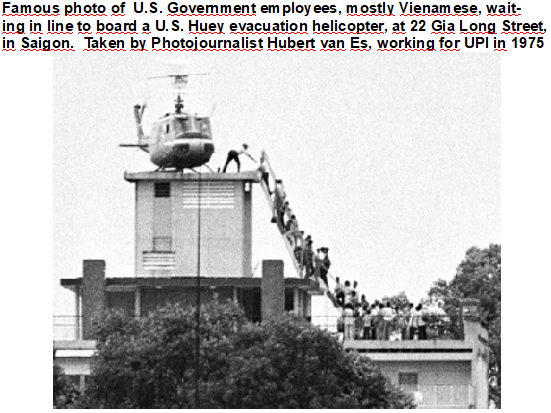


Of course large numbers of Vietnamese collaborators also flocked to the American Embassy where the Embassy Staff, in the person of the Marine Guard reinforced with other military personnel, cut down some trees on the Embassy Grounds to make space for a helicopter landing pad next to the Embassy buildings.  The Embassy did not resort to using the roof until the very end when the last couple of helicopters landed on the Embassy building’s roof to pick up the “rear guard” members of the Embassy’s security detail.  That was while the triumphant Vietnamese Communist forces and sympathizers were scaling the fence that surrounded the Embassy and were beginning to occupy the Embassy grounds.  Even this morning on NPR and over the past few days of the panicky news and analysis broadcasts I keep hearing that helicopters embarked numerous people from the roof of the U.S. Embassy in Saigon.  This is a bunch of malarkey and has become an integral part of the Mythology surrounding the ignominious end of the Republic of Vietnam, the Client State in that long and horrific war.


Another set of famous photos showed U.S. naval personnel pushing helicopters over the sides of various U.S. Aircraft Carriers as those helicopters got in the way of yet more incoming helicopters that wanted to land with yet more escaping South Vietnamese.


The last month or so of the existence of the Republic of Vietnam was a period of chaos. Desperate Vietnamese, who had collaborated with the Americans and the French, stampeded various venues trying to leave.  Vietnam had been wracked by an over 30 year long war, its society distorted and perverted to serve the wants and needs of occupiers and collaborators for decades. IndoChina had been controlled by the colonial French, then the Japanese who worked with the colonial French and the Americans as WW 2 wound down, then the Colonial French again (this time bankrolled by the Americans); then for over 10 years after the Geneva Agreements, the North was run by the forces derived from the Vietminh, and from 1955 - 1963, the South was run by an interloper, Ngo Dinh Diem, who had been residing in a Maryknoll Monastery in upstate New York; the client regime imposed by the U.S. changed with a variety of characters heading it up after the assassinaton of the Diem and his brother in 1963. 


In some ways the situation in Afghanistan resembles that of South Vietnam.  Afghanistan had actually been developing like a fairly typical poor country.  In the 1950s and 1960s in the Capital City Kabul middle class women were prominent in the professions; and most of them wore western clothes and had eschewed the burkha and the chador.  Smaller cities were less liberal but the real reservoir of conservative socioeconomic relations was in the villages and the rural areas that had not changed at all.  By 1972 the Soviets had assisted a Left-leaning government to take power in Afghanistan and it attempted to bring some reforms to the ultra-conservative and fanatically religious country side.  Afghanistan was buffeted and manipulated by outside powers from 1972 on and by the late 1970s the U.S. was running covert operations to support an assortment of extreme right-wing supposedly religiously based operatives.  A video clip shows Zbigniew Brzeziński (Jimmy Carter’s National Security Advisor) exhorting Mujahideen figures at a meeting on a hillside in Afghanistan to take violent action.  The result of the early machinations by the Carter administration and much more vigorous action by the Reagan Administration was the First Afghan War  Not coincidentally the mid to late 1970s saw the move of poppy cultivation and heroin production from the Golden Triangle, near Vietnam, to Central Asia particularly in Afghanistan though in Pakistan to a smaller degree as well.


Of course the immediate justification for attacking Afghanistan was the events of September 11, 2001.  An earlier iteration of the Taliban was running Afghanistan then,  and they offered to turn over Osama Bin Laden for trial, to a neutral country, if the U.S. presented credible proof of his involvement in the events of 9-11.  Proof the U.S. never did provide, as it merely  attacked Afghanistan beginning on October 7, 2001 using the 9-11 events as the pretext.  The real reasons for the U.S. attack on Afghanistan are to be found in control of the Opium Poppy trade and the Heroin business, in which the CIA had been implicated going back to the late 1940s in Turkey, Sardinia, Sicily, and Marseilles, France. (See, The Politics of Heroin: CIA Complicity in the Global Drug Trade, Alfred McCoy,‎ Lawrence Hill Books; Revised edition {April 1, 1991} ), McCoy discusses the move of the production area for the Poppy / Heroin business from the Golden Triangle of SE Asia to Afghanistan in the revised edition.  The presence of large deposits of rare earth minerals in the mountainous regions of Afghanistan was also well-known to U.S. business and strategic planners.  Another issue was the potential plan for a trans-Afghanistan pipeline to bring oil and/or natural gas down from the Caspian Sea area and out to embarkation points on the Indian Ocean for sale to fast growing East and South Asian markets, without crossing Iran.  American political and security leaders promised the Taliban a carpet of gold or a carpet of bombs according to their cooperation in that venture.  The Second U.S. - Afghan War used a minimum of ground forces and a maximum of air attacks.  The largely CIA, Special Forces, and mercenary operation was shunted aside by the much larger, and strategically more important and central, attack on Iraq in 2003.


Looming up we see some sort of investment and siege of Kabul looking likely.  Typical of various U.S. / Western client regimes the Afghans controlled the cities while the Taliban controlled much of the rural area of Afghanistan.  Most of the secondary cities have been taken by the Taliban including numerous provincial capitals.  This is similar to the end of the U.S. client state in Vietnam, where most of the Republic of Vietnam’s secondary cities had already been taken by the Communist forces; before they began a final push to take Saigon and total control of the Republic of Vietnam during the last 2 months of its existence.  This is clearly shown in the Map below, the somewhat wider red arrows denote the movement of Communist forces during the last 2 months.  Those movements were almost all directed at Saigon for a culminating battle for control of the Client State Capital city and the largest city in all of Vietnam.
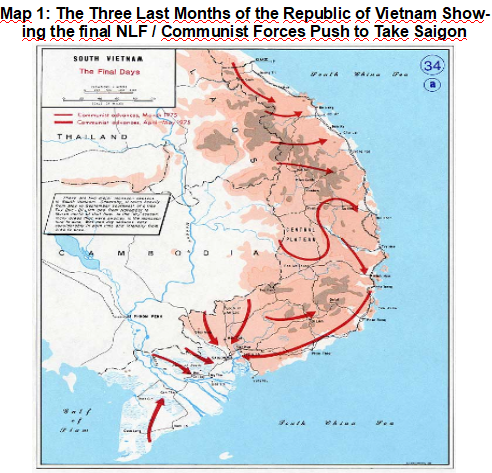


(Source: “Fall of Saigon”, Wikipedia, at < https://en.wikipedia.org/wiki/Fall_of_Saigon >)


A series of 4 Maps below shows the change over time of the control of the country by the Client Government, the Taliban, and those that are contested.  The maps run from November 2017 to August 14, 2021.  The deterioration of the Client Government of Afghanistan is clearly evident.  According to the Foundation for the Defense of Democracies (an imperialist pro-Zionist NGO financed by the U.S. primarily through the CIA), the Taliban controlled 73 districts on November 28, 2017 and they control 256 as of August 14, 2021.  Conversely, the Client Government of Afghanistan controlled 217 districts on November 28, 2017, and they controlled only 59 as of August 14, 2021. Clearly the Taliban is closing in on Kabul for the final climactic battle; for the Capital and largest city of Afghanistan.

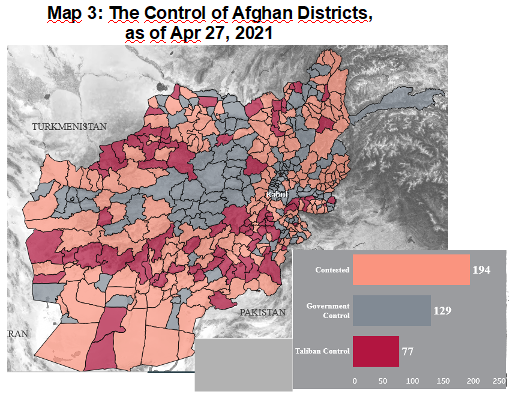
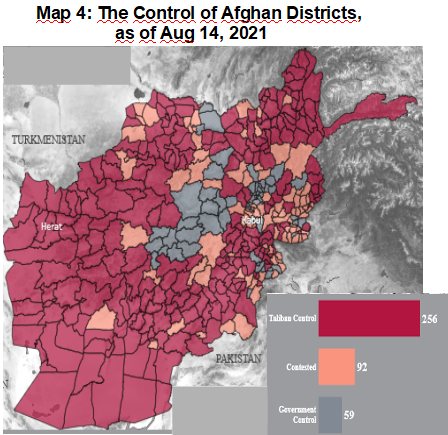


(Source: “Mapping Taliban Contested and Controlled Districts in Afghanistan”, “Weekly time lapse video of the Taliban’s Advance | Apr 13 to Present”, “Map of Afghanistan’s districts, updated daily”, Bill Roggio, FDD’s Long War Journal, at < https://www.longwarjournal.org/mapping-taliban-control-in-afghanistan >)
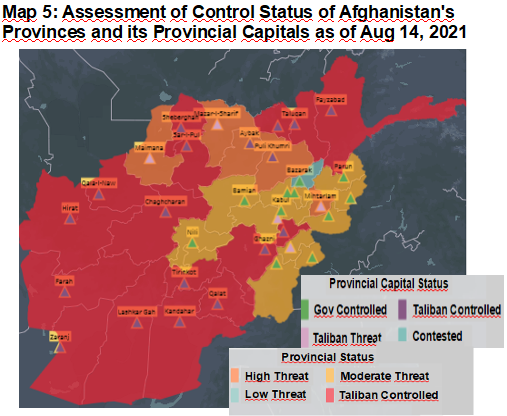


(Source: “Map of the Status of Afghanistan’s provinces”, Bill Roggio, FDD’s Long War 

Journal, at < https://www.longwarjournal.org/mapping-taliban-control-in-afghanistan >)


The end of the Client Afghan state appears imminent.  The Taliban, who are replacing them, are a harsh bunch and I would not want to live under their aegis.  We can ask why is this happening so much faster in Afghanistan than did the similar process that took place some 37 years ago in Vietnam.  During the Vietnam War, the U.S. was wracked by massive anti-war demonstrations and, more importantly; the U.S. military after 5 years of deployment in a colonial war type situation collapsed into insubordination, refusal to obey orders, rampant drug use, sabotage of equipment, and even the killing of unpopular officers (there were at least a couple of hundred cases of this and likely more).  The “all-volunteer” current day U.S. military did not suffer from these sorts of problems and there were a few anti-war demonstrations, most particularly the massive global one before the attack on Iraq in 2003.  But the U.S. ruling class learned part of the lesson of Vietnam, the end of conscription defused the immediate resistance of the young part of the population.  And in reality there have been many more mercenaries, and proxy forces from other societies, used in both Iraq and Afghanistan than was the case in S.E. Asia.


The real reason for the rapidity of the collapse of the client State in Afghanistan lies elsewhere.  President Joe Biden is the first President since Dwight Eisenhower to have a child who served in the military, and who in fact went into combat in Iraq two times.  Having also lost 2 of his 3 children and a young wife, Biden is more keenly and personally aware of the impact of these events than any President in modern times (certainly far more than “Bone-Spur Don” who preceded him, and who also publicly proposed a U.S. military withdrawal from Afghanistan).  Biden was always the most skeptical voice in the Obama White House when it came to prosecuting the Middle East and Central Asian Wars.  But more profound issues are at play.


Simply put the U.S. is now at the end of its time as the unquestioned “Global Hegemon”.  This fact is not probably evident to the rank and file Taliban fighters, but it is known to 

the relatively astute and worldly ranks of the Taliban leadership.  The Vietnam War marked the shift from Strong Hegemony to Weak Hegemony for the U.S. role in the Capitalist hierarchy (See, Long Cycles: Prosperity and War in the Modern Age, Joshua Goldstein, New Haven, Yale U. Press, 1988).  This has been somewhat similarly delineated as the occurrence of the “Signal Crisis of U.S. Capitalism and Hegemony” (See, The Long Twentieth Century: Money, Power and the Origins of Our Times, Giovanni Arrighi, New York, ‎Verso; New and Updated Edition {February 16, 2010} ).  Arrighi specifically meant that the “Signal Crisis“ for a hegemonic state marked the shift from an emphasis on productive / industrial capital to finance capital rule.  Though he was certainly aware of the other connotations that “Signal Crisis” carried.  


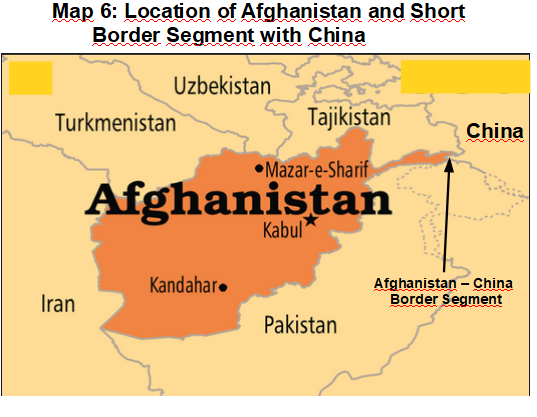
This looming end in Afghanistan marks the end of even Weak Hegemony in the Goldstein definition, and the “Terminal Crisis” for U.S. Global Hegemony in the terminology of Arrighi.  For Arrighi, the “Terminal Crisis” mostly refers to the fact that the former hegemon can no longer enforce the economic conditions that made Financial manipulations by its ruling class the dominant economic feature of Global Capitalism.  But he was well aware of the other meanings that attend to a phrase like the “Terminal Crisis”.  The fact that a powerful country is no longer hegemonic does not mean it becomes totally powerless.  But in the case of U.S., considering the rapid rise of the power of China, it means that the Chinese are gradually assuming the mantle of global leadership, that the U.S. carried in the period after WW 2.  We could even argue that there has already been a period of co-Hegemony involving the U.S. and China that is ending, or perhaps that is just now beginning (just as the period between WW1 and WW2 can be viewed as a period of co-Hegmonship of the U.S. and Britain). The Taliban’s leaders live in a country that even has a short strip of border with China.  They certainly realize that China will loom ever larger in their affairs while the U.S. will likely fade away.  


I discussed some of these issues at greater length previously (including a short discussion of the significant contributions of Immauel Wallerstein and George Modelsky to the World Systems Theory view of global events), in “Long-Term Global Trends Affecting the U.S.:  Analysis of Historical Global Developments and their Relevance to the Internal Situation of the United States”, Sep 28, 2020, dmorista, Leftist Politics, at < https://leftist---politics.blogspot.com/2020/09/historicalglobal-developments-and-their.html >, and in addition I posted some thoughts about the roles of the U.S. vs China, in “Comparisons of China and the U.S. in Their Roles as Global Hegemons”, Apr 3, 2021, dmorista, Leftist Politics, at < https://leftist---politics.blogspot.com/2021/04/comparisons-of-china-and-us-in-their.html >

 

Friday, August 13, 2021

Afghanistan - US Imperialism

https://www.wsws.org/en/articles/2021/08/10/pers-a10.html

and 

Podcast https://popularresistance.org/the-afghanistan-war-was-a-disaster-veteran-danny-sjursen-on-us-pullout/.   Note:  the interview with Sjursen begins at about 20 minutes into the podcast.

~~ posted for dmorista ~~

   (Concerning the WSWS article and its list of provincial capitals and cities that the Taliban have taken control of.  In addition, Kandahar and Herat, the 2nd and 3rd largest cities in Afghanistan have gone under Taliban control in the last couple of days.  At 4 days old the WSWS article is already dated in some ways ~~dmorista) 
 Afghan regime’s rout exposes crisis of US imperialism


The rout of Afghan regime forces at the hands of the Taliban insurgency has led to increasingly bitter recriminations in US ruling circles on the theme of “Who lost Afghanistan?” The Wall Street Journal Monday published an editorial that termed the US withdrawal a “debacle” and charged that the Taliban was able to make its advances because “Biden ignored military advice and withdrew so recklessly and without a plan to prevent disaster.”
Taliban in Kunduz city, northern Afghanistan on Aug. 9, 2021. (AP Photo/Abdullah Sahil)

A military catastrophe on this scale, however, cannot be attributed to the lack of a “plan.” The reality is that US imperialism is paying the price for two decades of crimes against the people of Afghanistan carried out under four successive administrations, Democratic and Republican alike. Together they sent three-quarters of a million US troops to Afghanistan to wage a dirty colonial-style war in which it is conservatively estimated that at least 175,000 civilians were killed. The result of this mass killing, as well as the terrorizing of the population with the ever-present threat of bombing raids and drone strikes, night raids and the systematic torture of detainees, succeeded only in swelling the ranks of the insurgency.

Within the space of barely one week, the Taliban has overrun six provincial capitals. On Friday, they captured Zaranj, near the border with Iran, and Sheberghan in the north, and on Sunday they took three more capitals: Kunduz, the commercial hub in the north of the country, as well as Sar-i-Pul and Taloqan. On Monday, local officials confirmed that the insurgency was fully in control of Aybak City, the capital of Samgan province, which controls the main highway linking the capital of Kabul with the country’s northern provinces.

Ongoing urban warfare has reduced the grip of the US-backed regime in Kabul to just some neighborhoods and, in some cases, blocks in other besieged capitals, including Lashkar Gah, the capital of Helmand province, and Kandahar City in the south. Fierce fighting is also taking place in Herat and Mazar-i-Sharif, the largest city in Afghanistan’s north.

Defending forces loyal to the US-backed regime in Kabul have surrendered to the Taliban by their thousands or laid down their weapons and removed their uniforms. In some cases they have defected to the insurgency. The Taliban has insisted that, in most instances, it has been able to negotiate surrenders of districts and cities without fighting.

Where there has been resistance to the insurgents, as in Lashkar Gah and other besieged capitals, it has been heavily reliant on airstrikes by US warplanes operating from “over the horizon.” This has included the use of B-52 strategic bombers flying from the Al-Udeid airbase in Qatar, F/A-18 Super Hornet fighter jets flying off the deck of the nuclear-powered aircraft carrier USS Ronald Reagan deployed in the Arabian Sea, and AC-130 Specter gunships.

The use of this airpower against heavily populated urban areas will inevitably inflict a bloody toll in terms of civilian casualties. In Lashkar Gah, US bombs destroyed a health clinic and a school, while officials reported 20 civilian deaths over the space of 48 hours. Afghan security officials, while attempting to minimize the government’s loss of control, have taken to touting body counts from the air strikes, claiming the deaths of hundreds of Taliban fighters. How many civilian bodies are lumped into these totals is unknown.

The reasons for the Taliban’s success can be grasped in the record of the US occupation in the largest of the cities the insurgency has overrun in recent weeks, Kunduz, with a population of nearly 350,000.

In 2001, shortly after the US invasion, Taliban forces in Kunduz surrendered to US special forces and a militia loyal to the warlord Gen. Rashid Dostum, who forced them into metal shipping containers and transported them to Sheberghan, Dostum’s stronghold. Most of some 2,000 prisoners suffocated in the containers, those still alive were shot.

In 2009, a German officer called in a US military airstrike against a crowd in Kunduz province that was siphoning fuel from two tanker trucks stuck at a river crossing. The 500-pound US bombs left at least 142 civilians incinerated.

And in 2015, a US AC-130 gunship slowly and deliberately reduced to rubble a civilian hospital run by Doctors Without Borders (MSF) in Kunduz, killing at least 42 patients and medical staff and wounding many others.

No one has ever been punished for any of these crimes, but they are certainly not forgotten by those who survived them and the relatives, friends and neighbors of those who did not.

The regime that these crimes were meant to defend has never been more than a puppet of the US occupation and a corrupt kleptocracy, enriching a layer of politicians, warlords and their cronies through the embezzlement of US aid.

At a press conference last month, US President Joe Biden defended his decision to order all but a handful of US troops out of Afghanistan by the end of this month and strenuously denied that there existed any similarity between the debacle in Afghanistan and the one in Vietnam in 1975. “They’re not remotely comparable in terms of capability,” he said. “There’s going to be no circumstance when you’re going to see people being lifted off the roof of an embassy of the United States from Afghanistan.”

With both Washington and London telling their citizens over the weekend to get the first flight out of Afghanistan, and gun battles breaking out in the streets of Kabul, Biden’s assurances ring increasingly hollow.

In Vietnam, it took more than two years from the withdrawal of US troops for North Vietnamese and National Liberation Front forces to take Saigon. In Afghanistan, the US intelligence agencies’ “worst case scenario” of Kabul falling within three months of US troops pulling out of Afghanistan is beginning to look overly optimistic.

A debacle on this scale calls into question the survival of not just the regime in Kabul, but the one in Washington as well. The collapse in Afghanistan is part of the implosion of an entire policy pursued by US imperialism over the course of more than three decades.

In the wake of the Stalinist bureaucracy’s dissolution of the Soviet Union in 1991, the American ruling class concluded that nothing stood in the way of its employing US imperialism’s overwhelming military power to reverse the protracted erosion of Washington’s global economic position and impose US hegemony over strategically vital areas of the globe. From the first Persian Gulf War and the US interventions in former Yugoslavia in the 1990s, Washington has been at war ever since.

The US invasion of Afghanistan in October 2001, launched on the pretext of retaliation for the September 11 attacks, had been prepared well before the collapse of the Twin Towers. The war’s strategic objective was not the destruction of Al Qaeda, a Frankenstein’s monster created by the CIA-orchestrated war against Soviet forces in Afghanistan in the 1980s. Rather it was waged to project US military power into Central and South Asia by seizing control of a country bordering not only the oil-rich former Soviet republics of the Caspian basin, but also China and Iran.

Under the slogan of the “war on terror” or what George W. Bush described as “the wars of the 21st century,” Washington claimed the right to invade any country it perceived as a threat to its global interests. Within less than two years of the Afghanistan invasion, the US military was sent into a war in Iraq based on lies about nonexistent “weapons of mass destruction.” Regime change wars, launched under the hypocritical banner of “human rights,” were waged in both Libya, the country with the largest oil reserves in Africa, and Syria.

While killing and maiming millions, turning tens of millions more into refugees and decimating entire societies, these wars have failed to further Washington’s hegemonic aims, while producing debacles similar to the one now unfolding in Afghanistan.

Far from deterring the growth of American militarism, the debacles produced by the “war on terrorism” have only paved the way to the shift of US global strategy to “great power conflict,” in the first instance, confrontation with nuclear-armed China and Russia. The withdrawal from Afghanistan was carried out not to end America’s longest war, but rather to shift the Pentagon’s resources to the South China Sea, Eastern Europe and the Baltic.

Underlying the eruption of American militarism and the growing threat of a third world war is the insoluble crisis of US and world capitalism, which finds its sharpest expression in the policy of “herd immunity” and social murder pursued by the ruling classes in the United States and internationally in response to the COVID-19 pandemic. The relentless pursuit of profits at the expense of human life has laid bare the irreconcilable contradiction between capitalism and the needs of masses of working people the world over, while provoking mounting class struggle.

This struggle of the working class in the United States and internationally is the objective foundation for a movement against the drive to war by US and world imperialism. The most urgent need is that of a revolutionary leadership that can arm this movement with a socialist and internationalist perspective. That requires building sections of the International Committee of the Fourth International in every country.                                      


Sunday, August 1, 2021

Genocide and Colonialism: Challenging the Canadian State ~~ Socialist Project

  https://mronline.org/2021/07/28/genocide-and-colonialism-challenging-the-canadian-state/

~~ posted for collectivist ~~


Public opinion has been shaken by the ‘discovery’ of unmarked graves of children who died in residential schools. The word ‘discovery’ has to be placed in quotation marks because Indigenous communities have been saying for many years that terrible things happened at these places. The time has come to call this what it is–a genocide.

The Birth of European Colonialism

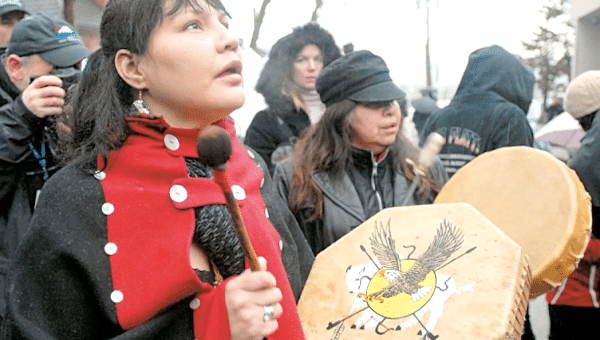
| Turtle Island | MR OnlineFollowing the ‘discovery’ of the Americas in 1492, a brutal process of plunder was unleashed by European powers with the goal of taking control of plethoric mineral resources, vast hunting grounds and abundant arable lands. The consequences for Indigenous communities were catastrophic. Through killing, disease and enslavement, they carried out one of the greatest genocides in world history.

On the Shores of the St. Lawrence

In the northern part of the continent, the Indigenous population was spread out across a huge territory, with many communities possessing a significant capacity for resistance, at a time when European settlements were still sparsely populated. Competition between England, France and the Netherlands obliged the French colonial power to come to terms with Indigenous Peoples, more out of necessity than virtue.1
While its aims were the same, France negotiated a number of treaties recognizing the rights of Indigenous People, both to open up western territories to trade and exploration, and to thwart English colonial ambitions.

Major Turning Point

By the second half of the 18th century, Britain was emerging as the major world power. Given the large French-origin population on the shores of the St. Lawrence, the British colonial power sought ways to subjugate but not annihilate them. They took a different approach to Indigenous Peoples. They crushed the revolt led by Odawa war chief Pontiac (Obwandiyag), traditional ally of the French, which erupted at Fort Detroit in 1763 and spread across the Great Lakes region. Following the secession of the territories that became the United States, the War of 1812 put an end to American ambitions and consolidated the hold of the British Empire.

Soon after, the defeat of the republican movement’s 1837-1838 insurrection further strengthened the colonial power. In 1841, Herman Merivale, Oxford professor and future Permanent Under-Secretary of State for the Colonies, recommended “insulation” and assimilation as a “solution” to the “Native Question.” Indigenous Peoples had to “choose” between assimilation and confinement to reserves where population movements and economic activities were strictly controlled. In 1842, the first Indigenous residential schools were established. The goal of these institutions was clear: “killing the Indian in the Child.”2

Confederation

In 1867, the British North America Act gave the federal government jurisdiction over lands reserved for Indians, and over Indians as such. In 1869, Indigenous lands were privatized and leased back to them, with a certificate of ownership (“location ticket”) issued to formalize the transaction. Indigenous women forfeited status if they married someone outside their community. This colonial arrangement was completed through the crushing of the Manitoba Métis and the execution of their leader Louis Riel in 1885, opening up western territories to large-scale settlement.

In the Shadow of the Canadian State

After the Second World War, the Canadian state proposed the elimination of Indigenous People’s distinct status, supposedly to give them the same rights as Canadians. But Indigenous Peoples rejected what they saw to be a policy of assimilation. In the 1980s, a memo drafted by a team of experts recommended a limiting of federal-government obligations, a reduction of federal spending on First Nations and a shifting of responsibilities to the provinces. Adopted in part, these measures have created the current state of affairs.

Third Party Management of communities by remote white accounting firms paid out of meagre band budgets is used as a form of fiscal and political punishment. Traditional governance has been eroded by the continued imposition of Ottawa’s band council system. Indian political organizations and First Nations are controlled by annual funding cycles in which large amounts of money can be withheld to express political displeasure, making long term planning impossible.3

While Canada ranked 12th internationally in 2016 according to the UN Human Development Index, the Registered Indian population would have ranked 52nd among countries with ‘very high’ human development, compared to a ranking of 63rd in 2006. The off-reserve Registered Indian population would rank 42nd in 2016 among countries with ‘high’ human development compared to 47th in 2006. The 2016 on-reserve Registered Indian population would rank 78th, while the 2006 on-reserve population would rank 89th, among those with ‘high’ human development. Destitution, unsanitary housing, lack of access to drinking water, malnutrition, and inadequate health and education services are widespread. Indigenous culture and languages have been marginalized.

| Orange is the new red Canada Bay 2021 | MR OnlineThe Main Stumbling Block

Since the revelations of crimes knowingly perpetrated by the Catholic Church, public awareness in Quebec and Canada has evolved. As for the federal state, though, beyond holier-than-thou rhetoric advocating “reconciliation” and increased spending, the main pillars of the system remain unchanged. No attention is paid to the fundamental issue–Indigenous sovereignty, the right to self-government, in accordance with the UN Declaration on the Rights of Indigenous Peoples. Ottawa refuses to negotiate with communities who do not want to give up title, ignoring the recommendations of the Royal Commission on Aboriginal Peoples.

One hears the word “reconciliation” everywhere these days. “Moral” responsibility for what happened is accepted, but the colonial system remains untouched. In the absence of real sovereignty, though, there cannot be substantial change. Moreover, were the rights of Indigenous Peoples to be recognized, they would constantly come into conflict with a Canadian state whose political economy is based in large measure on resource extraction, which requires territorial control. The Indigenous activist and academic Glen Coulthard has put this another way: “For our nations to live, capitalism must die.”4

So What Can Be Done?

The fundamental institutions of the Canadian state, built on a foundation of colonial plunder, cannot be reformed. You can’t fix a house whose foundation is rotten. In the short-term, though, there are emergency measures on which we must focus:

  • Demand accountability from the institutions which allowed this genocide, from the Canadian state down through its consenting partners in provincial governments and the Catholic Church. The murders that took place in residential schools, the systemic violence that continues against Indigenous women, and the entrenched institutional racism as exemplified by the Joyce Echaquan case, cannot remain unpunished.
  • Develop an emergency plan to bring an end to poverty and the under-development of infrastructure, which condemn Indigenous communities to live in a kind of Fourth World.
  • Immediately suspend new resource-extraction projects which threaten territories with the destruction of the environment and the building of massive facilities that further disfigure the land.
  • Buttress governance structures for and by Indigenous Peoples, including in the areas of security and public safety.
  • Support the Indigenous renaissance, which involves breathing new life into civil-society organizations and rehabilitating Indigenous cultures and languages, under Indigenous control.

In the long-term, however, a total overhaul is required, with full recognition of the right to self-determination as its starting point.5
Such a “deconstruction” would only lay down markers for a possible “reconstruction,” probably on the basis of reinvented state entities. Of course, an epic struggle will be required to reach that point. From the point of view of Quebec’s movements for emancipation, an alliance with Indigenous Peoples is indispensable, through a process like the constituent-assembly project promoted by Québec Solidaire in recent years. We can only rebuild Turtle Island if we do so together. •