Monday, March 22, 2021

8M: For a revolutionary feminism, which is not a cover photo but a struggle against all exploitation ~~ Cecilia Zemudio

https://mronline.org/2021/03/16/8m-for-a-revolutionary-feminism-which-is-not-a-cover-photo-but-a-struggle-against-all-exploitation/

~~ posted for collectivist ~~
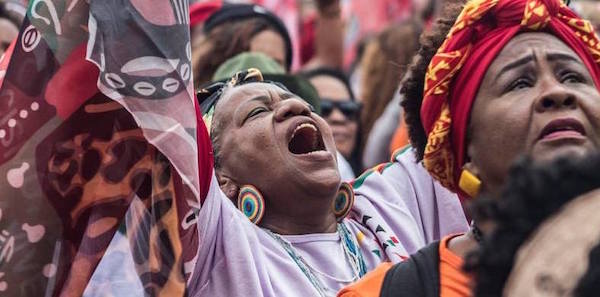
Activists at the National Black Women’s March Against Racism, Violence and for Well Being in Brazil.

The struggle for the emancipation of women and the struggle against capitalism are inseparable.

March 8 commemorates the revolutionary working woman. The communist Clara Zetkin proposed the commemoration at the conference of socialist women in 1910, to honor the struggle of women against capitalist exploitation. We remember the murder of 129 striking women workers burned alive at the hands of Big Capital in a textile factory in the USA: the factory owners closed the doors with them inside and set them on fire (as a measure of “deterrence” to prevent other women workers from following their example of struggle). It commemorates the struggle for social justice, for the rights of the working class, the struggle against patriarchy and capitalism, whose mechanisms seamlessly interconnect.

March 8 was also underpinned as an eminently revolutionary date by the events of March 8, 1917 in Tzarist Russia: thousands of women took to the streets clamoring for their rights, against exploitation and the wars that the bourgeoisie imposed on the people: they triggered the October Revolution. After the October Revolution women won their economic, social, sexual and reproductive rights: the right to vote for all women (not only for property owners as in Great Britain), the right to divorce, the right to abortion, full rights to study and work, guaranteed housing, health and education, etc. All these rights are still being fought for in the vast majority of capitalist countries.

We women are the hardest hit part of the exploited class. We are victims of imperialist wars, of capitalist plunder that impoverishes entire regions and countries, of privatizations and precariousness, and we are also victims of machismo incessantly promoted by the media and the entire cultural industry of capitalism. Because capitalism is sustained by fragmenting and dividing the exploited class: that is why the cultural industry of capitalism incessantly spreads paradigms of discrimination such as sexism and racism.

We are the exploited women workers, students, artists, unemployed and retired women who are being deprived of a dignified life, sometimes even of food, housing, access to health, access to education, etc. We are deprived of decent working conditions and remuneration by the capitalists who extract surplus value from our work. We are the mothers whose work at home is not recognized, those who remain in absolute precariousness without a pension. We are the migrant women pushed to suffer the worst exploitations: in appalling maquilas, sprayed with poison in the agro-industrial sector, forced into the exploitation of prostitution or to be objectified and plundered as “wombs for rent”. We are the girls raped and forced to give birth. We are designated by this system as the target of the aberrant frustrations that this system causes, of the misogyny that it fosters. That is why feminicide is rampant: because the media trivialize torture and all alienating discrimination functional to capitalism, because the violence exercised in a structural way drives its hatred against us.

We are victims of capitalism and its barbarism, victims of the machismo that Capital itself promotes; but we are also women fighters and revolutionaries.

March 8 is not the day of princesses, nor of exploitative businesswomen. The women oppressors, the Christine Lagardes, the Thatchers, the Hillary Clintons and others who profit from devastating forests, oppressing populations, enslaving thousands of workers in factories of fear, who also profit from fomenting machismo through their means of mass alienation, are the exploiting class, just like the men of the exploiting class.

Capital is interested in keeping us tied to the sexual division of labor, to unpaid care work, to wage discrimination for being women. Capital is interested in an exploited class pulverized and beaten, prevented from unity by machismo, racism, xenophobia, individualism and other alienations that the exploiting class is responsible for cultivating.

Faced with such a brutal reality, reformism, always serving to prevent deep questioning, attempts to encapsulate our struggle and superficialize it, hiding its class character, obviating the functionality that machismo has for capitalism.

The reformists, who seek to continue deceiving us with the cynical fable of a supposed and impossible “capitalism with a human face”, seek to hide the fact that we will not succeed in changing the profoundly sexist culture that reigns in the whole world, unless we take over the means of production and therefore those of diffusion and education. In this system a whole artillery of ideological subjugation is implemented by the bourgeois class; the paradigms of oppression are actively hammered from multiple flanks: from religious institutions historically functional to the ruling classes, through the great audiovisual industry, to the not at all ‘innocuous’ video games. To counteract this large-scale alienation, which causes so much suffering, measures are obviously needed to subvert the current social order; abolishing patriarchy will not be possible without abolishing capitalism.

The Trojan horses of the bourgeoisie pretend that the exploiting women are our sisters, when they also participate in perpetuating this system that devours nature, exploits human beings (the working class), and perpetuates machismo, racism, individualism, behaviors and discriminations fundamental to the maintenance of this rotten system.

Revolutionary women know that class society is perpetuated on violence: violence exercised by the exploiting class (which owns the means of production) against the exploited and precarious majorities, and we also know the burden that machismo represents for the unity of the exploited class.

We also fight for a revolutionary feminism, to be able to oppose the infamous recuperation that the system is trying to make of the feminist struggle, with its aberrant Trojan Horses and its discourse of “inter-class sorority” (as if we had to have “sorority” with an exploiting capitalist, a pimp or a token of the military-industrial complex for the mere fact of being a woman!).

We fight against all exploitation, and our struggle against the oppression of working women, we advance it by fighting day by day against machismo, against the bourgeois class, against a social order of concatenated exploitations; fighting against the root that sustains social inequalities: fighting against a system that fosters the oppression of women because it needs this oppression as a mechanism of domination and division of the exploited class; fighting against a system that fosters macho violence as a way of social control (as a perfidious escape valve for the frustrations that such a system creates); fighting against a system in which a handful of billionaires capitalize by crushing humanity and carving up the planet.

The rampant Feminicide is part of the barbarism of an economic, political, social and cultural system, the capitalist, violent in essence and perverse in its logic. A system based on the exploitation of workers and the plundering of nature is a system that needs to trivialize exploitation, social injustice and torture.

The struggle for the emancipation of women and the struggle against capitalism are inseparable. For a revolutionary feminism, which is not a cover photo but a daily struggle, which fights against all exploitation.

Wednesday, March 17, 2021

Rising Food Prices and War ~~ Thom Hartmann and Richard Wolff

https://www.rdwolff.com/thom_hartmann_rising_food_prices_could_bring_world_war


Food lines, growing prices, and widening inequality are all leading to global unrest. Economist Richard Wolff warns that it will only get worse. 

What is the relationship between rising food prices and social unrest? Prices have increased by 2.4% in just February. What does this mean for the economy? What does that mean for the world's hungry? Professor Richard Wolff joined The Thom Hartmann Program to discuss how healthy the economy is for food and whether there is trouble on the way.


Tuesday, March 16, 2021

What Does Critique Do? — On the Critical Predation of China

 https://www.qiaocollective.com/en/articles/what-does-critique-do

~~ posted for collectivist ~~ 

CHINA_CRITIQUE_06.jpg

The Western left has largely fallen in line behind interventionist platitudes of “standing with the Chinese people, not the Chinese government.” But their cover of “principled critique” elides the fact that criticism does not exist in a vacuum. In this case, it is greasing the wheels for Western imperialist intervention under the auspices of a “new” Cold War. 


Amidst the feverish critiques of China made by a growing cadre of “China scholars,” “media watchers,” and “think tank freelancers” across the Western world (the “free world,” they might tell you), a virulent distaste toward China for supposedly ethical reasons has become the norm. We’ve woken up to find ourselves in a Twilight Zone where the precondition for engaging with Sinophobia is the performance of a different kind of Sinophobic antipathy—one that disavows the possibility of Chinese political legitimacy while it virtue signals the Western critic’s own commitment to “justice.” 

We’ve woken up to find ourselves in a Twilight Zone where the precondition for engaging with Sinophobia is the performance of a different kind of Sinophobic antipathy—one that disavows the possibility of Chinese political legitimacy while it virtue signals the Western critic’s own commitment to “justice.” 

Western critiques of China, however, lay bare its stakes even as it feverishly disavows the very position from which it emerges. As principled Marxists, we must always ask after the historical context and political functions in which our words and actions take meaning. Why, we must ask, is it so enticing to name China as the “new” face of imperialism, even as the United States retains undisputed global military supremacy, with more than 800 military bases abroad and an international sanctions regime enabled by the dollar standard? Why do we continue to insist on the morally-bankrupt argument of “inter-imperialism and shared sins when the very people whom we benefit by doing so are, in order of significance, the U.S. military, the Euro-American military industrial complex, and international right-wing white supremacist organizations?

***

I. What/who/how are we critiquing?


A series of frighteningly simple assumptions undergird China-watchers’ performance of ethical commitment. Many a think piece has begun with the proclamation that the new era of multipolarity will be defined not by U.S. imperialism, but by Chinese hegemonic ascendence. Such arguments, as they are furthered by Western leftists, adhere to a simple definition of imperialism, usually cropped from Lenin. Their reduced theoretical analysis goes like this: imperialism is the highest stage of capitalism, borne by “the persistent tendency of mature capitalist state systems to generate violent conflict,” as Amiya Kuma has put it. Since China is capitalist, same as the rest of the world, it must also be veering toward imperialism, especially since it seems to be opening a number of trade partnerships with other Global South nations. 

Unlike the late capitalist dons of Europe and the U.S., however, this Chinese “capitalism” is framed as more aggressive and predatorial; China’s relations with other Global South nations can’t be anything but exploitative, since exploitation has been the dominant theme in post-1945 relations between Euro-American empires and the rest. China must be chomping at the bit to rise to similar dominance: her boundless appetite for labor and raw materials from the developing world bespeaks her endless greed, alerting us to the stakes of her menacing rise. (Naturally, this discourse is also pulsating with sexualized pathology and racialized excesses.) Since it is the job of any Marxist to oppose the capitalist foe, “we” must stand against China’s bad-faith practices, and, armed with questionable sources and plenty of U.S. State Department-sponsored media material, “we” must correct China’s malignant development.

One must wonder, really, what the profound ignorance of such Western leftist alarmism really means. Is their eager denouncement of China—red-faced and panting, like a poor child racing to rejoin the “party line”—not altogether a rather bleak disavowal of the international socialist project itself? Consider a widely-cited 2016 article by Ashley Smith from the International Socialist Review, which notes: 

The neoliberal boom from the early 1980s through 2008 is the principle cause of this new imperial rivalry [between the U.S. and China].... States like China have become new centers of capital accumulation. Inevitably these have become increasingly assertive in the world system bringing them into conflict with its hegemonic power, the United States, which has suffered a relative decline in the wake of economic, imperial, and political crises.

The crisis of the “inter-imperial rivalry,” we are told, is one borne by global capitalist integration. This integration, which officially absorbed China starting in the “early 1980s,” has now become so absolute that newly “capitalist” states, “like China,” have become empowered to challenge the old masters for the throne. In other words, Chinese capitalism is the endowing condition of its contemporary opposition to U.S. imperialism.

This assertion is not merely astounding, but comedic. It suggests that, actually, newly acquired capitalist confidence drove developing nations to turn against their Western imperializers. Not because those imperializers committed warfare or covertly installed genocidal dictators, or propped up postwar systems of comprador capitalism across half the world, as this writer might be persuaded to think—but because “capital accumulation” empowered developing nations’ “inevitable” desire for world domination. Hear, hear, the lesser Other can only mimic the hegemonic power, and now they’re threatening to overtake us.

By framing China’s perceived “aggression” as “inevitable,” Smith conveniently elides the possibility of asking a set of much more historically grounded questions—for example, why did China begin allowing Western companies partial domestic access, after thirty years of brutal U.S.-imposed sanctions? How did Chinese socialism move to moderate and redirect the flow of Western capital, post-1979? The stark absence of those questions across a whole swath of vigilant “China-watching” commentaries write their own story of contradiction. [Qiao has offered a historical assessment of China’s agenda of national development through the controlled injection of foreign capital here and here.]   

Case in point, Smith finds herself needing to contend with the enduring contrast between Chinese socialism and Euro-American capitalism even as she denounces the Chinese government as a “band of thieves.” A few pages later, she admits: “China retained state ownership over key sections of its economy (such as energy), compelled foreign investors to partner with Chinese corporations, and developed its own private capitalist class.” 


Given the fact that there has never been a successful socialist revolution in the Western world, it seems awfully suspicious that so many Western leftists jump to legislate what is and is not socialism.


Is China capitalist or socialist? Imperialist or anti-imperialist? We know, very well, what it means to be capitalist. Yet it remains uncertain whether Western leftists actually know what it means to be socialist, or to truly oppose the imperial structure that grounds the fabric of their reality. Given the fact that there has never been a successful socialist revolution in the Western world, it seems awfully suspicious that so many Western leftists jump to legislate what is and is not socialism. Unlike capitalism, a theory that retroactively explains a brutal practice, theories of socialism are founded on—and accountable to—practices of revolution. Unlike theories of capitalism, whose seemingly-benign language obscures the brutalities at work, actually existing socialism—in China, Cuba, the DPRK, and Venezuela, to name a few—are dynamic practices that account for strategic survival in the face of imperialist, capitalist, and racist genocidal hostility from the capitalist Western bloc. Not just surviving but thriving, the accomplishments of Chinese socialism speak for themselves.

***
II. What does critique do?

Western critique against China serves three main purposes. 

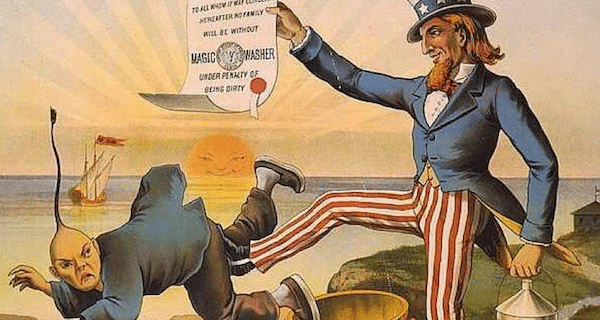
First, it reifies the myth of the yellow peril, impinging on the centuries-old trope of the Oriental menace. You’ve seen him/her/it, a nagging iteration of the xenophobic terror deeply seeded in the white-Western consciousness. From Fu Manchu to the popular caricature of Chinese people as rats, the specter of a rising China has long haunted the Western cultural complex, awakening within itself a sense of civilizational inferiority. 


This fear mongering around China, the Oriental menace and despotic yellow peril du jour, is possible because imperial ideology is able to continually reframe China in contrast to docile, “democratic” U.S. neocolonies in East and Southeast Asia. Model neocolonies, meet the big, bad wolf.


Today, the yellow peril continues to be remade as Chinese despite the broader geopolitical indeterminacy of “yellowness” as racial marker. It’s a difficult task to litigate the ethnic specificity of the yellow peril against the broadening color line. But imperialists, reaching into their domestic toolkit of racist triaging, have found an expedient solution by highlighting Asian neocolonies as model “democracies” against the wretched authoritarianism of “Red China.” This fear mongering around China, the Oriental menace and despotic yellow peril du jour, is possible because imperial ideology is able to continually reframe China in contrast to docile, “democratic” U.S. neocolonies in East and Southeast Asia. Model neocolonies, meet the big, bad wolf. 

Together, those neocolonies—including but not limited to Taiwan, South Korea, Japan, Thailand, Singapore, and the Philippines—form an archipelago of U.S. influence in the region. These model minority Asian nations also constitute the U.S. empire of bases. Under treaties established by the Philippine-American War (the Philippines), World War II (Japan), the Korean War (South Korea, Taiwan), and the Vietnam War (Singapore), they have ceded parts of their territories for U.S. military use, and offer technological, biopolitical, and monetary support of U.S. military domination in the Asia-Pacific. Consequently, across the U.S. military bases of East and Southeast Asia, nuclear warheads and an active contingent of soldiers (the largest of all the military’s foreign outposts) encircle the belly of mainland Asia, threatening China, the DPRK, and Russia with what the Pentagon euphemistically refers to as an “asymmetric advantage.” In this light, the truth emerges, that under the rhetorical distraction of the Chinese yellow peril lies a stringent U.S. imperialist agenda of securitization and expansion—one that costs U.S. taxpayers trillions of dollars a year and has run a permanent war in Asia and the Pacific since 1950.

In contrast to the explosive anxiety around “rising China,” we might consider how and why the U.S. has embraced, even instrumentalized, the rise of South Korean soft power with much ado about nothing, except a continental obsession with eyeliner and facemasks. Geopolitical analysis offers us another explanation for this comical distribution of imperial resentment. As a U.S. protectorate that relies on the U.S. militarily and economically, South Korea poses not a threat but a facade of indigenous “postcoloniality” for the structure of U.S. imperialism. So long as the U.S. remains in a permanent war against the DPRK, so long as the U.S. eats away at the belly of Asia through its “hosts” in the Pacific, South Korea, one of its oldest regional neocolonies, is nothing but a feather in the cap of the multicultural U.S. empire. 

Contrastingly, China, which recognizes the imperialization of most of its Eastern and Southeastern neighbors, is one of the last holdouts against the U.S. military empire in the Asia-Pacific. For many, it’s terrifying that China has warily bucked the advances of Western imperialism (a discordant symphony that usually follows the four movement-form of sanctions, economic penetration, political involvement and violent regime change). Terrifying, that is, if you’re a cog in the imperial machine and believe the line that everyone who is not with “us” is against us, and everyone against us must die. This classic Cold War paranoia has produced more than a few U.S.-backed genocides-cum-puppet regimes (in Indonesia, Chile, El Salvador, Iraq, Afghanistan, Japan, and Korea, to name just a few), leading some scholars to name it as the impulse driving the U.S.’s target of the world.


Western critique against China sucks momentum from principled opposition to U.S. expansion of its empire of bases in the Asia-Pacific under the auspices of a renewed anti-China containment doctrine.


Secondly, Western critique against China sucks momentum from principled opposition to U.S. expansion of its empire of bases in the Asia-Pacific under the auspices of a renewed anti-China containment doctrine. As the site of the U.S.’s longest-reigning military commitment, the Asia-Pacific has been the playground of U.S. commanders, war criminals, and rapists since the start of the Philippine American War in 1902, in which the U.S. succeeded in brutally suppressing a Filipino revolution. Since 1902, the U.S. has steadily built up an empire of military bases that gives it coverage over 60% of the world, and 70% of the world’s seas. 

In the same vein as the current vitriol against China, we might remember how, when Japan was on the economic rise during the 1980s and 90s, there was an ascendent U.S. anxiety and corresponding trade war against Japanese firms—including the jailing of Toshiba CEO and the siphoning of Toshiba’s intellectual property. But that antagonism, resolved by a U.S. trade war that essentially destroyed Japan’s burgeoning semiconductor industry, had at least the decency to be explicitly leveraged at the island nation’s economic growth. Today, U.S. wariness of Japan has been rerouted through a crude sexual fascination resulting in a familiar cultural duet of fetishism and fear. 

One crucial fact, however, remains impossible to overlook: despite its nascent anxieties, the economic development of Japan, a crucial American neocolony in the Asia-Pacific, was and is deeply strategic to the interests of U.S. empire. On this topic, the Filipino scholar Walden Bellow writes: Since World War II, “the U.S. dominates [the Asia Pacific] militarily, Japan has mastered it economically.” Elsewhere, Bruce Cumings notes that Japanese fascism never ended, but was merely handed over to the U.S. after the Japanese defeat in 1945. While the U.S. moved in to cash its gains from the Potsdam Conference by establishing the largest military empire the world has ever known, Japan received the consolation prize of playing second fiddle in the redevelopment of the Asia-Pacific. “Perversely framed as modernizing opportunities, the Korean War was essential to postwar Japan’s economic recovery,” Christine Hong writes, just as “the Vietnam War [was] likewise critical to South Korea’s compressed development under military dictator Park Chung-hee.” 

As of the 1990s, the Pacific Command (the U.S.’ military command in Asia, and its largest yet) was interested in deterring India, China, and Indonesia, while keeping in check the power of its comprador, Japan. Today, the renamed Indo-Pacific Command has as its top interest the containment of a rising China and the expansion of its military power through Central Asia to the Middle East. All of this explains the sustained American embrace of Japan and South Korea against its fervent ideological campaign against China. Why wouldn’t the imperial machine actively seek the destruction of the last thing standing between it and domination over all of Asia? The question remains, however: why should you, me, we do the empire’s work?


That political actors as diverse as Mike Pompeo and Jacobin coalesce behind indistinguishable rhetoric on China is not a contradiction. Behind his seemingly “neutral” position, the Western critic is deeply invested in the ability to comfortably assert both his and his country’s ethical superiority to a despotic, communist China.


This leads us to the third and final point: critique functions to reify the very subject position of the Western critic, who maintains the purity and superiority of occupying a “principled” position despite the unequal impact of their words in an imperial discursive landscape. Indeed, the Western critic is a subject position in which the ostensible political differences between ultraleftist Trotskyists, white supremacists, and war hawks converge in tired tropes such as “support for the Chinese people, not their government.” That political actors as diverse as Mike Pompeo and Jacobin coalesce behind indistinguishable rhetoric on China is not a contradiction. Behind their seemingly “neutral” position, the Western critic is deeply invested in the ability to comfortably assert both his and his country’s ethical superiority to a despotic, communist China. This “white man’s burden,” liable to be taken on by any and all in the imperial core, insists on a liberalizing imperial agenda. Fuck despotic China, goes their critique, fuck its brainwashed citizens, whom we both hate and desire to save. As they insist on the overthrow of the Chinese government, the Western critic, whether in State Department bombast or pseudo-leftist jargon, positions themself in defense of continued U.S. imperial triumph.

This thinly veiled liberal impulse is threaded with cynicism. In it, the Enlightenment subject (the Western speaking-subject) appears as an inextricable outgrowth of imperialism. His own speaking power—indeed, his very political position—is strengthened by comparison against the bedeviled hoof of “communist authoritarianism.” Because Western liberalism exists only in relation to “Oriental despotism” these “principled critiques,” even when they come from those who are ostensibly critical of Western liberal capitalism as well, function to naturalize and reify the liberal West versus despotic East formation which continues to inform Cold War imperialism.

***
II. What does critique foreclose?

The reality of the U.S. hybrid war—ideological, economic, and increasingly, a possible military war—against China is buttressed by a powerful discursive arsenal that seeks to reroute all critiques against China to justify heightened aggression. Already, we’ve seen it in the works, at home and abroad: recent sanctions against Chinese companies as well as politically motivated arrests and violent attacks on Chinese people, including Chinese and other Asian Americans, cite “authoritarian China” as their justification. In the throes of this imperial discursive system that seeks to reroute any and all critique against China into fodder for the U.S. war machine, the stakes of critique are higher than ever.

What does it mean to engage critically with China, outside of this imperial dynamic? Indeed, is it even possible? One of the great tragedies of this totalizing discursive encroachment is a certain impossibility of speech. Nobody, but especially no Chinese people, can discuss Chinese affairs without being impinged upon by the malicious agendas and impervious agents of the imperialist west. That there are avenues of many critical engagements with China—in praise and in criticism—are facts well known to Chinese people themselves. China is, after all, a People’s Republic: the CPC’s immense popular support is in no part due to citizens’ staunch investment in their country, and in the discourse of their country’s affairs. However, the eager cooptation of all speech, especially Chinese speech by U.S. covert forces, forecloses the viability of true, good-faith engagement anywhere. Every utterance is staked on the knife’s edge, when a voyeuristic agent of the U.S. is listening to your conversations and eagerly trying to turn it into ammo for ideological war. When you have no way of engaging with your own, no possibility of internal discourse with your compatriots, one must ask: Is there such a thing as freedom of speech under imperial predation? 

Further, when foreign critiques are leveraged, Chinese governmental responses are diminished and altogether erased from imperialist media. Internal mechanisms of accountability are altogether disappeared from view. This raises the question: What does critique do, if it doesn’t grease the wheels for intervention and war?


As anti-imperialists living in the imperial core, we insist that our primary responsibility is to disrupt the U.S. war machine, not to debate the social or economic character of countries that are in its crosshairs.


Our assessment of the function of criticisms of China is therefore founded not on a facile belief that contemporary China is a utopian society without flaw, but rather on the recognition that critique does not exist in a discursive or political vacuum. Having no authentic ties to Chinese political discourse of movements, and no influence over the trajectory of Chinese politics except by imperialist force, the primary function of armchair observations from Western critics is inevitably to strengthen imperialist narratives about China and to stroke the ego of the critic. That Western debates over the arbitration of China’s political economy as “socialist” or “capitalist” rise and fall in tandem with Western aggression on Chinese sovereignty is not a coincidence but a reflection of the fact that the primary utility of such debates is not to build real internationalist solidarity but rather the derail any momentum towards a real left challenge to the machinations of Western empire. As anti-imperialists living in the imperial core, we insist that our primary responsibility is to disrupt the U.S. war machine, not to debate the social or economic character of countries that are in its crosshairs.

***
“Free” speech in a landlocked empire

Who has the right to critique? When China Foreign Ministry Spokesperson Zhao Lijian reposted a satirical graphic critiquing the recent revelations of Australian war crimes in Afghanistan, Western media outlets framed Zhao’s post as “evidence” of a supposed Chinese misinformation campaign. Instead of focusing on the context of the war crimes—in which twenty-five soldiers brutally and sadistically murdered some thirty-six Afghani civilians—outlets such as NPR, CNN, ABC, BBC, the New York Times, and the Globe and Mail chose instead to spectacularize Zhao’s social media post. As FAIR’s Joshua Cho points out, “The important information was not that Australia had committed war crimes in Afghanistan, but that a Chinese government official had been spreading offensive images containing false information.” 

It’s tempting for Western leftists to assume a mastery of world-historical knowledge. But this hubris, endemic to imperial cultures, serves none but the victor, inculcating him in an arrogant delusion that he knows what’s best and may act on others’ behalf. “Ideology in action,” as the postcolonial critic Gayatri Spivak reminds us, “is what a group takes to be natural and self-evident, that of which the group, as a group must deny any historical sedimentation. It is both the condition and the effect of the constitution of the subject (of ideology) as freely willing and consciously choosing in a world that is seen as background.” 

If Western leftists are to be truly principled, truly accountable to the world-historical situation, “we” must disentangle ourselves from the imperialist ideologies that dominate the discursive landscape the West takes for granted.

Anti-Asian racism never stopped being an outgrowth of U.S. imperialism ~~ Danny Haiphong

https://mronline.org/2021/03/11/anti-asian-racism-never-stopped-being-an-outgrowth-of-u-s-imperialism/

~~ posted for collectivist ~~

Anti-Asian Racism Never Stopped Being an Outgrowth of U.S. Imperialism


Scant attention has been placed on the context of anti-Asian racism and its roots in the history of U.S. imperialism.

Gimme that ball, gook.

Can you see with those eyes, chink?

Did your Dad get your Mom in Vietnam?

These were just some of the references to anti-Asian racism heard frequently throughout my childhood which were often accompanied by social humiliation and threats of violence, whether in the form of robbery (many times) or a puzzling curiosity about the size of my genitals. More politically correct adults would throw praise at my perceived “model minority” status. This sent an early message that the best means of surviving within a racist society was to focus on individual uplift and avoid conflict with those in power.

The U.S. mainstream has caught up with the existence of racism toward Asians in America, mainly because it has become harder to ignore. Violence directed at Asian Americans has skyrocketed since the emergence of the COVID-19 pandemic.  According to the Asian American Bar Association of New York, more than 2,500 cases of anti-Asian “hate incidents” have been reported across the country between the months of March and September of 2020. Notable cases include the January assault of an elder Thai man in San Francisco and the stabbing of a Chinese man in New York’s Chinatown last month.

The wave of violence has caught the attention of the Biden administration, the corporate media, and prominent celebrities. Former NBA and current G-League player Jeremy Lin took a strong stance against anti-Asian racism in late February. Lin’s post on Facebook came in response to being called “coronavirus” on the basketball court. His statement ended with a question: “Is anyone listening?” While more has been said in recent weeks about the rise of anti-Asian racism and the urgency to address it, scant attention has been placed on the context of anti-Asian racism and its roots in the history of U.S. imperialism.

The United States was a willing participant in China’s “Century of Humiliation” following the Opium Wars of the early to mid-19th century. Prominent capitalists such as Franklin Delano Roosevelt’s maternal grandfather Warren Delano enriched themselves from the sale of opium, an industry imposed on China by way of treaties that massively displaced and impoverished the population. American gunboats sailed along the Yangtze protecting U.S. interests for nearly a century prior to the Chinese Revolution of 1949. Migrant Chinese workers in the United States were dehumanized as “coolies” to justify the white supremacist violence leveled against them, even by a large section of organized labor.

The dehumanization of peoples of Asian descent is often isolated and disconnected from the white supremacist violence experienced by Black and indigenous peoples in the United States. Yet the U.S.’s original sins of racialized slavery and settler colonialism helped form the material basis for the rise of anti-Asian racism. During the decade and a half-long U.S. occupation of the Philippines, U.S. soldiers justified mass slaughter and plunder by routinely equating the Filipino people with the same racist tropes used to describe Black Americans and Indigenous nations. Eventually, a unique language of racism was deployed to normalize not only the destruction of the Philippines but also the internment of Japanese residents and the brutal wars of aggression waged in KoreaVietnamLaos, and Cambodia. As Black Americans faced the violence and exploitation of Jim Crow, the scope of white supremacy was widening in service of the U.S. project of imperialist domination.

However, U.S. imperialism has also required white supremacy to constantly shape shift to fit the interests of its ruling class. State violence and economic dislocation has unevenly affected the various nationalities that make up the “Asian American” umbrella. A concerted effort to “diversify” the U.S. mainstream with popular movies and programs highlighting of “Asian” riches has intensified the identification of Asian America as a privileged stratum far closer to white America on the class ladder than the U.S.’s oppressed and super exploited Black and Indigenous populations. The U.S. corporate media and political establishment has reinforced this generalization by paying close attention to forces in Asian American communities calling for more law enforcement protection against racist violence.

All of this combined has divorced anti-Asian racism from its roots in the development of U.S. imperialism. The separation of anti-Asian racism from U.S. imperialism has both encouraged a potential reliance on the state to resolve the very racist violence it commits with regularity and the systematic erasure of the real reasons behind the rise in anti-Asian racism in the United States. Just as the United States deployed racism to justify its empire-building in the Asia Pacific during the 20th century, so too has the U.S. ruling class intensified a deep skepticism of China amid the devastating spread of COVID-19 on the U.S. mainland. While the corporate media has acknowledged the role of Trump’s scapegoating of China for the spread of COVID-19, it hasn’t explained why the U.S. is so hostile toward China in the first place.

The truth is that “Kung Flu” and other racist tropes peddled by Trump and his legions are only one aspect of a larger U.S. campaign to contain the rise of China. China is set to surpass the United States as the world’s largest economy within a decade and has garnered favorable international attention for its containment of COVID-19 and its efforts to curb extreme poverty and climate breakdown. The rise of China has placed the hegemony of U.S. imperialism into question on the highest stage possible: that of the fundamental relations between nations and economies. This has spurred a U.S.-led New Cold War against China led by all sections of Washington’s establishment, including its most left-leaning elements.

The New Cold War on China is first and foremost a military campaign comprised of four hundred U.S. military bases, hundreds of thousands of U.S. troops, and over sixty percent of all U.S. naval assets stationed in the Asia Pacific. But the U.S. strategy to contain China includes political and economic sabotage. Sanctions have been placed on Chinese officials and tech corporations and the U.S. has waged an endless campaign of interference in China’s internal affairs relating to Xinjiang Uygur Autonomous Region and the city of Hong Kong. Both corporate and so-called progressive media such as Democracy Now have obsessively focused on the reproduction of negative stories that mirror the U.S. Department of State’s official posture toward China. The endless stream of anti-China propaganda has been effective; eighty percent of all Americans currently view China unfavorably, according to recent polls.

The only difference between the recent wave of intense anti-Asian racism and that which has endured over the course of U.S. history is the stage of the imperialist system. The U.S is no longer a rising empire. Rather, U.S. imperialism has entered a state of decay decades in the making and can only speak the language of military, political, and economic violence. The struggle against anti-Asian racism thus cannot be left to the militarized police forces terrorizing Black American communities or to the larger U.S. political apparatus that honed anti-Asian racism as a weapon of imperialist expansionism. Instead, U.S. hostility toward China and the peoples of the East should be seen as an opportunity to develop the broadest popular front possible toward the cause of peace, self-determination, and liberation from the oppressive rule of imperialism.