Friday, April 23, 2021

Decolonization or Extinction: Indigenous Red Deal Lays Out Plan to Save the Earth ~~ Democracy NOW

https://www.democracynow.org/2021/4/22/the_red_deal_book

~~ posted for collectivist ~~


https://youtu.be/Teqh6xLcXds

On Earth Day, we speak with two of the more than two dozen Indigenous authors of a new book that looks at the history of resistance against colonialism and capitalism and lays out a vision for the future to address the climate crisis. “The Red Deal: Indigenous Action to Save Our Earth” details the centuries of Indigenous resistance that created the movement at Standing Rock against the Dakota Access pipeline and what movements centering justice for Indigenous people must look like. The book offers a “people’s program to prevent extinction,” says Melanie Yazzie, assistant professor of Native American studies and American studies at the University of New Mexico and co-author of “The Red Deal.” “The plan is really clear. The stakes are really clear,” Yazzie says. “We draw centrally from Indigenous movements over the last couple of decades for decolonization.” We also speak with Uahikea Maile, an assistant professor of Indigenous politics at the University of Toronto–St. George and one of the book’s co-authors.

Transcript
This is a rush transcript. Copy may not be in its final form.

AMY GOODMAN: This is Democracy Now! I’m Amy Goodman, with Nermeen Shaikh.

Today is Earth Day. As President Joe Biden begins a two-day virtual Leaders Summit on Climate, a group of 101 Nobel laureates has published a letter urging them to, quote, “keep fossil fuels in the ground” and support a just transition to clean energy. This week, Congressmember Alexandria Ocasio-Cortez and Senator Ed Markey reintroduced the Green New Deal resolution in the House with over 100 co-sponsors.

This comes as Indigenous leaders and land and water defenders have denounced the Army Corps of Engineers’ decision not to shut down the Dakota Access pipeline as it continues a second environmental review of the pipeline on Standing Rock Sioux land or adjacent land. This is a clip from a video message to President Biden produced by Standing Rock Sioux Tribe and the group Earthjustice in the Lakota language.

FUTURE: [translated] My name his Future. My mind remembers, but the heart feels it. It was the gathering of all directions. Standing Rock 2016. That’s where it all began. Thousands answered the call and came together to protect our river. [in English] President Biden, you can be on the right side of history. Shut down the Dakota Access pipeline.

AMY GOODMAN: More than two centuries of Indigenous resistance led up to the movement at Standing Rock that proclaimed “Water is life.” We spend the rest of the hour discussing this history and a vision for the future that’s laid out in a new book, published today, titled The Red Deal: Indigenous Action to Save Our Earth.

We’re joined by two of the book’s two dozen Indigenous authors. In Albuquerque, Melanie Yazzie is co-founder of The Red Nation, a grassroots Indigenous liberation organization, chair of the board of directors for Red Media, an imprint of Common Notions. The Red Deal is Red Media’s first publication. Yazzie is a citizen of the Navajo Nation. She’s Diné, assistant professor of Native American studies and American studies at University of New Mexico. We are also joined from Toronto by Uahikea Maile, a Kanaka Maoli scholar and activist from Maunawili, O’ahu. He’s also a member of The Red Nation, assistant professor of Indigenous politics at the University of Toronto.

We welcome you both to Democracy Now! Thank you so much for joining us. Melanie Yazzie, let’s begin with you on this Earth Day. If you can talk about the red plan, The Red Deal?

MELANIE YAZZIE: Sure. So, The Red Deal is essentially a people’s program to prevent extinction. You know, we talk a lot in The Red Deal about, like, the plan is really clear. The stakes are really clear. It’s decolonization or extinction. And the reason why we use the language of decolonization is because we draw centrally from Indigenous movements over the last couple of decades for decolonization. You know, Indigenous people have been on the frontlines of the struggle for climate justice since 1492, but, more recently, as the call for climate justice has been reverberating across the globe to address kind of this 30 — well, we’re actually at a 29-year — right? — clock towards climate disaster. You know, Indigenous people, whether it’s at Standing Rock, the clip you just showed, Apache people fighting Resolution Copper, or Uahikea’s people fighting the Thirty Meter Telescope in Hawaii, Indigenous people have really been on the frontlines of the struggle to advance the climate justice movement. And so we draw really centrally from that, and that’s why we say “decolonization or extinction.”

And we can really trust Indigenous movements historically. So, Indigenous people make up 5% of the world’s population, but we protect 80% of the world’s biodiversity, which, of course, is incredibly important when we’re thinking about climate change and curbing climate change. And also something The Red Deal does, because we do claim that you can trust Indigenous movements because we’ve been on the frontlines and we’ve been fighting this battle for so long, you know, is that we draw really centrally from Indigenous knowledge. And the way that we talk about Indigenous knowledge in relationship to climate justice is not the same way that we’re often sort of cast or stereotyped in the mainstream environmental movement, which is often sort of a spiritual or a cultural window dressing — right? — to the larger mainstream claims about climate justice and environmental justice. But, for us, what constitutes Indigenous knowledge are actually Indigenous traditions of governance and science and technology that are really premised on caretaking our relations, right?

So, Vine Deloria Jr. once said that the crisis that we’re facing as a species, as a globe, it’s not actually climate change. He said we’ve simply fallen out of right relation with the Earth. Right? We belong to a nation and a people who, instead of caretaking the Earth and seeing the Earth as a relative, we prey on the Earth, right? We have a predatory relation. And so, what we argue for in The Red Deal from an Indigenous perspective is that we — A, the reason why climate change is happening is because we have fallen out of right relation with the Earth, and, B, what we need to do to rectify the situation is to draw from Indigenous peoples’ experience on the frontlines of climate justice and really enter back into right relation with the Earth.

And we propose a couple of ways to do this. The first — and we draw really centrally from calls for abolition that are coming from the Black Lives Matter and the Movement for Black Lives movements, for the abolition of carceral institutions — right? — the institutions that cause the most harm: prisons, police, the U.S. military. You know, Amy, you just said in the previous segment there are calls to reduce funding for the Pentagon — right? — to pull out of Afghanistan. Why don’t we take the money that goes into harming people and put it instead and to reinvest it into that which gives people life and dignity: healthcare, education, COVID-19 vaccines, infrastructure, transportation — right? — housing, those types of things. And so The Red Deal really talks about this from an abolitionist perspective. So we see that elevating the dignity of working-class and poor people is really central to an Indigenous interpretation of climate justice from a decolonial perspective.

And I’ll just say one more thing. You know, something that we — and I’ll talk a little bit more about this, perhaps, in the next few minutes — but something that we talk a lot about in The Red Deal is that when we were looking at the Green New Deal, which was the impetus for The Red Deal, we found that it was not comprehensive, perhaps, or extensive enough. It’s quite a short document, at least the one that was introduced by Alexandria Ocasio-Cortez. And in early 2019, we decided to sit down and think through what would it mean to indigenize the Green New Deal. And that’s where The Red Deal was born.

And for us, part of what that means is that we had to take a much stronger stance than the Green New Deal does on global imperialism, or U.S. imperialism and global capitalism as the primary kind of philosophy of falling out of right relation with the Earth. And so, we really draw centrally from the Cochabamba Agreement and the People’s Gathering of 2011 in Bolivia, which had an explicitly anti-imperialist and anti-capitalist perspective on what Indigenous people are saying about climate justice. And so, these are some of the things that are really at the heart of The Red Deal. It’s an action-based program. Red Nation has always been a very action-based organization. And it’s really meant for everybody to kind of dig in. There are multiple entry points. And it really embraces a diversity of tactics.

NERMEEN SHAIKH: Professor Maile, if you could talk about your book releasing today, which is when Biden’s climate summit begins? What are your expectations of this summit? Biden is being lauded for — apparently, he’s expected to make unprecedented cuts, pledging to make unprecedented cuts, the U.S. cutting carbon emissions by over 50% by 2030. Your response to that? And what are your demands from the Biden administration? What needs to be done?

UAHIKEA MAILE: Thanks for that question. It’s great to be on the show.

You know, the Biden climate leaders summit isn’t actually about climate leadership. We see it as a summit about climate imperialism. After the Trump administration pulled out of the Paris treaty, the international community lost confidence in the U.S. as a leader in climate justice. After Obama signed onto the Paris treaty and Trump exited, the Biden administration has a political obligation, let’s say, not just to rejoin, but to attempt to assert leadership in the international community and secure its confidence. But even those within the alleged borders of the so-called United States are not confident.

The climate leaders summit is less about climate justice and the international community, and more so about Biden’s plan for reducing global warming, reducing greenhouse gas emissions, and committing funds to renewables. But as we know and as the Climate Action Tracker suggests, the United States cannot assert itself and identify — be recognized even — as a leader in climate justice by reducing greenhouse gas emissions by 50% by the year 2030. They must be committed, according to the Climate Action Tracker, to reduce greenhouse gas emissions by more than 60%.

And so, what we see in the gathering of Biden’s climate leaders summit is a facile performance of U.S. imperialism that’s dressed as American exceptionalism masquerading as environmental justice. Even Biden’s pointing fingers at China, in his own version of xenophobia, the truth is, since 1750, the preindustrial era, the U.S. has emitted 400 billion tons of carbon dioxide into the atmosphere, compared to China’s 200 billion tons. That’s double the amount of China’s emissions. Although Biden canceled the Keystone XL pipeline, he has yet to shut down the Dakota Access pipeline, Enbridge’s Line 3. We see, within the so-called borders of the U.S. nation-state, that Biden’s attempt to convene a climate leaders summit is merely a symbolic performance that attempts to shore up American exceptionalism and the U.S.’s leadership internationally.

And so, we also see other nation-states coming to the summit that are allegedly climate leaders, when in fact they’re, on the ground, not recognized by people in this way. For example, Prime Minister Justin Trudeau, an alleged climate leader in the world, that’s been invited by President Biden, hopes to actually keep oil and gas pipelines flowing. Differently than Biden not canceling the Dakota Access pipeline and Enbridge’s Line 3, Justin Trudeau actually purchased the pipeline, the TransCanada Mountain pipeline, and, since the pandemic, has bailed out the oil and gas industry upwards of $20 billion during the COVID-19 pandemic. And so, what we see in this climate leaders summit is that, like Biden, Trudeau isn’t a climate leader. These are climate clowns that mime and perform the rhetoric and language of climate justice and environmental justice, when in fact, in —

AMY GOODMAN: Five seconds.

UAHIKEA MAILE: — material ways, are committed to extracting fossil fuels.

AMY GOODMAN: Professor Maile and Professor Yazzie, we’re going to ask you to stay with us. And on this Earth Day, we’re going to do a special post-show conversation that we’ll post online at democracynow.org. I want to thank you both for being with us. And congratulations on your book, published today, The Red Deal: Indigenous Action to Save Our Earth. I’m Amy Goodman, with Nermeen Shaikh.

Wednesday, April 21, 2021

Nearly 250 years after land theft, Madawaska Nation wins settlement in Canada ~~ Ted Kelly

https://www.workers.org/2021/04/55887/

~~ posted for collectivist ~~

An agreement negotiated by the Madawaska Maliseet First Nation and the Canadian government April 13 has become the largest compensatory land settlement in the country’s history. The Ministry of Crown-Indigenous Relations has agreed to pay $145 million to the Madawaska Maliseet First Nation after Canadian courts ruled that a specific 18th century settler land grab was illegal.

Townships of Algonquin-speaking Maliseet people were the most densely populated areas in Madawaska territory by the mid 1700s, when European land theft intensified. Settlers used the stolen resources of the land to develop logging and wood pulping industries, the growth of which was accelerated by the creation of the Canadian Pacific Railway.

In 1787, European settlers, in violation of their own legally binding treaties, stole almost 2,000 acres of land that had been reserved for the Madawaska Maliseet Nation in the northwestern corner of what is now called New Brunswick. When the railway abandoned the area in 1936, the Madawaska Maliseet began efforts to reclaim the territory. Today there are still 50,000 people who report First Nations, Métis or Inuk identity living in the region.

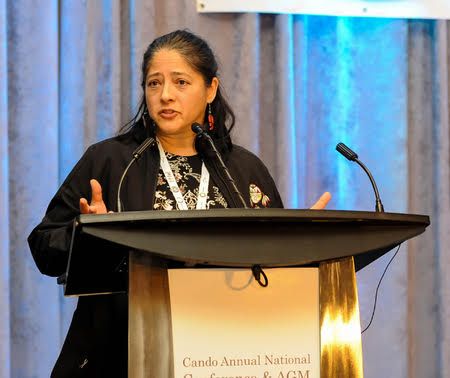
“We will be consulting with the community to determine what type of land and what uses of that is going to be for,” said Chief Patricia Bernard of the Madawaska Maliseet First Nation. Shown here Oct 25, 2018, accepting a Community of the Year award. Credit: Cando

Chief Patricia Bernard was a university student majoring in history when she learned this history and discovered that the seizure of her Nation’s land had violated a royal proclamation issued by King Geroge III in 1763. During her research, she also learned that the first person who resisted the encroachment on reserve land by bringing the case to a local magistrate was 90-year-old Louis Bernard — her great-great-grandfather’s great-great-grandfather. (Aboriginal People’s Television Network)

The historic settlement comes just a few months after the Mosquito, Grizzly Bear’s Head, Lean Man First Nation in Saskatchewan were awarded $127 million for a 1905 land theft. (Global News) 

Since March of last year, the Federal Government of Canada has now paid $1.7 billion in land theft compensation to various First Nations in 36 separate claims, over half of the 51 total claims brought forward. Four more are currently being reviewed by the country’s high court. (Yahoo Finance)

First Nations people face widespread discrimination

Across Canada, First Nations and Inuk people face a staggering 40% unemployment rate. The Métis are people with a mixed heritage of Indigenous and mostly French European backgrounds and have a high but lower jobless rate of approximately 25%. (Statistics Canada) 

Lack of adequate childcare for those seeking work is a major barrier to employment, and men are more likely to find work than women. 

Poor housing, lack of transportation infrastructure and difficulty acquiring driver’s licenses are part of the institutional white supremacy in Canada that forces the underdevelopment of First Nations communities.

In addition to the unprecedented financial compensation, the settlement grants the Madawaska Maliseet the right to acquire 1,935 acres of land — the same amount that was stolen from them almost 250 years ago.

#LandBack, the struggle for restoration of Indigenous people’s sovereignty over occupied or stolen land, is a global anti-colonial, anti-racist movement. The liberation of oppressed nations — from Palestine to Mexico, from Nunavut to Bolivia — lies in the land. 

In the words of Fannie Lou Hamer, the legendary African American sharecropper-turned-organizer and founder of the Freedom Farm Cooperative: “In order for any people or nation to survive, land is necessary.”

Following the Chauvin verdict: Stay in the streets! Abolish the police!

https://www.workers.org/2021/04/55929/

~~ posted for collectivist ~~

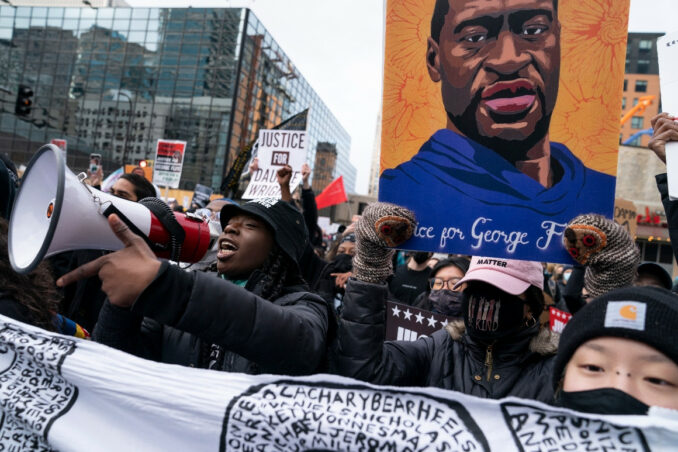
Workers World Party expresses its solidarity with the family of George Floyd, along with the Minneapolis community and anti-racist activists everywhere, who understandably applaud the three guilty verdicts against the racist, white, killer cop, Derek Chauvin, who wantonly lynched Floyd May 25, 2020. 

Chauvin was found guilty today, April 20, 2021, of second-degree manslaughter, second-degree intentional murder and third degree murder. Three other cops, who stood by as Chauvin kneeled on Floyd’s neck and body until he died, have been fired and will face charges for aiding and abetting in subsequent trials.

We are in solidarity with those who will be in the streets tonight and throughout the coming days and weeks who express relief with the verdict and at the same time, acknowledge its limitations. In the long run, more than the jailing of Chauvin or any individual killer cop is needed for eradicating police terror and white supremacy — two evils which go hand-in-hand.  

We demand that not one person be arrested or assaulted by the police or National Guard for being in the streets to express themselves on the verdicts — however they see fit to do this. Hands off the protesters!

Chauvin’s trial before a racially mixed jury began three weeks ago. But a decisive factor for the unanimous verdicts began much earlier in the streets of the U.S. and throughout the world. Throughout months, massive protests, including the torching of a Minneapolis police station, began the day Floyd was murdered.  

To bring justice for others who have lost their lives, were maimed and traumatized in so many other ways by police violence, more is needed than the conviction of one killer cop — even though this conviction is unprecedented in the U.S. In the vast majority of these cases, none of the killer cops were even arrested or charged, much less convicted for these crimes against humanity.  

The issue of police brutality cannot be confined to weeding out some individual bad apples. Policing in the U.S. is all about maintaining social order, oppressing the masses of the people. It includes the occupation of Black and Brown communities, all forms of racial profiling, physical and mental assaults and killings of Black and Brown bodies, especially young people.  

The Chauvin verdict alone will not stop this war against Black and Brown people, because the police exist to protect private property and profits of the superrich at the expense of the poor and workers of all nationalities.  

One thing is perfectly clear: This verdict will not halt police terror or the struggle against police terror. It should help take it to a higher political level, to the point that more and more activists and revolutionaries will be making the demand to abolish the police through revolutionary struggle, not simply reform. 

This is the only way to win true, lasting justice for George Floyd, Daunte Wright, Adam Toledo, Breonna Taylor, Sandra Bland, Tamir Rice, Eric Garner, Rekia Boyd and countless others whose lives police violence tragically cut short. Black and Brown Lives Matter! 

Sunday, April 18, 2021

"Cold-Blooded Murder": Chicago Police Officer Shot 13-Year-Old Adam Toledo with His Hands in the Air ~~ Democracy Now

https://www.youtube.com/watch?v=6diwqz8H8-0

~~ posted for Collectivist ~~

Protesters in Chicago took to the streets to condemn the police killing of Adam Toledo, a 13-year-old Latinx boy, after bodycam video released by the Chicago police showed Toledo had his hands up in the air when a police officer shot him dead on March 29. Police initially described the incident as an "armed confrontation," but the video shows Toledo raised his hands after being ordered to do so. He was killed within 20 seconds of the officer leaving his car to chase him down a dark alley following a report of gunshots in the area. "A Chicago police officer murdered Adam Toledo, a 13-year-old. There is no other way to describe what we saw in the video," says Rey Wences, a community organizer based in Chicago's Little Village. We also speak with Rossana Rodríguez-Sanchez, a Chicago alderperson, who says city officials spent weeks disparaging Adam Toledo before releasing the bodycam footage. "Lori Lightfoot ran as a reformer. She ran on transparency," Rodríguez-Sanchez says of Chicago's mayor. "She's doing exactly the opposite of that."

Racial Oppression Will Not be Overcome Under Capitalism ~~ PAUL STREET

https://www.counterpunch.org/2021/04/16/racial-oppression-will-not-be-overcome-under-capitalism/

~~ posted for collectivist ~~


Photograph by Nathaniel St. Clair

Much of America’s chatterbox class is aghast at the authoritarian racism on ugly display on the white-nationalist Amerikaner FOX News right. The Don Lemons, Anderson Coopers, Rachel Maddows, and Joy Reids et al. shake their heads and roll their eyes at the nauseating idiocy of the Republifascist Caucasians who advance and support measures to suppress Black voting, who find absurd reasons to back cops who murder and maim people of color, and who preposterously deny the existence of systemic anti-Black racism in American life.

I get the disgust. Millions of white Amerikaners are perfectly willing to accept the absurd Derek Chauvin defense, according to which the white Minneapolis police officer’s act of placing his knee on George Floyd’s neck for nine-and-a-half minutes was just an unfortunate co-morbidity in Floyd’s supposedly self-inflicted, drug-induced death. These lethal idiots nod along like Nazified bobbleheads when some neofascist clown goes on FOX News or OAN to claim that Black people are no more likely to be killed by cops than whites or that the Democrats “stole” the 2020 presidential election from the malignant racist Donald Trump. Bear in mind the not-so-subtle racial subtext behind the Big “Stop the Steal” Lie: Trump should be president because he won the white vote.

Corporate Media Feeds White Racism

Still, the liberal non-FOX talking heads have little reason to be proud given their industry and the system that lines their pockets. American corporate media is a machine for generating white nationalist racism. It fills the nation’s telescreens with a steady parade of wealthy Black celebrities, including a Black president with a Muslim-sounding name for eight years and a Black-Indian female vice president today. The regular procession of Black and brown faces in high and celebrated places feeds the deadly illusion that racism no longer provides any serious barriers to Black advancement and equality while fueling many whites’ false and paranoid belief that “the Blacks” are moving ahead of them with unfair advantages granted by dastardly liberal and left elites.

At the same time, American corporate media feeds white viewers with a routine nightly news diet of de-contextualized Black inner-city criminality and bloodshed. This “urban nightmare” coverage is reinforced in television crime dramas and Hollywood movies (which are loaded with menacing Black characters and images and racist tropes), and objectively fascist “reality” freakshows like Jerry Springer and Maury Povich. It offers no serious commentary and perspective on the miserable, trauma-inducing conditions imposed on Black people living under savage race-class apartheid in deeply impoverished, hyper-segregated ghettoes of despair. The rooting of Black distress in 250 years of slavery, a century of Jim Crow, and a half century of racist mass incarceration and felony marking is routinely ignored.

When combined with pervasive images of supposedly racism-disproving Black success, this makes for a lethal mix, offering alleged proof that Black poverty and violence reflect Black failure, inferiority, and irresponsibility, not societal and racial oppression. Since racism purportedly no longer poses obstacles to Black progress – “look at Obama, Oprah, Kamala, Denzel, Beyonce, Michael, and LeBron” – the only cause of the ghetto carnage on the nightly news must be internal to Black people and culture.

The media imagery matters as much as it does thanks in great part to persistent extreme racial residential and concomitant educational segregation, which renders real Black experience and the lives of the majority of Black Americans (who are neither celebrities nor urban gang members) invisible to all but a minority of whites.

As if this isn’t bad enough, the corporate media and the Internet-based “social media” help untold tens millions of Americans into atomized and ignorant consumers, brain-addled and one-dimensional ex-citizens. Amerikaner minds are damaged by absurdly long working hours and corporate-poisoned food, water, and air, unmentioned comorbidities behind COVID-19’s strength in the U.S. Cognitively crippled subjects lose their capacity for rational thought beyond infantilized tribal identity and rage. They become incapable of grasping any complex historical, social, political, and environmental phenomena: racial oppression, climate change, the anti-democratic absurdity of the Electoral College, the meaning and liberating potential of Single Payer health insurance, arguments for unionization, the public health requirements imposed by a pandemic, the insane amount of public resources stolen from the potential meeting of human and environmental needs to pay for world history’s largest military-industrial complex, and the regular life-draining extraction of surplus value from humanity and Earth that lay at the dark heart of capitalism. They wander through life and politics in a crippling and deadly cloud of mass, corporate-manufactured amnesia, lacking elementary historical knowledge in ways that encourage them to repeat past crimes and atrocities. The preponderant majority of young American adults has no knowledge of the Nazi Holocaust. A tenth of those Americans think the Jews caused the Holocaust.

Racial Capitalism

Then there’s the deeper system that cable news talking heads are dedicated to protecting far-out “radicals” like (the vaguely social democratish) Bernie Sanders: capitalism, whose hegemony is normalized in the long commercial breaks (loaded with clever drug, car, insurance, and investment service advertisements directed at the upper middle class) between liberal CNN and MSNBC talking heads’ segments. From its earliest origins, capitalism has relied on the subjugation, destruction, and exploitation of nonwhite labor, lands, and civilizations – and on racist ideologies and sentiments that pretend to justify that pillage.

Capitalism has also long profited from the division of the populace along racial lines, something that has worked to prevent united mass opposition to its rule while granting masses of non-elite Caucasians in what the great Black American Marxist intellectual W.E.B. DuBois called “the psychological wage of racism”: the insidious yet powerful idea that they are somebody, part of a great privileged “Us.” and not one of “Them”: “niggers,” “gooks,” “wetbacks,” “Japs,” “savages,” “red devils,” “Chinamen,” “Chinks,” “Japs,” “kikes,” “towel heads,” “camel jockeys,” etc.

Many who support capitalism cringe at the notion that racial oppression and white supremacism are inherent in the workings of their supposedly “democratic”[1] regime. Liberal and some moderate, non-Amerikaner whites proudly agree that Black Lives Matter, advocating interventions to make capitalism less racially indecent and more racially inclusive: affirmative action programs, corporate pressure campaigns against white nationalist state governments like those atop Georgia and Texas, racial sensitivity training, sympathetic media and political treatments of Black victims of police violence, integrated news teams and commercials, racially inclusive television dramas and comedies, a really bad Broadway musical that absurdly portrayed Blacks and LatinX people as Founders of the U.S. slave nation, integrated corporate and police review boards, and more.

While much of this liberal activism is well intended, the attempt to overcome racial inequality and cruelty under capitalism is doomed to fail. Meaningfully attacking a substantive portion of the misery that America and the West have inflicted on Africa and diasporic people of African descent is beyond the capacities and interests of those atop the profit system’s de facto class dictatorship. Profit rates are under continuous attack thanks to the anarchic logic of global competition. Real and potential popular opposition to and resentment of the amoral system that poisons the Earth, cancelling livable ecology along with social justice and democracy, necessitates persistent racial divide and rule (whose ugly outcomes are a great seller on cable news, offering endless fodder for the chattering classes) and the preservation of DuBois’s “psychological wage.” The notion of the ownership class and its increasingly cojoined permanent political caste permitting properly proportionate public and private resources to be spent on overcoming divisions that have propped up its parasitic and plutocratic power since 1600 is preposterous. The resources required for even of a hint of the reparations due is far beyond the investment level the masters of capital and empire would ever let America make.

The Real Issue to be Faced

There are no lasting and substantive solutions to “the race problem” under capitalism. DuBois understood this, which is why he was rejected by the Carnegie Corporation as the distinguished scholar to head a great 1930s and 1940s research project on how to understand and overcome “The American Dilemma” of racial separatism and inequality. Carnegie went instead with the milquetoast Swedish social democrat Gunnar Myrdal, whose exhaustive documentation of American racism was accompanied by soft and squeamish recommendations that fell far short of the structural and institutional changes required. For Myrdal, the solutions were about erasing prejudice from white heart and minds, in accord with America’s supposedly democratic values and institutions. For Du Bois and the great and forgotten Black sociologist Oliver Cox, Myrdal’s “idealistic preachments” on behalf of racial inclusion and democracy were comforting bourgeois deflections from the social systemic and political-economic roots of racial division.[2]

As the ecologically ruinous post-World War II “Golden Age” of American and Western capitalism wound down, environmentalists warned of impending ruin. Two key assassinations – that of Dr. Martin Luther King, Jr., on April 4, 1968 (one year to the day after he came out against the U.S. war on Vietnam) and that of presidential candidate Robert Kennedy (who would have become president on January 20, 1969, had he lived to run for the office) – preceded the fascistic “law and order” presidency of Richard Nixon. Nixon won the White House with his deeply racist “southern strategy” and launched the War on Drugs to criminalize Blacks and antiwar protesters [3]. He loved New York governor Nelson Rockefeller’s vicious military suppression of the 1971 Attica Prison Rebellion because “you see it’s the Black business…the whole thing was led by the Blacks.”

Writing near the end of his life on the historical eve of this reactionary disaster, Dr. King reflected on how “the Black revolution” was forcing the United States “to face all its interrelated flaws – racism, poverty, militarism, and materialism. It is exposing evils that are rooted deeply in the whole structure of our society. It reveals systemic rather than superficial flaws and suggests that the radical reconstruction of society itself is the real issue to be faced.

That was an elegant way of calling for revolution over and against what King called “the triple evils that are interrelated:” racism, capitalism, and military imperialism. The alternative, King felt, in the wake of two straight summers of racial bloodshed, was continuing violence and “a rightwing takeover and a fascist state that will destroy the soul of the nation.

I’m not sure the U.S. ever had a decent and democratic soul to be destroyed, but King was right about the choice. It’s socialism or fascism (if we’re lucky, given the little problem of capitalogenic ecocide).

We have recently won a partial reprieve from the right-wing takeover that King warned about. A clumsy and undisciplined but virulent and dangerous white-supremacist pandemo-fascist sat in the White House, with open fascists (Steve Bannon and then Stephen Miller), as his top political advisors for four years. He would have returned for a tragic, potentially terminal second term but for the historical “accident” of COVID-19. In the short breathing space that we have been given, we would be fools not to turn our attention to King’s “real issue to be faced,” which means a rather bigger and deeper commitment to societal change than liberal neo-Myrdalian media stars like Rachel Maddow, Don Lemon, Anderson Cooper, and Joy Reid will ever publicly embrace, whatever their private beliefs or knowledge [4]. It’s long past time to organize for a real revolution, nothing less.

Endnotes

[1]. The former Democratic US House Majority Leader turned multi-millionaire corporate lobbyist Richard Gephardt recently explained his corporate clients’ opposition to racist voter suppression legislation being advanced in Texas in the following terms: “Corporations are always reticent to get involved in partisan battling. But this is about whether we’re going protect the democracy. If you lose the democracy, you lose the capitalism.” (New York Times, 13 April, 2021, B1). To what democracy is Gephardt referring? The United States is an open corporate and financial plutocracy and oligarchy where the majority populace is virtually powerless on key policy matters. The U.S. populace does not elect its chief executive on the basis of a national popular vote. Its lower legislative body is badly gerrymandered and its powerful upper legislative body grants two seats to each state regardless of the states’ wildly divergent population sizes. These and other characteristics of the U.S. system of governance (absurdly called the “envy of the world” by Joe Biden) are open violations of the elementary democratic principle of one person, one vote. And why on Earth does Gephardt think capitalism requires democracy? Webster’s New Twentieth Century Dictionary defines capitalism as “the economic system in which all or most of the means of production and distribution … are privately owned and operated for profit, originally under fully competitive conditions: it has been generally characterized by a tendency toward concentration of wealth and, [in] its latter phase, by the growth of great corporations, increased government controls, etc.” There’s nothing about popular self-rule (democracy) in that definition. And there shouldn’t be. “Democracy and capitalism have very different beliefs about the proper distribution of power,” liberal economist Lester Thurow noted in the mid-1990s: “One [democracy] believes in a completely equal distribution of political power, ‘one man, one vote,’ while the other [capitalism] believes that it is the duty of the economically fit to drive the unfit out of business and into extinction. … To put it in its starkest form, capitalism is perfectly compatible with slavery. Democracy is not.” Thurow might have added that capitalism is perfectly compatible with and generative of fascism, racism, nativism, sexism, militarism, and imperialism among other authoritarian and anti-democratic forces and formations. More than being merely compatible with slavery, moreover, U.S.-American capitalism arose largely on the basis of the Black cotton slave system in the nation’s pre-Civil War South. This is demonstrated at length in historian Edward Baptist’s prize-winning study The Half Has Never Been Told: Slavery and the Making of American Capitalism, which is richly consistent with something Dr. Martin Luther King, Jr. observed in 1967: “Again we have deluded ourselves into believing the myth that Capitalism grew and prospered out of the Protestant ethic of hard work and sacrifice. The fact is that capitalism was built on the exploitation and suffering of black slaves and continues to thrive on the exploitation of the poor – both black and white, both here and abroad.”

“We must make our choice,” onetime Supreme Court Justice Louis Brandeis is reputed to have said or written: “We may have democracy in this country, or we may have wealth concentrated in the hands of a few, but we cannot have both.” This statement (whoever made it) was perhaps unintentionally anti-capitalist. Consistent with Webster’s (above), the historically astute French economist Thomas Piketty has shown that capitalism has always been inexorably pulled by its very nature towards the concentration of wealth (and hence power) into ever fewer hands relative to the total human population.

2. See Cox’s brilliant critical review of Myrdal’s American Dilemma in Oliver Cox, Race: A Study in Social Dynamics (New York: Monthly review Press, 2000), 207-238.

3. In a 2016 Harper’essay, Dan Baum reported that Nixon’s domestic policy chief, John Ehrlichman, admitted that the war on drugs was designed to criminalize the Black community. In a 1994 interview, Mr. Ehrlichman said, “You want to know what this was really all about?” He continued: “The Nixon campaign in 1968, and the Nixon White House after that, had two enemies: the antiwar left and Black people. You understand what I’m saying? We knew we couldn’t make it illegal to be either against the war or Black, but by getting the public to associate the hippies with marijuana and Blacks with heroin, and then criminalizing both heavily, we could disrupt those communities. We could arrest their leaders, raid their homes, break up their meetings, and vilify them night after night on the evening news. Did we know we were lying about the drugs? Of course we did.”

4. Lefties like to quote this aphorism from Upton Sinclair: “It Is difficult to get a man to understand something when his salary depends upon his not understanding It.” In my experience within the intellectual and professional classes, the bigger problem has been how salary and status prevent affluent professionals from saying publicly what they often privately understand to be true.