Tuesday, May 25, 2021

George Floyd’s murderer convicted – But no real justice exists in a racist system! ~~ Erika Roedland AND Arman Ebrahim

https://marxiststudent.com/george-floyds-murderer-convicted-but-no-real-justice-exists-in-a-racist-system/

~~ posted for collectivist ~~

Last summer, tens of millions of people in the US participated in the Black Lives Matter movement sparked by the racist police murder of George Floyd. Nearly one year later, on 20 April 2021, his killer Derek Chauvin was convicted of three charges: second-degree unintentional felony murder; third-degree “depraved mind” murder; and second-degree manslaughter. Chauvin’s conviction is a far cry from justice for George Floyd and all those constantly facing police brutality.

One individual cop being ‘held accountable’ for his actions is a symbolic gesture that comes in response to the enormous energy expended by the masses during the movement last year.

But the uprising last summer was not just caused by George Floyd’s murder—it was an explosion of all the pent-up anger from the constant harassment and exploitation that millions of oppressed people experience every day. In Minneapolis alone, police killed nearly 50 black men over the past 20 years. Between 2013 and 2020, police officers in the US killed over 9,000 people—a quarter of them black. The movement last year was sustained by the killing of Breonna Taylor in Kentucky and the shooting of Jacob Blake in Wisconsin. It called for justice, not only for George Floyd, but also for all the nameless victims whose killers in blue never had a court date.

Same thing, different day

In the last eight years, just 151 of those police killings that have been documented resulted in officers being charged with a crime—let alone convicted. That amounts to just 1.6%. For example, the officer who brazenly shot Jacob Blake in Kenosha is not facing any consequences for his actions. He is also not reflected in these statistics because he is still alive, paralyzed from the waist down after being shot point-blank in the back seven times.

The officers who murdered Breonna Taylor faced no charges. Neither did the Chicago officer who shot 13-year-old Adam Toledo, despite the graphic bodycam footage that shows the kid raising his hands right before his murder.

Since the beginning of the Chauvin trial on 29 March, police have killed more than three people per day. And on 11 April, before Chauvin’s defense could even present their case, Daunte Wright was murdered by police in Brooklyn Center, a short distance away from downtown Minneapolis.

There was an immediate response to this latest killing, with hundreds pouring out in protest. The National Guard, which was poised and ready for the Chauvin verdict, was deployed ahead of schedule. Democratic Governor Tim Walz notified Minnesotans that the “largest police presence in Minnesota history” would be enforcing a curfew, conveniently to begin at 7 p.m.—the time set for a protest after Wright’s killing. But the protesters assembled anyway, and faced vicious repression, with rubber bullets and tear gas causing injuries nearly every night.

Running scared

Far from a show of strength, this police violence against protesters, alongside Chauvin’s guilty verdict, shows that the ruling class is deeply concerned about another mass movement. Last year’s Black Lives Matter protests struck fear in the hearts of the ruling class. At its height, it had President Trump hiding in an underground bunker, threatening to use the full might of the military against unarmed civilians.

Biden’s hundredth day of office is fast approaching, and after four turbulent years of Trump’s presidency, the bourgeoisie was looking to re-establish the credibility of their system. So, along with the stick, the carrot is also being used. During the trial, Biden called George Floyd’s family to say he was “praying” for the “right verdict,” and congresswoman Maxine Waters said she hoped Chauvin would be found “guilty, guilty, guilty”. Even the police chief testified saying Chauvin’s actions were out of bounds. The guilty verdict is part of a concerted ruling-class effort to prove that the justice system is “fair”—in order to prevent another nationwide, millions-strong outburst.

Given the high stakes, the government made an effort to control the information, dialogue, and “stability” during the trial. Shortly before the proceedings began, the Minneapolis government erected barricades around the downtown courthouse—the very image of a “free, fair, and confidence-inspiring” justice system. In coordination with Governor Walz, the city of Minneapolis deployed 2,000 National Guard troops for the duration of the trial as part of “Operation Safety Net.” The police placed barbed wire around government buildings in an attempt to intimidate protesters.

Nonetheless, about 1,000 people protested outside the barricaded Hennepin County Government Center on the first day of the trial, and there have been nearly daily protests since then.

No fairness under capitalism

The city also tried to “influence” public opinion of the trial through a plan to contract social media influencers to disseminate information. The hiring ads specifically targeted ethnic minorities in the area, offering $2,000 each to six people who would spread “city-generated and approved messages.” The majority-Democrat City Council tried to do what Democrats do best—co-opt the movement’s leaders to push their agenda. Facing public backlash, these “job opportunities” were eventually retracted.

Additionally, the bourgeois media attempted to provide “neutral” and “accurate” coverage during the trial, and the state accommodated a greater degree of “transparency” for the press, this being the first criminal trial in state history to be televised. Some of this “neutral” coverage by the St. Paul Pioneer Press included the opinions of University of Minnesota Law School professor Richard Frase, who defended the need to find jurors who “don’t have their minds made up on the case” in rural areas of Hennepin County—which happen to be predominantly conservative and white.

Contrary to the Pioneer Press’s idea of “impartiality,” black defendants are convicted 1.25 times more often by an all-white jury than are white defendants. Pools of 50 or 100 potential jurors usually only have one or two potential black jurors—if any—even in the most “diverse” counties in the country. In this trial, a pool of 300 jurors was sorted through by both the defense and prosecution. The final jury of 12 and two alternates was heralded as “more diverse than Minneapolis”—which essentially meant that it was not all white.

But there can never be genuine “impartiality” and “fairness” under capitalism because it is the ruling class that sets the rules for an inherently racist system. As stated in the ABCs of Communism: “Whatever the composition of the court, its decisions are restricted in accordance with the volumes of statutes in which are incorporated all the privileges of capital and all the lack of privileges of the toiling masses.” You cannot exorcise systemic racism from society through more “diversity” in the system’s justice or law enforcement apparatus. The police enforce the racist laws passed to defend the interests of the property-owning minority, and the courts uphold and legitimize them.

The capitalist criminal justice system is particularly rigged against poor, working-class black people. It is illegal to strike jurors based on race alone, but lawyers can easily manufacture “race-neutral” reasons for disqualifying them. For example, Chauvin’s attorney Eric Nelson dismissed potential juror number 76, stating that the juror “had a bias against the Minneapolis Police Department”—simply because of his experience with everyday racism. The potential juror had described that police would drive through his neighborhood blasting “Another One Bites the Dust” after a shooting or arrest in the area. Still, one selected white juror, who claims to have a “neutral view of Black Lives Matter” and strongly opposes defunding the police, was not considered “biased.”

While George Floyd was extrajudicially executed for being black, the watchdogs for capitalism opened their pocketbooks to foot an enormous bill. Chauvin received over a million dollars in legal funds from the Minneapolis Police and Peace Officers’ Association, and has 11 lawyers at his disposal, in addition to a private attorney.

Hiding their crimes

The defense rested on the contrived argument that George Floyd’s death was not the direct result of the nine-minute chokehold, but rather, due to drug use and other unrelated health problems. But the evidence is clear and plainly contradicts this: Floyd was slowly choked to death as he pleaded for his life. The prosecution showed the videos from security cameras and cell phones at the beginning of the trial.

Witnesses were brought to the stand by the prosecution, including a former wrestler who explained that Chauvin was using a “blood choke.” A forensic pathologist with over 36 years of experience summarized the autopsy plainly: “The activities of the law enforcement officers resulted in Mr. Floyd’s death.”

In the minds of the millions of people who saw the viral video of George Floyd’s final moments, there was not a shadow of a doubt that he was brutally murdered in broad daylight and cold blood. But while the immediate perpetrator of this racist crime was Derek Chauvin, he was just one link in a chain of institutions designed to uphold a system with exploitation and racism in its very foundations.

Capitalism engenders the need for an armed force to defend private property and repress the working class and poor. It was capitalism that gave rise to racist ideology and violence to divide and rule against the working class. Capitalism aided and abetted the murder of George Floyd. Derek Chauvin and the other officers who stood by him are products of this system.

And yet, the police department was not on trial—nor were the three other officers present at the scene with Derek Chauvin, who will be tried in August. The city council, which voted to increase the number of police officers in the city last December after promising to dismantle the force, was not on trial. Hundreds of killer cops will continue to get away with murder as long as this system persists.

To end racism – end capitalism!

There is no such thing as blind, impartial justice in a society built on exploitation and oppression. Nothing exists in a vacuum. A racist, exploitative society will not produce an unbiased justice system, a “color-blind” police force, or humane rehabilitative prisons. The courts are not neutral arbiters of justice, but an arm of the state that serves the ruling class’s interests, and we can have no illusions that the courts will indict a system they belong to and uphold. There can be no justice as long as a police force that evolved out of slave catchers is maintained.

Last summer, many in the movement concluded that what was needed was to “defund” or “abolish the police.” But the only way to eliminate the law enforcement apparatus is to overthrow the system that dictates the laws. Ultimately, it is not as simple as just “disbanding” the Minneapolis police force—the whole system must be upended.

To achieve this aim, the BLM movement needs greater organization, coordination, and a clear program of struggle. Organized labor must throw its full weight into the movement. We saw a glimpse of the potential power of organized labor during the protests after Daunte Wright’s murder. After it became known that National Guardsmen had been using the St. Paul Regional Labor Federation building as a base, rank-and-file workers showed up to demand they vacate, and the National Guard left without a fuss. Many unions have expressed solidarity with the protesters, including the Minnesota Nurses Association, Minnesota Workers United, and the St. Paul Federation of Educators.

The neighborhood watch committees that emerged in Minneapolis last summer were a concrete example of what workers’ self-defense and self-organization could look like. As conditions demand, they should be revived, coordinated by the labor movement, cemented with democratic leadership, established in every workplace and neighborhood, and spread throughout the Twin Cities and across the country.

Along with protecting our neighborhoods from the police and far-right vigilantes, these committees, with their organic connection to the working class, would play a vital role in coordinating preparations for a general strike—which the labor leaders should call and mobilize for. This is the only serious way to challenge the dominance of the capitalists and their system!

Only a truly massive movement and the conscious power of the working class can win even an ounce of justice for George Floyd and the billions of other victims of this system. To end racism, we must end capitalism. This is what the IMT fights for, and we invite you to join us!

Restaurant Workers Say They Won’t Return to Work Without a Living Wage ~~ Saru Jayaraman

 https://truthout.org/articles/restaurant-workers-say-they-wont-return-to-work-without-a-living-wage/

~~ posted for collectivist ~~

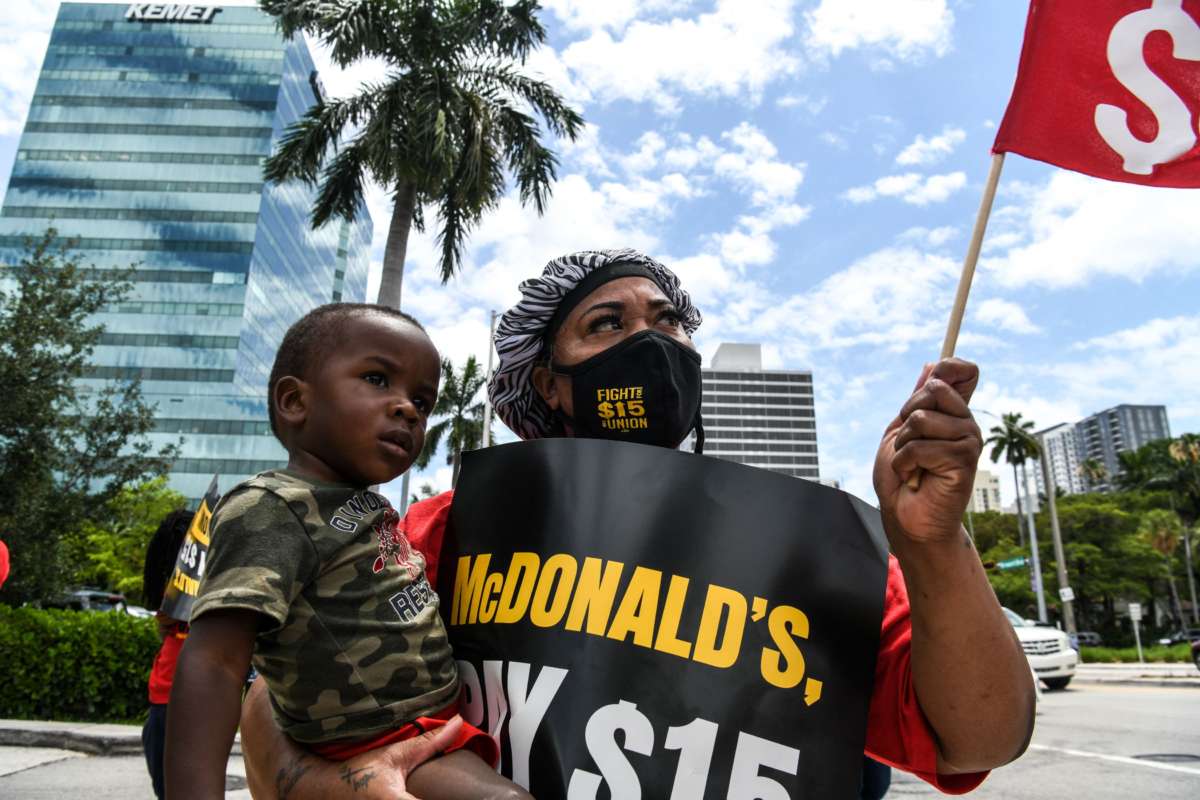
Deatrice Edie holds her grandson as she protests alongside employees of a McDonald's franchise in Fort Lauderdale, Florida, on May 19, 2021, to demand a $15 an hour minimum wage.

On May 20, 2021, about 50 service worker leaders at One Fair Wage, an organization I lead that brings together service workers to demand a living wage, gathered to take an official vote on whether to go on a “wage strike.” Some workers had already left the restaurant industry and were considering not returning, and some had stayed, doing the work of two or even three workers in understaffed environments. All were united in their determination not to continue to work for anything less than a full, living wage — plus tips.

“When the pandemic hit, I was furloughed. I tried to get unemployment, but my subminimum wage was too low to qualify,” said Ifeoma Ezimako, an African American server from Washington, D.C. who became a leader with One Fair Wage right after pandemic-related shutdowns began last year. “My real issue is that tips are supposed to be extra. It’s not the customer’s obligation to pay us. So the fact that the employer is not giving the customer that obligation, and the customer knows this, that’s where sexual harassment comes in.”

Ezimako told fellow service worker organizers of her experiences working at a local bar during the strike vote, saying that drunk customers would make unreasonable demands of her. “I felt obligated to do certain things because I’m like, ‘This is how I’m getting paid,’” she said. “But when I leave work, I have to feel right about myself. So I thank God for the pandemic because it made me stop and think, ‘This isn’t right. This isn’t right at all.’”After Ezimako and other service workers spoke out during the strike vote in states across the country, including New Hampshire, Michigan, Illinois, New York, D.C. and California, One Fair Wage voted unanimously to conduct the strike this week, agreeing not to return to work until employers paid them a base living wage, plus tips.

“It’s not that we’re being lazy. We just want to be paid for the services we actually have. I stand with One Fair Wage because that’s all we want. Ultimately, that’s really what it comes down to. We’re not going back to work until we get one fair wage, or we’re going to find other work to do,” Paris Singeltary, a host and server from Michigan, told members and organizers during the vote.

But although restaurant owners, elected officials and the media seem to only now be discovering restaurant workers’ unwillingness to work for poverty wages, their demands are nothing new: This week’s strike is the third national work stoppage service workers affiliated with One Fair Wage have called over the last year.

The pandemic has created both the most devastating crisis ever experienced in the modern U.S. restaurant industry and the greatest opportunity for building worker power. This has come to a head in what many are calling a mass “worker shortage” — what we at One Fair Wage are calling a “wage shortage” and a moment of vastly increased worker leverage.

Prior to the pandemic, with 13.5 million workers, the restaurant industry was one of the largest and fastest-growing sectors of the U.S. economy while also being one of its lowest-paying. The industry’s low wages can be attributed almost entirely to the money and power of the National Restaurant Association, which we call “the other NRA,” and which is driven by the nation’s largest corporate restaurant chains: Olive Garden’s parent company Darden, Denny’s, IHOP/Applebee’s, and many more.

The other NRA was formed over 100 years ago explicitly to fight wage increases for restaurant workers. During emancipation, restaurant owners who eventually formed the other NRA sought to hire Black workers as a way to justify not paying a living wage, transforming the practice of tipping from an added bonus, as it had originally been, to becoming a replacement for wages. This has resulted in tipped workers, disproportionately women and women of color, receiving a federal subminimum wage of $2.13 an hour, and other subminimum wages in 43 states. Even before the pandemic, tipped workers suffered more than double the poverty rate of other workers as well as the highest rates of sexual harassment of any industry.

With the pandemic, these already dire working conditions became completely unbearable. We at One Fair Wage created a Service Workers Emergency Fund to help support nearly 250,000 workers amid the pandemic. We began organizing this new base, inviting them to participate, speak out in and lead dozens of digital town halls to share their struggles, needs and concerns with elected officials ranging from then-Senator Kamala Harris to Rep. Alexandria Ocasio-Cortez and Gov. Gretchen Whitmer.

As summer allowed for greater in-person events, we began staging strikes and actions to call for living wages and working conditions in the restaurant industry. During these town halls and actions, thousands of workers shared their struggles amid the pandemic: Over 6 million restaurant workers reported losing their jobs during the initial shutdowns, and 60 percent reported facing challenges in obtaining unemployment benefits because their subminimum wages were too low to qualify for benefits in most states, according to One Fair Wage’s surveys of workers who participated in the town halls and actions.

When millions returned to work in summer 2020, 66 percent reported that tips had declined by 50-75 percent while health risks, hostility and sexual harassment had increased. The Centers for Disease Control and Prevention and the University of California San Francisco named restaurants the most dangerous place to work: Workers were now asked to enforce social-distancing and mask-wearing rules on the very same customers from whom they were supposed to obtain most of their wage, resulting in being tipped even less. Half of the women surveyed reported sexual harassment increased during the pandemic, with hundreds of women submitting comments detailing how male customers asked them to remove their masks in order to judge their looks — and their tips — on that basis.

Amid health risks, declining tips, and increased hostility and harassment, it should come as no surprise that millions of restaurant workers were already leaving the industry before this spring. In May 2021, One Fair Wage released a report based on 3,000 surveys of restaurant workers nationwide on why they were leaving the industry. The report largely confirmed what we already knew: Over half (53 percent) of all workers reported that they are considering leaving their restaurant jobs, with 76 percent saying their considerations are due to low wages and tips, and 78 percent reporting that their top reason to stay or return would be a living base wage. Workers told us that in many cases, with a subminimum wage of less than $5 an hour and declining tips, it costs them more for transportation to get to work than what they earn on the job.

While we had been hearing these stories from workers over past year, employers, elected officials, and media seemed surprised by the simultaneous unemployment/underemployment and lack of willingness to fill poverty-wage jobs in the restaurant sector. The issue was really exposed when governors started allowing restaurants to reopen at full capacity, and many restaurants found they could not actually do so for lack of staffing. When these restaurants attempted to open for greater capacity anyway, their overworked and underpaid workforces walked out en masse. Restaurant walkouts spread like wildfire, shutting down businesses across the country. One Fair Wage’s recent strike vote orients the leverage that those walkouts have created around particular demands for a living, base wage of at least $15 an hour, and increased worker power and voice on the job.

One of Ezimako’s colleagues, restaurant worker Tizoc Zarate, spoke eloquently about how the pandemic developed his leadership, telling service organizers during the strike vote that now more than ever is the time to stand up to the restaurant industry’s greed and make the voices of restaurant workers heard. “Far too many people are under the assumption that tips are a reliable source of income. It turns out the majority of people who believe that have never worked in the industry. We are supposed to take our jobs seriously as professional servers and cooks, but whenever we mess up, or take too long to bring their ketchup, customers are so quick to say, ‘How hard can it be?’ and it’s a slap in the face, because at the end of the day, you’re expected to put up with customers who harass us,” he said.

He told worker organizers that before he got laid off from the last restaurant he worked for, there were days he went home with only $30 after a seven-hour shift. There was no hourly wage, little to no COVID protections and only two servers working. After being laid off, he says he didn’t receive his check for two months. “The pandemic has demonstrated how critical our role is in society. Corporations are begging their workers to return to work, [and] politicians are starting to listen, but most importantly, we are coming together to protest and speak out against this injustice. So, let’s keep on fighting because I believe we can and will win the fight for fair wages,” he told worker organizers.

While some seem to be willfully ignoring these workers’ voices, others are finally hearing them. While Republicans and eight Democratic senators are hearing only the other NRA’s ever-constant claim that they can’t possibly raise wages and stay open, Sen. Bernie Sanders and Rep. Bobby Scott have responded by pushing the Raise the Wage Act. Backed by President Joe Biden, House Democrats and 42 Senate Democrats, the bill would raise the federal minimum wage to $15 an hour over several years and phase out the subminimum wage for tipped workers, workers with disabilities, and youth, providing restaurant workers with the base living wage they’re demanding.

While the debate has raged all year, the new realization that workers will simply not return to work without one fair wage has changed the tenor of the debate, creating new urgency that this week’s wage strikes reinforce. Elected officials are realizing they have to raise wages or face a stalled recovery. Independent restaurants are beginning to raise their wages on their own, even joining with workers to call for policy change to even the playing field. Likewise, consumers are realizing they can’t enjoy their Sunday brunches the way they used to unless wages rise.

As with other historical moments of seismic economic disruptions, this crisis must be resolved through higher wages and greater worker power, or we will all suffer.

Thursday, May 20, 2021

The Entire US Tax Code Is Implicated in the Forced Displacement of Palestinians ~~ Talya Wintman

https://truthout.org/articles/the-entire-us-tax-code-is-implicated-in-the-forced-displacement-of-palestinians/

~~ posted for collectivist ~~


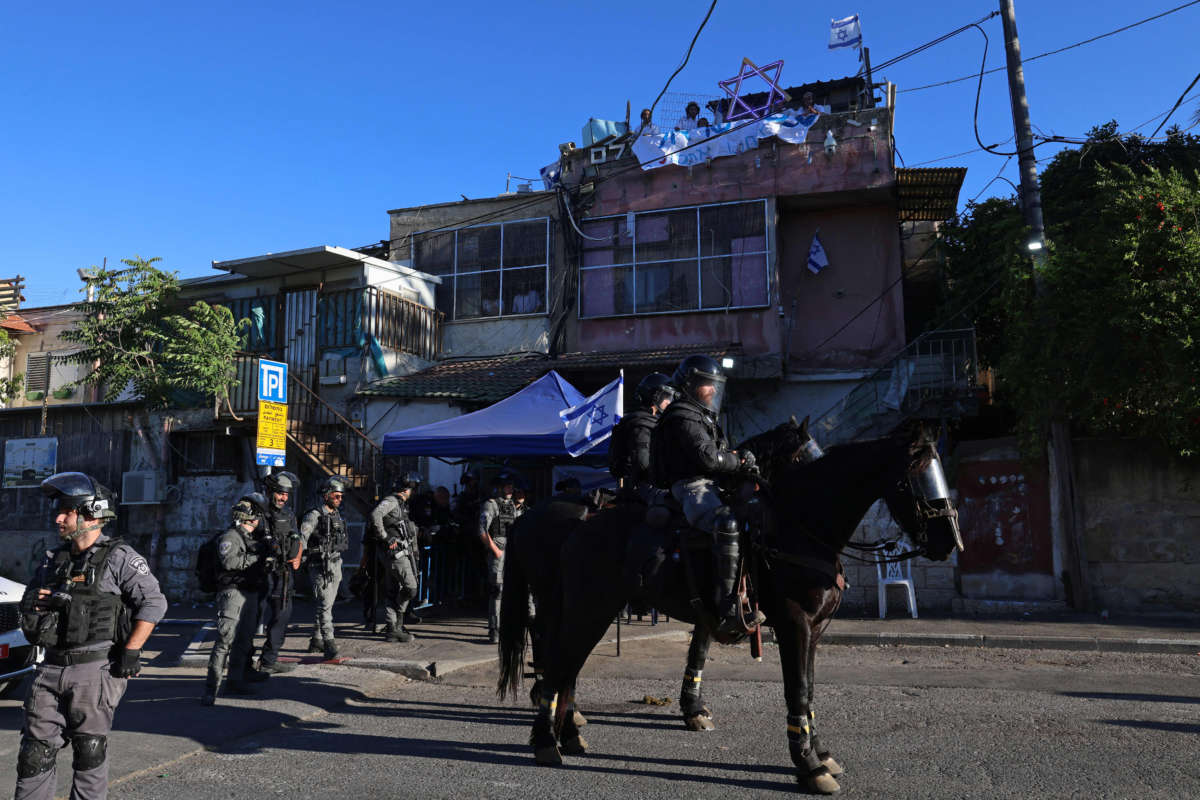
Israeli security forces stand guard outside an Israeli settler house in the Sheikh Jarrah neighborhood of East Jerusalem on May 15, 2021.

Like many, I have watched with horror as cynical state actors and the legacy of Palestinian dispossession and settler colonialism have fueled the latest conflagration across Israel/Palestine. Underwriting the cheap political calculus of Israeli Prime Minister Benjamin Netanyahu and his political cronies is a network of U.S. financial support. Indeed, U.S. military aid and perverse corporate incentives underlie the U.S.-Israeli arms trade. A few courageous politicians are beginning to forge new conversations on sanctions and conditioning U.S. aid. However, absent from these conversations has been the messier, but no less critical, U.S. financial vehicles that fuel Israeli state violence. Corporate welfare and tax subsidies are also taxpayer monies that come at a cost to local communities.

So let us start at the beginning then in Sheikh Jarrah, where four Palestinian families face the imminent threat of forced displacement. How is it that violent appropriation of the homes of Palestinian refugees through paramilitary and state policing can be peddled as a private property dispute? The answer has to do with U.S. capital and its ability to subsume any critical interrogation into its production. Just as former Israeli Prime Minister Golda Meir famously appealed to Americans for their open hearts and open purses, so too today is this patronage at work. However, the funding streams are perhaps more convoluted. While anecdotally, one can find no shortage of Americanized Hebrew in East Jerusalem, the settlement enclaves sprouting up across the area are supported by a constellation of corporations and nonprofits financed mainly through U.S. tax-exempt donations. In the case of Sheikh Jarrah and other East Jerusalem neighborhoods, one need only look at two such settler organizations, Nahalat Shimon and Ateret Cohanim.

In 2003, the Delaware-based Nahalat Shimon International purchased Sheikh Jarrah properties from two Jewish trusts. Nahalat Shimon intended to push Palestinians out of their homes and build a 200-unit housing complex. Delaware happens to be a corporate tax haven, but it is also convenient for setting up shell operations to launder money. Even the minimal corporate ownership disclosures required by the state of Delaware are blocked from public view. Just as the Israeli settler movement has hidden its activities under state-contracted mercenaries and local police, it has also benefited through the cover of sophisticated transnational tax havens. The movement’s financiers and board of trustees remain shrouded across the Atlantic and receive public subsidies in the form of Delaware’s lax corporate taxes. These financial structures lend themselves well to extrajudicial home seizures.Similarly, Ateret Cohanim, another settler organization active two miles away in Batan al-Hawa, receives tax-exempt foreign donations through its “American Friends of” 501(c)3. A quick Google search reveals an address on West 35th Street in New York City. In his groundbreaking 2015 Haaretz investigation, Uri Blau found that Americans sent at least $220 million in tax-exempt donations over a five-year period to Israeli settlements, through organizations like Friends of Ateret Cohanim. These tax subsidies and the activities they support — the ethnic cleansing and Judaization of East Jerusalem — come with a loss to the U.S. Treasury. As the violence escalates, it is incumbent on us and our government to examine how our tax policies are furthering Israeli state violence and Palestinian dispossession, and fomenting political instability.

Though the U.S. Treasury does not actively condone this dispossession, they purport these U.S. charities to be lawful as long as they comply with IRS codes and self-reporting requirements. While U.S. policymakers pay lip service to the peace process, how is it that private citizens have legally spent millions inciting political violence and Jewish supremacy through our tax codes? The donations are damaging to U.S. interests abroad, and they most certainly do not offset the societal monetary costs of the tax exemptions themselves. More importantly, this philanthropic system was never democratic to begin with. Somehow, a handful of subsidized U.S. donors whose identities are not even public have contributed to Israeli apartheid and violent incitement.

Gaza is on fire, and U.S. multinational corporations and their investors are not just fanning the flames, they are literally part of the combustion. Of the U.S. munitions used in Gaza — Boeing, Hewlett Packard, Lockheed Martin and Raytheon — the list is long and predictable. These corporations not only bring in revenue from their contracts with the Department of Defense and independent arms dealings, many also receive additional corporate welfare through state legislatures by bullying local officials and threatening job cuts. Raytheon did this in the mid-1990s in Massachusetts, my home state, radically rewriting Massachusetts’ corporate income tax code. Boeing has historically been one of the largest recipients of corporate welfare in the country, receiving an incentive package estimated at $8.7 billion in state tax breaks in 2013 that was only overturned in 2020. This corporate malfeasance is the product of rapacious capitalism with low taxes, low wages and little regulation.

Our tax money is not just subsidizing Israeli military aid. It subsidizes private provocateurs, settlement lobbies and multinational corporations sowing destruction in Gaza, the West Bank and East Jerusalem. It is time we start recognizing tax breaks as public funds worthy of public debate and discretion. Reforming the United States’s antidemocratic finance system and holding our citizens and corporations accountable for what they do with federal and state subsidies is critical not only to ending apartheid in Israel/Palestine, but also to democratizing a tax system that’s fundamentally unjust.

CDC’s maskless mandate puts workers at risk

https://www.workers.org/2021/05/56453/

~~ posted for collectivist ~~

The Centers for Disease Control and Prevention has recklessly capitulated to pressure from U.S. corporations in issuing their latest guidelines lifting masks requirements. They announced May 13: “Fully vaccinated people can resume activities without wearing a mask or physically distancing, except where required by federal, state, local, tribal or territorial laws, rules and regulations, including local business and workplace guidance.” 
While the percentage of adults getting vaccinated continues to rise, only 1 in 3 people in the U.S. are fully inoculated. The CDC guidelines contain no mandate stating individuals must provide proof they are fully vaccinated. This puts the lives of essential workers at serious risk. 

Since the start of the pandemic in early 2020, scientific studies have shown that  mask wearing and social distancing are the most effective ways to limit the spread of COVID-19. Removing mandatory mask wearing is bound to result in new spikes of viral infections and deaths, particularly among the poorest and most oppressed communitieswhose access to vaccines has been more limited. 

The CDC’s guideline, which came as a surprise to many people working in public health, conflicts with the views of many scientists. A New York Times informal survey of 723 epidemiologists found that 80% said individuals need to wear masks in indoor public areas for at least another year, and 88% responded that even fully vaccinated people should wear masks at large outdoor gatherings.

Vivian Towe, program officer at the Patient-Centered Outcomes Research Institute, said to the Times, “Unless the vaccination rates increase to 80% or 90% over the next few months, we should wear masks in large public indoor settings.” (May 13)

States, bosses coerce workers

Some states are beginning to cut off access to unemployment insurance benefits to force workers to return to jobs in dangerous environments lacking adequate safety measures to protect them from the virus or where they are paid subsistence wages.  Already burdened with enforcing mask mandates, frontline workers are now being put in the impossible position of determining if customers or others whom they encounter are truly vaccinated. 

Even with mask mandates implemented, there have been multiple incidents of workers being harassed and even injured while trying to enforce the protocols.  Most at risk are workers in jobs with heavy exposure to the public, in grocery and retail stores and warehouses, and those toiling in the service sector in transit, health care, postal or sanitation jobs or employed in restaurants, hotels and other hospitality businesses. Children under 12, not yet eligible for vaccines, now account for 22% of new cases.

The year-plus history of the coronavirus pandemic is rife with examples of large gatherings where unvaccinated people deliberately flout mask mandates, further fueling the spread of COVID-19. Throughout the pandemic, the right-wing, anti-mask movement has ignored protocols by appearing in public without the vital protection of masks. Many are vocally anti-vaccine.

With mask mandates in place, workers in restaurants and other businesses open to the public could restrict access for these individuals. Now the door is wide open for anti-maskers and anti-vaxxers to fill public spaces without restraint, endangering people’s lives.

People who are immunocompromised, not yet immunized, or who lack access to, or eligibility for, the vaccine will pay the consequences. This affects the many Latinx immigrants, who want to be inoculated as soon as possible but are afraid of risking their jobs, or their immigration status, if they take time off to get vaccinated.

Tuesday, May 18, 2021

The 'third wave of autocratization': Analyzing red-state America's place in a landscape of democratic decay ~~ Paul Rosenberg

https://www.alternet.org/2021/05/autocratization/

~~ posted for dmorista ~~

While “Liberal Democracy” is at best a flawed political system that works to defend the interests of the capitalist rich, I still think it is preferable to various types of Authoritarian and Tyrannical rule. This article, “The 'third wave of autocratization': Analyzing red-state America's place in a landscape of democratic decay”, by Paul Rosenberg posted at Alternet discusses the at least 20 year trend towards the decay of Liberal Democracy, in both the U.S. and in various other places in the world. The biggest single source of data for the discussion is a report entitled Autocratization Turn Viral, Democracy Report 2021, produced by the V-Dem Institute which is located in the Political Science Department of the University of Gothenburg, in Gothenburg Sweden. There are links to many other academic papers, books, interviews and other sources. The main focus is on the U.S., and the many ominous developments in the various state governments and the evolution of the Republican Party into an anti-democratic authoritarian party. The Republican Party as it has now evolved, wants to maintain the “window dressing” aspects of democracy but eschew the substantive elements. I think this article is well worth the 20 – 25 minutes needed to read it. dmorista

=============

The Article:  


The 'third wave of autocratization': Analyzing red-state America's place in a landscape of democratic decay
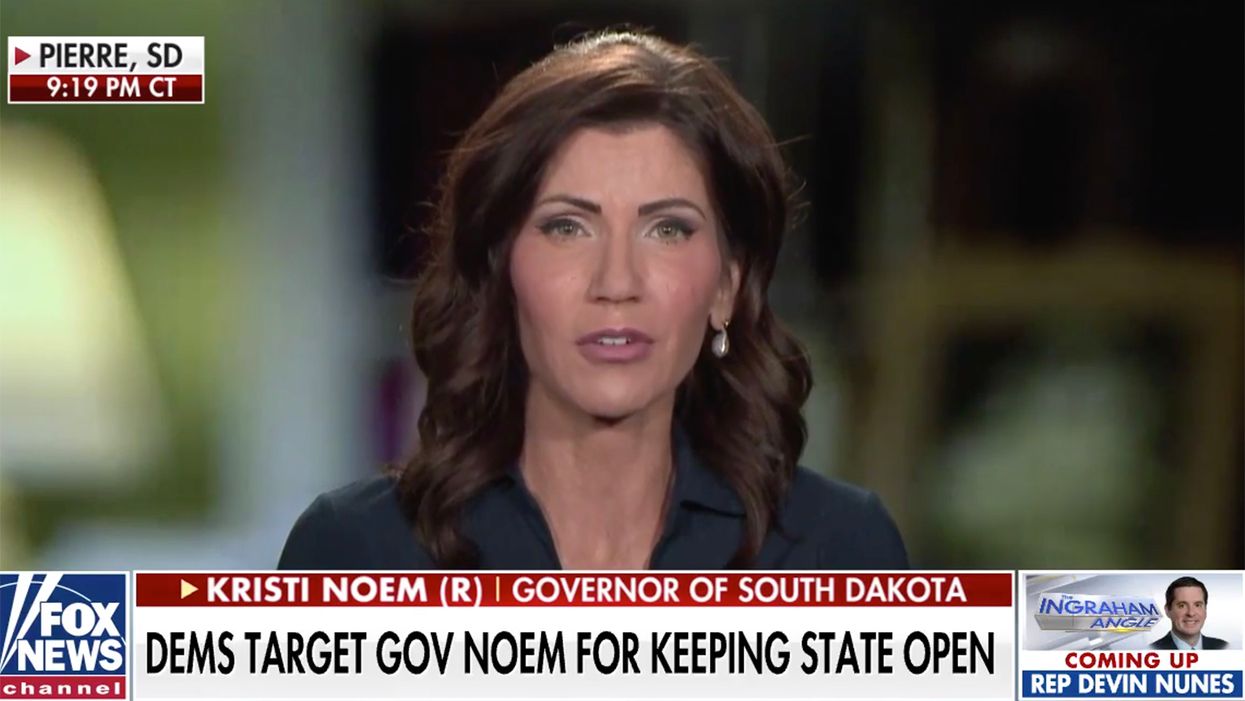
Image via Screengrab.

As the Jan. 6 insurrection recedes in time, media attention is beginning to focus on potential 2024 Republican presidential candidates, including "new faces" like Kristi Noem and Josh Hawley, old also-ran Ted Cruz and others and, of course, Donald Trump. In a representative democracy, it's only natural that elected leaders — or credible potential ones — should be a significant focus of attention.

But there's an air of unreality hovering over all such portrait-mode coverage when a broader landscape view shows that the very survival of democracy is up for grabs — not just in the U.S., where GOP House members are in deep denial about the Jan. 6 insurrection while Republican legislators have introduced voter suppression bills in 47 states, but around the world. The Swedish-based V-Dem Institute's 2021 annual report notes that "the global decline in liberal democracy has been steep during the past 10 years and continues in 2020" and concludes that the "level of democracy enjoyed by the average global citizen in 2020" has fallen "to levels last found around 1990." At that time there was a jubilant buzz about the "End of History." Now there's an undertone of dread that we could "meanly lose, the last best hope of earth," as Abraham Lincoln warned.Talk of as many as 24 potential GOP candidates in the next cycle recalls pre-2016 talk about the GOP's "deep bench," which, as I noted at the time, was a media-hyped myth. Those andidates fell into three groups: governors with horrible to mediocre job-creation records plus some ex-governors who hadn't run in a while, first-term senators with paper-thin résumés in a particularly dysfunctional Congress, and assorted wild cards, including Ben Carson and Carly Fiorina, as well as a certain New York real estate developer turned reality-TV star. I focused primarily on the shared failure of GOP economics, the party's purported strong suit. "The degree to which key articles of GOP economic faith clash with overwhelming expert judgment is staggering — and there's nary a hint of it in most of the media," I wrote. "It's a disconnect reminiscent of global warming, but much less widely recognized."

The problem goes much deeper now, to the shared failure of Republican patriotism, as their party has turned against democracy. While media awareness may be better, without grounding coverage in a "landscape view" of the problem journalists are fumbling the biggest story of our time — the global threat to democracy, and the enormous potential for a renewal that could finally realize democracy's full promise for all.

America's place in a landscape of democratic decay

What's known as the "third wave of autocratization" — characterized by creeping democratic erosion rather than violent coups — continues to spread: V-Dem's report notes that "25 countries, home to 34% of the world's population (2.6 billion people), are in democratic decline by 2020." One especially disturbing highlight "is that India — formerly the world's largest democracy with 1.37 billion inhabitants — turned into an electoral autocracy," meaning a system in which elections continue to be held but the chance of power changing hands is virtually nil. Prior to Jan. 6, the U.S. seemed far from being in a similar situation, but that is effectively what the new wave of GOP voter suppression laws could accomplish, especially with added provisions that jeopardize the post-election process.

America is still a long way from becoming India — but things can change quickly. The U.S. score on V-Dems "Liberal Democracy Index" or LDI is 0.73 (out of a possible 1) while India is less than half that, at 0.34, a precipitous decline since 2010 that places it among the planet's top 10 major "autocratizers." While the U.S. doesn't make that ignominious list, it's marked in red to "signify cases of significant and substantial autocratization." In 2010, the U.S. was among the highest-ranked nations, and is now no longer in the top 30, falling below Chile and Greece, countries with recent histories of military rule."The U.S. is somewhat unusual among the decliners," a trio of V-Dem researchers — Anna LührmannDan Pemstein and Juraj Medzihorsky — told Salon via email. "Most of the decliners are reasonably young democracies," they wrote, adding that the U.S. has had a high and stable LDI in their rankings since the civil rights era. "The U.S. is a very different case than India or Brazil and also the various Eastern European countries [which] have much shorter democratic histories, despite being at similar levels in 2010."The American case, they note, "shows that it is possible for this illiberal playbook, which we're seeing play out in diverse places ranging from Brazil to India, Hungary and Poland, to gain traction even in consolidated liberal democracies."

The party landscape: Even starker

Things look even more perilous from two other landscape views: the landscape of parties across the world, and the landscape of state-level government. A V-Dem briefing paper and its followup, entitled "Walking the Talk: How to Identify Anti-Pluralist Parties," found that the Republican Party has shifted dramatically in recent decades, from being in the same ideological territory as the British Conservative Party in 2000 to the neighborhood of India's Hindu nationalist BJP now, while the Democratic Party has barely moved at all."We did not see any sufficiently similar examples that we could bring up," Medzihorsky responded. "Given the information that we have, we refrained from speculation."

The red-state landscape of democratic decay

Another landscape perspective that can shed some light is that of state-level government, explored by University of Washington political scientist Jacob M. Grumbach in a paper called "Laboratories of Democratic Backsliding." Inspired by the V-Dem model, Grumbach developed a measure of subnational democratic performance called the State Democracy Index. He tested a range of different theories about what might contribute to democratic erosion over the period from 2000 to 2018, "based in party competition, polarization, demographic change, and the group interests of national party coalitions." Strikingly, he found "a minimal role for all factors except Republican control of state government, which dramatically reduces states' democratic performance during this period."

I reached out to Grumbach to ask about his findings and their significance. He began by discussing certain consequences of the American federal system:Even compared to other countries with federalism, American federalism is especially decentralized, giving more control over political institutions to the lower subnational units. This means that the U.S. can experience extreme regional differences in democratic performance, as it did during the slavery and Jim Crow periods. Current regional differences in U.S. democracy aren't as big as they were in Jim Crow, but they're substantial and growing.

Grumbach's data only goes through 2018, but we're now seeing a vast wave of Republican efforts to suppress democracy and crack down on dissent and education, as I discussed in a recent Salon story on conservative "cancel culture." I asked Grumbach where he thought we might be headed.

We've seen 300-something new voter suppression bills out of Republican state legislatures since the 2020 election, as well as anti-protest bills and bills to outlaw particular forms of educational content that challenge nationalistic interpretations of U.S. history. We've also heard continued claims that the 2020 presidential election was stolen. All of these are threats to key tenets of democracy, including free and fair elections and civil rights and liberties. Although the politics and policy moves have been distinct, we've seen similar threats to democracy in Hungary and Brazil in recent years, which makes me concerned about the global trends.

The V-Dem 2021 report outlines a typical pattern to the process of "autocratization": "Ruling governments first attack the media and civil society and polarize societies by disrespecting opponents and spreading false information, then undermine elections." That seems like a strikingly accurate description of what happened during Trump's four years in the White House. But Grumbach's work points to a lengthy prehistory as well. I asked how we should understand the whole story, from the state-level story he describes through Trump's time in office to the fall-out today. He responded:

This is such an important question. I argue that Trump — and the [Jan. 6] insurrection — were just the latest and most visible manifestations of a longer term antidemocratic trend in the GOP. We've heard about "Stop the Steal" since 2020, but the GOP has for decades been selling conspiracies about mass voter fraud and suggesting that Democratic governance is illegitimate. The GOP currently is a coalition of two groups, an elite coalition of the very wealthy and an electoral base motivated by white identity politics. Both of these groups have an interest in pursuing minority rule through voter suppression, norm erosion, gerrymandering and other tactics.

Finally, Grumbach noted another dimension where partisan differences were minimal:

It's important to note that my main State Democracy Index focuses on electoral democracy, and there you see the GOP leading democratic backsliding. However, when I focus the measure on civil liberties and freedom from state authoritarianism, this kind of illiberalism has been bipartisan. American federalism puts policing and incarceration authority at the state level, and Democratic, divided and Republican state governments have all pursued "tough on crime" policy that has led the U.S. to become the most heavily incarcerated country on earth (more than dictatorships with larger populations).

How that came about is one of three interconnected social policy strands described by Cornell historian Julilly Kohler-Hausmann in her 2017 book, "Getting Tough: Welfare and Imprisonment in 1970s America." (I'll be interviewing her for a forthcoming Salon feature.) Last year's Black Lives Matter demonstrations signaled a long-overdue challenge to that wretched bipartisan consensus, forged in the aftermath of the civil rights movement. Because national Democrats have shown at least some willingness to respond to this challenge, Trump and the Republicans have sought to demonize them for it, so this may become another party-polarized dimension — or, more optimistically, part of a new consensus, as suggested by various public opinion polls, as well as the almost 2-to-1 passage of Florida's Amendment 4, which restored ex-felons' voting rights (although that was later gutted by the Republican legislature and governor, an issue now in litigation).

Discerning the differences between the two realms — electoral democracy and civil liberties — is precisely what a landscape view of politics makes possible: differences of history, agency, motivation and possible futures. Making sense of these different landscapes and their relationships is crucial to navigating them — and perhaps making meaningful democratic governance possible.

Denialism vs. democratic decay

Perhaps inevitably, there's a nascent right-wing denialist response that tries to reject any such analysis of democratic decay. At the Free Beacon, Aaron Sibarium wrote a story criticizing Grumbach's scoring system, and more broadly all such systems, called "The Myth of Measuring Democracy." But simply claiming bias and crafting a self-comforting narrative doesn't exactly prove a counter-argument.

Bias could emerge, Sibarium argued, through "the choice of variables used as proxies for democracy and the process by which those proxies are assessed." He attacked Grumbach for the first, and V-Dem for the second:

At least three of the factors that decrease a state's democracy score — voter ID laws, high incarceration rates, and denying felons the right to vote — are things that large majorities of Americans support. According to Grumbach, maximizing democracy means defying the popular will.

Sibarium called V-Dem's framework, "the most balanced," then went on to say that "it too reflects the liberal consensus — because the indicators are all scored by liberal academics."

Both Grumbach and V-Dem offered detailed responses. In essence, Grumbach said, Sibarium assumes that democratic support would make slavery democratic — one answer to what's known as "Wollheim's paradox." Grumbach also said his index includes measures that capture both sides of the paradox, meaning "policy responsiveness to majority opinion and procedural indicators of how costly it is to vote, how gerrymandered districts are, etc.""Because people might have different opinions on how to measure democracy, I simulate 100,000 different measures that weight indicators differently," Grumbach explained. "Across the 100,000 measures, it is clear that GOP control of state government reduces democratic performance. This finding isn't an artifact of some particular way that I measured democracy."

The V-Dem trio called Sibarium's criticism "part incorrect and part banal." It was incorrect in labeling the expert scorers "liberal academics," they said: Many are outside the academy and they come from all over the world. "Ascribing all of these experts from different countries and backgrounds the same ideology — 'liberal' or otherwise — is simply silly," they said.

The criticism is banal, they said, "because of course the values are a mathematical representation of expert opinion. ... The purpose of the project is to measure concepts that are incredibly important but inherently difficult to observe."

"Scholars have subjected the V-Dem data to a multitude of validity tests, and it has generally held up well," they said. "We also emphasize that our measures exhibit uncertainty — experts disagree! — and provide public estimates of the scale of that uncertainty."

In short, the measures used by V-Dem, Grumbach and others are meant to inform our understanding of how well or poorly democracies are functioning, not to dictate judgments. They don't pretend to tell us everything. The unique status of the U.S. as the highest-ranked democracy to undergo "significant and substantial autocratization," its two-party system with only one party radicalizing, its decentralized federalism and its distinctive, highly contested racial history, among other factors, mean that it's imperative to seek out other approaches as well.

Leaders, norms and violence: A different landscape view

One of the most helpful of those is to look back at our own history, as in Nathan Kalmoe's book "With Ballots and Bullets: Partisanship and Violence in the American Civil War" (Salon interview here). Kalmoe has a lot to say about how political leaders and partisan media affect the potential for violence — another example of a "landscape mode" effect, as opposed to a "portrait mode" direct-causation account.

"Whether looking at U.S. history or cross-nationally at politics around the world," Kalmoe said in a more recent exchange, "party leaders, including media figures, play a key role in how ordinary partisans think and act. That extends to extremes like violence."

Leaders both embody and influence group thinking in multiple ways, he said:

Leaders are experts whose judgment their followers trust, and leaders are seen as definitional group members whose words and deeds set the norms for the group. Party leaders are especially influential when they simultaneously represent multiple political and social identities (e.g., race, religion), and those group alignments make violence more likely.
Leaders mobilize violence in many ways, not just direct calls for violence, though those may be most powerful. They also encourage violence with their failure to condemn violence by their own group, by violent metaphors and coy remarks implicitly supporting that violence, and by using vilifying and dehumanizing language that makes it easier for group members to rationalize harming their opponents.
Leaders set norms for the group and those norms can shift overnight. In conventional politics, for example, we see instant 10 or 15 point swings in policy views among partisans when top leaders endorse a policy, even when it goes against the party's ideology. In the historical context of Civil War violence, northern Democrats followed their party in initially supporting and then violently rejecting the war to uphold Lincoln's election, including a change in their willingness to kill and die in that war.

Once a new group norm is established, Kalmoe continued, "leaders and group members then police the new bounds, silencing and expelling dissidents within the group. We're seeing that now with Republicans rallying around defense of Trump's multifaceted attempts to reject his loss in a free and fair election."

In short, despite the unique situation we find ourselves in, there's nothing exceptional, or even especially unusual, about the partisan leadership dynamics involved.

Profound change? Landscape of a possible future

But in a broader sense our situation may be historically unique, as suggested by Ian Hughes, author of "Disordered Minds: How Dangerous Personalities Are Destroying Democracy" (Salon interview here.) Hughes combines studies of key 20th-century pathocracies (Hitler's Germany, Stalin's Soviet Union, Mao's China, etc.) through the lens of the "the toxic triangle" — destructive leaders, susceptible followers and conducive environments — with an argument that democracy can be understood as a multi-layer defense system against such disordered leaders and the pathocracies they create.

"This system of defenses comprises the rule of law, electoral democracy, the principle of liberal individualism that underpins the separation of church and state, social democracy and legal protection for human rights," Hughes explains. Those principles have all come under relentless attack during the Trump era, in ways for which we were woefully unprepared. But now there's a chance to recover, and rebuild. Now that he's stripped of official power, "Trump is not the real issue anymore," Hughes told me via email. He sees "an opportunity to step back, understand the big picture" and "move the U.S. and the world onto a better path," not just a slightly improved one.

"We are at a historic moment of profound change," Hughes said, going on to explain:

Most of the social institutions that have been holding society together, however brutally and inequitably, are failing. They are failing in two senses. First, they have contributed to what Biden referred to in his Inaugural Address as the cascading crises of our time — climate change, species extinction, levels of inequality within and between nations that are undermining social cohesion and international order, the erosion of democracy and the persistence of authoritarianism, and the emergence of cultures of animosity, polarization and blame. The list goes on. These cascading crises are the fruit of failing systems of economics, politics, technology, gender, religion and education.
These social institutions are also failing in a second sense. Not only have they helped create the multiple crises we face, they are also (as Einstein might have said) incapable of resolving these crisis, given the level of thinking they are trapped within.

Hughes sees much more than a landscape of failures. "There is also hope, enormous hope," he said. "For each of the social institutions I listed above there is a global movement aimed at building something new, of making that radical rupture with existing paradigms." He continued:

In economics, for example, there is a whole variety of movements exploring "beyond growth" economics, circular economies, economies where care is recognized and rewarded, an economics that can rein in the parasitic and destructive system of contemporary financial capitalism, and so on. The same is true for gender and race with the #MeToo movement and Black Lives Matter movement being part of a much broader reimagining of societies where participation and diversity lead to radical system transformations. Well-being and spiritual movements are questioning the valorization of material wealth as the epitome of human development and are reclaiming values of empathy, cooperation and love from their monopolization by organized religion. In the area of technology, movements demanding the responsible development of new technologies and the taming of the destructive uses of existing technologies now have global reach.

Conventional, portrait-mode analysts look at Joe Biden's agenda in terms of distinct issue categories — pandemic relief, infrastructure, voting rights and so on, and consider the major political actors in each realm. But Hughes' description of democracy as a multi-layer defense system suggests a more expansive landscape viewpoint, with a powerful central theme.

From that perspective, Hughes said, "Biden's agenda can be assessed by the degree to which it can successfully join up all the 'rivers of progressive change' and empowers them further as a means of dismantling the structures that continue to shore up Trump and the pathological incarnation of the GOP," Hughes said. The central question, then, is "to what extent can Biden not bring the U.S. back to normal, but help bring about something new."

The portrait-mode approach to politics naturally favors the "return to normal" orientation. Familiar figures doing familiar things, to familiar praise, regardless of the medium- or long-term results. But a landscape view more readily accommodates change: We can at least potentially see different pathways, different destinations and even imagine different landscapes that might become visible if we stood on different, distant peaks.

"The degree to which Biden is able to empower these forces for building something new is also the degree to which he will have successfully constrained the former guy and his yesterday's men in the GOP," Hughes said. "In a sense, Trump and the GOP are a perfect fit for our dysfunctional times. Biden's challenge — and the challenge of any democratic leader at this historic moment — is to change our times so that Trump and his fellow authoritarian narcissists stand out as the misfits they truly are."